
Somnath Through Time
Architecture, Memory and the Making of a Monument
by
Neha Bhave
credit: https://www.bhaktiras.net/temple/somnath-temple/
Introduction
Situated at Prabhas Patan on the Saurashtra coast of Gujarat, the Somnath Temple occupies a distinctive position in the architectural and cultural history of western India. Primarily associated with the worship of Shiva, the importance of Somnath extends considerably beyond its religious function. Its history encompasses royal patronage, maritime connections, military campaigns, architectural reconstructions, archaeological investigations and changing approaches to cultural heritage. The monument visible today represents the most recent architectural phase within a much older historical landscape.
Somnath therefore cannot be understood as a single ancient building that has survived unchanged into the present. Archaeological and architectural investigations reveal successive phases of construction, alteration and rebuilding, while inscriptions and historical records document changing relationships between the monument, its patrons and political authority (Cousens, 1931; Bobbio, 2023). The history of the site also demonstrates the importance of distinguishing surviving material evidence from later historical memory. Examining Somnath through its geographical context, historical development, architecture, iconography and modern reconstruction reveals a monument whose physical form and cultural meanings have repeatedly evolved.
Location and Geographical Setting
Somnath is located at Prabhas Patan, near Veraval, on the southern coast of the Saurashtra peninsula in Gujarat. Its position overlooking the Arabian Sea is among its most distinctive geographical characteristics. Historically, however, Prabhas Patan formed part of a broader cultural and commercial landscape rather than functioning solely as the setting for an isolated religious monument.
The Saurashtra coast participated in maritime networks connecting western India with regions across the Arabian Sea. Epigraphic and architectural evidence demonstrates the presence of Muslim merchants and communities associated with maritime commerce in settlements across the region. At Somnath itself, inscriptions and surviving Islamic monuments provide evidence for these communities and illustrate the cultural diversity created by commercial networks (Shokoohy, 2012). This wider context is important because it demonstrates that medieval Somnath cannot be understood exclusively through episodes of military conflict. Commerce, migration and cultural interaction also contributed to the historical character of the settlement.
Prabhas Patan simultaneously developed as an important centre of pilgrimage. Its cultural and religious importance encouraged continued patronage and contributed to repeated investment in monumental architecture. Traditional narratives concerning the antiquity of Somnath are extensive, but these should be distinguished from the archaeological chronology of the surviving structures. The antiquity of a cultural tradition does not by itself establish the date of a particular building.
Origins and Early Historical Development
The precise date at which the first temple dedicated to Somnath was constructed remains uncertain. Traditional accounts describe successive temples constructed in different materials by divine, legendary and historical patrons. Significantly, this sequence also appears in the twelfth-century inscription associated with Bhava Brihaspati, which recounts earlier temples of gold, silver and other materials before referring to a stone structure associated with Bhima. Such statements provide important evidence for the traditions circulating around Somnath in the medieval period, but they should not be treated as an archaeological record of successive buildings (Cousens, 1931).
Material evidence provides a firmer basis for examining the architectural development of the site. Henry Cousens’ extensive investigation for the Archaeological Survey of India identified finished masonry and mouldings from an earlier structure incorporated within later construction. He concluded that portions of an older temple had remained in place and formed part of the core of subsequent masonry (Cousens, 1931). The evidence therefore demonstrates architectural succession at Somnath even where the precise chronology of the earliest phases remains uncertain.
One of the best documented episodes in the site’s early medieval history occurred in 1025-26, when Mahmud of Ghazni led a military expedition into Gujarat and attacked Somnath. The temple was plundered and its principal image was desecrated during the campaign (Eaton, 2000; Shokoohy, 2012). The event subsequently acquired a particularly prominent place in accounts of medieval Indian history.
The political context of temple desecration is relevant to interpreting such events. Eaton (2000) places attacks upon major temples within a wider pattern in which monuments associated with political authority, royal patronage and institutional wealth could become targets during military conquest. This interpretation does not remove the religious dimension of iconoclasm; rather, it recognises that important temples could possess political and economic significance in addition to their religious functions.
Mahmud’s campaign did not end monumental activity at Somnath. The site continued to attract patronage, and subsequent rebuilding created new architectural phases. The surviving evidence is therefore better understood in terms of recurring construction, damage, survival, reuse and reconstruction than through a simplified sequence in which each earlier temple disappeared completely before another replaced it.
Medieval Reconstruction and Transformation
Somnath underwent substantial reconstruction under the Chaulukya rulers of Gujarat. Cousens associated an important rebuilding phase with Bhima I, followed by a major reconstruction connected with Kumarapala during the twelfth century (Cousens, 1931). Particularly important evidence is provided by an inscription formerly associated with the Somnath temple and preserved at the Bhadrakali temple at Prabhas Patan. Dated to Valabhi Samvat 850, corresponding to 1169 CE, the record associates Bhava Brihaspati with the reconstruction undertaken during Kumarapala’s reign (Cousens, 1931).
The inscription is especially significant because it demonstrates that medieval rebuilding was itself remembered and recorded at the site. According to the record as discussed by Cousens (1931), Bhava Brihaspati encouraged the restoration of the temple and was associated with additional construction at Somnath Patan, including fortifications and other religious and civic structures. The temple should therefore be understood as part of a larger monumental settlement rather than as an architecturally isolated shrine.
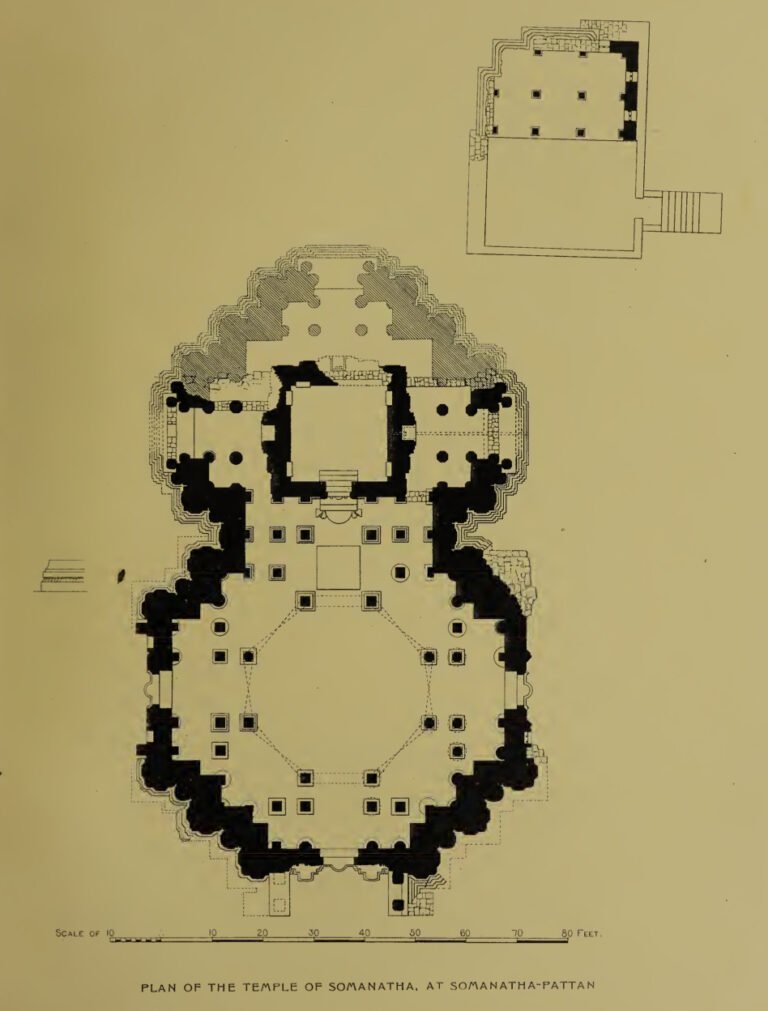
The Kumarapala-period temple represented one of the most substantial medieval phases at Somnath. Cousens’ architectural survey describes an east-facing complex in which a large enclosed gudhamandapa had three entrances, each approached through a substantial porch. The sanctuary occupied the western side of the hall and was surrounded by a broad pradakshina, or circumambulatory passage (Cousens, 1931). The arrangement indicates a complex and monumental architectural programme characteristic of the developed temple architecture of medieval western India.
The physical fabric also preserved evidence of earlier construction. Finished masonry belonging to a previous temple remained visible within later walls, suggesting that the earlier structure had not been completely removed when its successor was built (Cousens, 1931). This evidence is important because it complicates any simple model in which destruction was invariably followed by construction on an entirely cleared site. At Somnath, architectural continuity could include the deliberate or practical reuse of earlier fabric.
The political expansion of the Delhi Sultanate into Gujarat brought further disruption at the end of the thirteenth century. Somnath was affected during these campaigns, within a broader historical context in which important temples associated with conquered territories could become targets of military action (Eaton, 2000). Subsequent centuries brought further alterations, changes of political authority and renewed interventions at the site.
Military conflict, however, represents only one dimension of medieval Somnath. Shokoohy’s study of Islamic architecture and inscriptions demonstrates the presence of established Muslim communities at Somnath and elsewhere in Saurashtra, particularly those connected with maritime trade. Mosques, inscriptions and Muslim shrines formed part of this historical landscape, with some evidence predating the establishment of the Gujarat Sultanate (Shokoohy, 2012). Medieval Somnath was therefore a socially complex environment shaped simultaneously by religious institutions, commercial exchange, local communities and changing political authority.
In the eighteenth century, Ahilyabai Holkar, the Maratha ruler of Indore, sponsored a new temple at Prabhas Patan near the remains of the older structure. Rather than reconstructing the surviving medieval fabric, this created another architectural focus for worship at the site, further illustrating how cultural continuity at Somnath could persist despite major changes to its monumental architecture.
Somnath in the Colonial Period
During the nineteenth and early twentieth centuries, Somnath increasingly became the subject of antiquarian and archaeological investigation. Surveyors and archaeologists documented the ruined monument through architectural descriptions, plans and photography. Such records are particularly valuable because they preserve evidence for architectural remains that were later substantially altered by twentieth-century reconstruction. Cousens’ study, published by the Archaeological Survey of India in 1931, remains fundamental to understanding these earlier structures (Cousens, 1931).
At the same time, Somnath acquired renewed political significance through colonial interpretations of India’s medieval past. A particularly revealing episode occurred in 1842 following the First Anglo-Afghan War. Governor-General Lord Ellenborough ordered wooden gates from the tomb of Mahmud of Ghazni to be transported to India, presenting them as the original gates supposedly removed from Somnath during Mahmud’s eleventh-century expedition. The claimed provenance of the gates, however, lacked convincing historical evidence (Bobbio, 2023).
The episode illustrates the distinction between the material history of an object and the meanings subsequently assigned to it. Regardless of their actual origin, the gates were transformed into political symbols through their claimed association with Somnath. Bobbio (2023) demonstrates how the episode contributed to changing representations of the monument and its medieval history.
By the early twentieth century, Somnath consequently possessed several overlapping identities. It remained a culturally significant site, while its ruins simultaneously functioned as archaeological evidence and as material around which competing interpretations of India’s past were constructed.
Reconstruction in Independent India
The most substantial modern transformation of Somnath began following Indian independence. After the integration of Junagadh into India, Vallabhbhai Patel supported rebuilding the temple, while K. M. Munshi became one of the project’s principal advocates. Between 1947 and 1951, the treatment of Somnath consequently shifted from the conservation of a historic ruin towards the construction of a new monumental temple at the historic location (Bobbio, 2023).
The proposed reconstruction generated disagreement over the treatment of the surviving archaeological fabric. The Archaeological Department, under Mortimer Wheeler, favoured preservation of the historic ruins and proposed that any new temple should be constructed separately. Reconstruction directly upon the historic site risked altering or removing archaeological evidence. The approach ultimately adopted instead prioritised rebuilding at the historic location (Bobbio, 2023).
This disagreement reflected two different approaches to heritage. Archaeological conservation prioritised the preservation of surviving material fabric as evidence of earlier historical phases. Reconstruction sought instead to restore the architectural and cultural presence of Somnath as a functioning monument. The present temple should consequently not be interpreted simply as repaired medieval fabric. It represents a modern reconstruction deliberately situated within a much older archaeological and cultural landscape.
The project also intersected with debates concerning the relationship between religious institutions and the newly independent state. Jawaharlal Nehru opposed close governmental identification with the reconstruction, while the project proceeded through public contributions rather than direct state expenditure (Bobbio, 2023). President Rajendra Prasad nevertheless attended the installation ceremony in May 1951 (Bobbio, 2023). These differing positions demonstrate how Somnath became connected with wider debates concerning cultural inheritance, secular government and interpretations of India’s past.
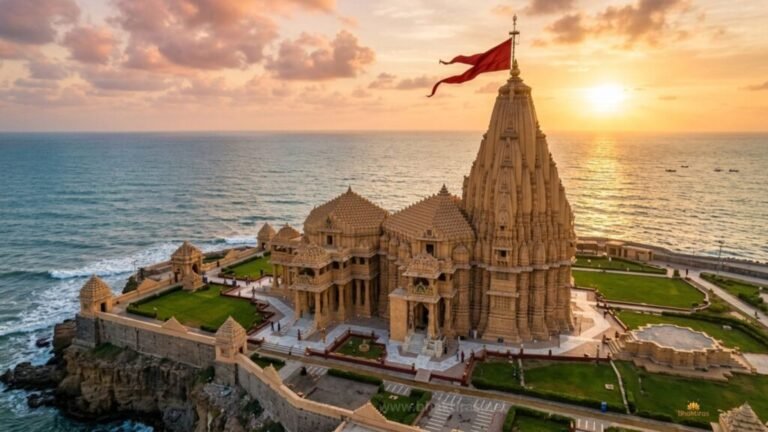
Architecturally, the reconstructed temple consciously adopted forms associated with the historic temple-building traditions of western India. Rather than constituting an exact archaeological reproduction of the ruined medieval building, it created a modern monumental interpretation of an earlier architectural vocabulary. The temple encountered today is consequently both a twentieth-century structure and a deliberate architectural reference to the site’s medieval past.
Architecture and Material Features
credit: Cousens, 1931
Understanding the architecture of Somnath requires a distinction between the medieval structures documented archaeologically and the modern temple standing today. The earlier complex belonged to the architectural traditions of western India and displayed a developed combination of sanctuary, circumambulatory passage, enclosed hall and monumental porches (Cousens, 1931).
The medieval temple faced east. Its gudhamandapa, or enclosed central hall, possessed three entrances approached through substantial porches, while the sanctuary stood to its west and was surrounded by a broad circumambulatory passage (Cousens, 1931). This spatial arrangement established a clear axial progression from the entrances and hall towards the sanctuary.
Such organisation accords with broader principles of Hindu temple architecture. The garbhagriha forms the innermost architectural and ritual focus, while halls and transitional spaces regulate movement towards it. Externally, the superstructure or shikhara emphasises the sanctuary and establishes it as the visual centre of the composition (Michell, 1977).
Somnath’s archaeological fabric is particularly significant because it demonstrates architectural reuse. Cousens observed earlier finished masonry beneath and within later construction, concluding that portions of a preceding temple had been left in situ to form part of the core of the later building (Cousens, 1931). Architectural history at Somnath was therefore cumulative rather than simply successive.
The present temple employs an architectural vocabulary derived from western Indian traditions while considerably postdating the medieval structures. Its stylistic coherence should not be confused with chronological continuity. The principal standing monument is a modern reconstruction rather than an intact medieval temple.
This distinction has important implications for cultural heritage. Reconstruction can restore the visual and functional presence of a monument while simultaneously transforming its archaeological context. At Somnath, the twentieth-century decision to construct a monumental temple at the historic location created a strong visual expression of continuity but altered the relationship between surviving medieval remains and the modern observer (Bobbio, 2023). The present building is therefore significant both as architecture and as evidence for twentieth-century approaches to heritage.
Iconography and Religious Context
The iconographic identity of Somnath centres upon Shiva, represented principally through the linga within the sanctuary. In Hindu art and temple architecture, the linga is a principal non-anthropomorphic representation of Shiva and commonly forms the ritual focus of the garbhagriha in a Shaiva temple (Michell, 1977).
Somnath is traditionally identified as one of the twelve jyotirlingas. The Śiva Purāṇa enumerates Somanatha in Saurashtra among the twelve sites (Śiva Purāṇa, Śatarudra-saṃhitā 42.2-4). This textual tradition is important for understanding the long cultural significance attached to Somnath, but it should not be used to determine the archaeological date of a particular temple structure.
This distinction between cultural tradition and material chronology is particularly important at a repeatedly reconstructed site. The continuing association of Somnath with Shiva does not imply architectural continuity between every historical phase. Similarly, surviving sculpture or architectural fragments belonging to earlier structures should not automatically be interpreted as components of the decorative programme of the twentieth-century temple. Iconographic and architectural evidence must therefore be understood within its individual chronological context wherever possible.
Cultural Heritage and Historical Memory
Somnath’s cultural significance derives substantially from the accumulation of its historical layers. Its heritage value cannot be reduced either to the antiquity of Prabhas Patan or to the architectural age of the present temple. Instead, it emerges from the interaction between archaeological remains, inscriptions, historical records, architectural reconstruction and the meanings assigned to the monument over time.
The history of Somnath also demonstrates the distinction between historical events and their later commemoration. Mahmud of Ghazni’s campaign, medieval reconstruction, colonial interest in the ruins and post-independence rebuilding were separate historical episodes. Later interpretations, however, repeatedly connected them into broader narratives concerning the significance of Somnath. The 1842 Gates episode provides a particularly clear example: objects whose association with the temple was historically uncertain acquired considerable political significance because of the history they were believed to represent (Bobbio, 2023).
The twentieth-century reconstruction created another historical layer rather than simply reproducing a lost medieval monument. Choosing reconstruction at the historic site over conservation of the ruined structure altered both the material character of Somnath and the manner in which its earlier architecture could subsequently be encountered. Bobbio (2023) consequently treats Somnath as an important case through which relationships between heritage, historical memory and identity in postcolonial India can be examined.
This perspective does not diminish the historical importance of Somnath. Rather, it allows the monument to be understood as the product of continuing interactions between architecture, political authority, patronage, archaeology and memory. The site’s repeated transformations are themselves part of its cultural heritage.
Conclusion
Somnath is best understood not as a single monument surviving unchanged from antiquity, but as a historically layered site shaped by successive periods of construction, disruption, reuse and reconstruction. Its position at Prabhas Patan situates it within an important coastal landscape historically connected with pilgrimage, maritime commerce and cultural interaction. Archaeological, architectural and inscriptional evidence demonstrates multiple building phases, while political changes and military campaigns repeatedly affected the physical form of the monument.
The Kumarapala-period reconstruction and the surviving Bhava Brihaspati inscription provide particularly important evidence for understanding the medieval temple, while the architectural remains documented by Cousens reveal both monumental planning and the incorporation of earlier fabric. Evidence for Muslim mercantile communities and Islamic monuments further demonstrates that medieval Somnath formed part of a complex social and commercial landscape rather than one defined solely by military confrontation.
Colonial documentation and the twentieth-century reconstruction introduced further layers to this history. The temple standing today is principally modern in fabric but consciously engages with architectural traditions and cultural associations connected with the historical site. The debate between archaeological conservation and monumental reconstruction following independence is itself an important episode in the history of Indian heritage practice.
Somnath’s significance therefore lies not solely in the antiquity of any individual structure, but in the relationship between place, architecture, material remains and historical memory. Viewed through this broader perspective, the site provides an important case study in Indian architectural history, archaeology and cultural heritage, demonstrating how the meanings and material forms of monuments can be repeatedly reconstructed across time.
References
Bobbio, T. (2023) ‘Somnath Mandir in a play of mirrors: heritage, history, and the search for identity of the new nation (1842-1951)’, Journal of the Royal Asiatic Society, 33(4), pp. 849-869.
Cousens, H. (1931) Somanātha and Other Mediæval Temples in Kāṭhiāwād. Archaeological Survey of India, Imperial Series, Vol. 45. Calcutta: Government of India Central Publication Branch.
Eaton, R. M. (2000) ‘Temple desecration and Indo-Muslim states’, Journal of Islamic Studies, 11(3), pp. 283-319.
Michell, G. (1977) The Hindu Temple: An Introduction to Its Meaning and Forms. London: Elek.
Shastri, J. L. (trans.) (1950) The Śiva Purāṇa. Śatarudra-saṃhitā, Chapter 42. Delhi: Motilal Banarsidass.
Shokoohy, M. (2012) ‘The legacy of Islam in Somnath’, Bulletin of the School of Oriental and African Studies, 75(2), pp. 297-335.
The documentation presented here is the result of independent field study conducted by Neha Bhave. All rights to this work remain with the author and are published on Trip and Tales under her authorization. Trip and Tales holds no ownership over this content.
Trip and Tales sincerely thanks Neha Bhave for permitting the publication of her work for the benefit of readers and heritage enthusiasts.