
Kaṭāramalla Sūrya Temple of Almora
Sanctifying Splendor
by
Arindam Chaturvedi
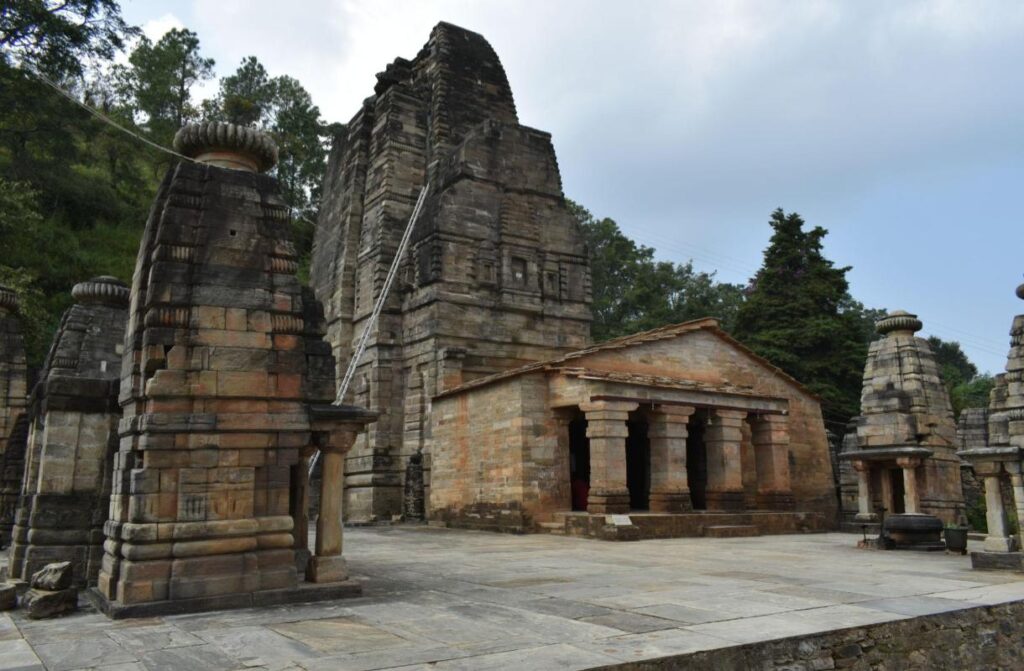
Numerically, temples devoted to solar-worship are far and few on the Indian subcontinent. While the lion’s share of attentional economy is seized by the enigmatic yet alluring Kōṇārka Sun Temple, Odisha, and the debilitated yet stately Mārtaṅḍa Temple of Kashmir, a temple tucked deep in the hills awaits the spotlight—Kaṭāramalla Sūrya Temple, located in Almora, Uttarakhand. Built in c. 9th-10th Century CE, the temple exhibits the exceptional entanglement of devotional patronage with structural flair, highlighting the confluence of mytho-cultural narratives and accomplished craftsmanship, and making it an exemplary extolment of ancient sacral architectural finesse, and reverential incandescence.
Figure 1: A view of the centre of the temple-complex, featuring the main shrine with frontality (Source- the author).
Introduction—
Sitting stately on the hilltops of Shivalik, afar from the vicissitudes of hassles of quotidian realm, the Kaṭāramalla Sun Temple, a resplendent relic of the Katyūrī kingdom, once an imperative locus of royal patronage, now lies abandoned by active propitiation, but it still stands steadfast, offering a glimpse of the times when it once sang sonorous and splendid sagas of Sūrya. In its alleys, icons, and architecture, the temple exhibits the happy and subtle convergence of the sublime with the supernatural.
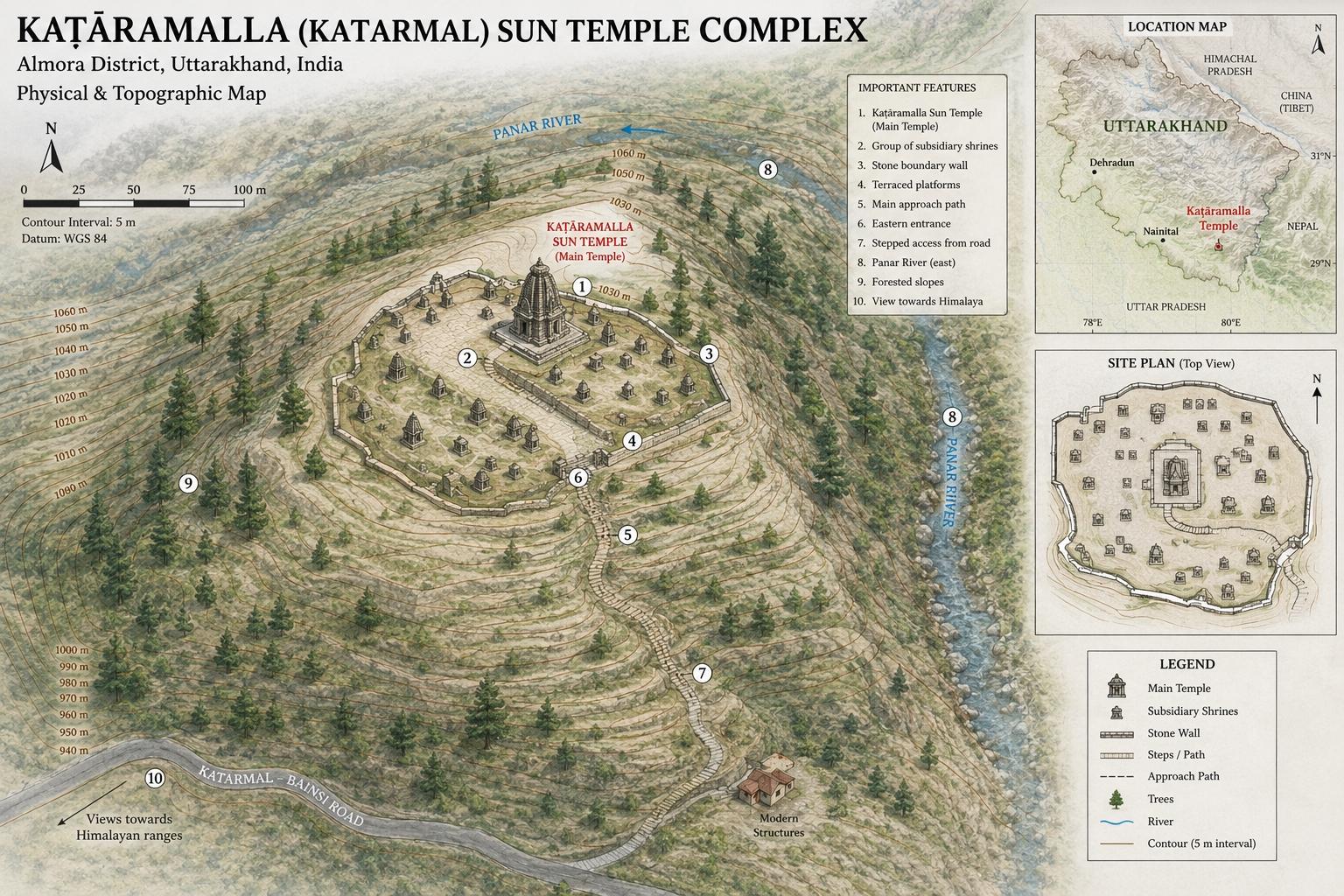
Figure 2: A geo-spatial vision of the situational context of Katarmal site (Source- the author).
Located in the patti Tala Tikhon, Katarmal village, 14 km west of Almora district, Uttarakhand, the site posits meagre archaeo-cultural records besides the temple-complex itself. However, the absence of cultural materiality is compensated by natural serenity that one experiences and withhold in the picturesque sujourn from urban brouhaha to reach the tranquil steadiness of the ‘countryside’, a demographic label not apt to describe the surroundings of the heritage site, on accord of the voluminous presence of home stays, hotels and resorts to provision comfort to both the curious aesthete, and the committed connoisseur of [what] remains of art-cultural effulgence of the Katyūrī epoch.
Though often recounted in itineraries as a ‘Sun Temple’, it would be quite pedantic, but historically appropriate to call the Katarmal site as a temple-complex, with myriad minor shrines devoted to other Hindu deities as well— Śiva-Pārvatī, Viṣṇu-Lakṣmī, Gaṇeśa etc. Nevertheless, the principal temple is exclusively dedicated to the veneration of Sūrya, a fact discerned from a five-line Nāgarī inscription that adorned a sheathed leaf attached to the right-side of the door that once stood on the entrance of the temple’s Mukha-maṇḍapa, but now lies in the National Museum, New Delhi. The inscription vividly narrates the act of establishment of the temple, sponsored by Kaṭāramalla, the regional warlord, and (possibly) a Katyūrī scion. This inscription is of vital significance, as in absence of any definitive stratigraphy to construct a plausible chrono-cultural record, palaeography and architectural evolutionary patterns come to our rescue, and help in tentatively dating or rather the situating the site, of course along with the main temple, in the time-bracket of c. 9th-11th Century CE.
Situated roughly at a height of 2,197 m above the mean sea level, Kaṭāramalla offers the perfect blend of lustrous serenity with the divine articulation of a Katyūrī warlord, and other patrons, for the temples at Katarmal continued to receive patronage Efforts to withhold the historical magnanimity of the Kaṭāramalla Temple comes get rewarded only after trekking for nearly 2 km along a steppable pathway made of locally quarried cobblestone, a feature that adds a slight discomfiture to the upward excursion, but makes it engrossing, whilst also giving it an antiquated feel. The ascent, when compared with other Kumāonī temples, is fortunately supplied with multiple caverns and eateries to freshen-up and refuel oneself, before one ultimately enters tête-à-tête with the grandiose luminescence of Kaṭāramalla. To comprehend and appreciate the inner world of Kaṭāramalla fully, however, a simple physical presence would not suffice. For that, one needs a brief understanding of the history, culture and architecture of Kaṭāramalla—elements that together sketch and constitute the epi-phenomenal
Sun Worship in Uttarakhand: A Brief detour
Offering reverence to the greatest, and evidently The most visible source of sustenance of life on Earth naturally made the Sun a recipient of hope, prayers and widespread worship from all walks of life—including both Vedic seers and other tribal social-groups, a postulate that gains strength from extant material records (Srivastava 1972). Means to worship the solar deity-figure were varied—symbolic (chakra, wheel, discuss, chariot, etc.), zoomorphic (eagle, interestingly—the horse was also conflated with sun in some cases), and ostensibly, anthropomorphic (in human or rather humanized form), the latter being the form that assumed commanding heights of popular cultic imagination. Evidence of sun-worship, in one form or another, exists in an unbroken chain of record, straight from the Harappan civilization (Parpola 2015), down to the Early Modern period (Vidyarthi 1961: 12—16). A peculiar idiomatic feature of sun-worship is the persistence of special inclination of its veneration amongst some special social-groups (for e.g. Śakas, Māgha Brāhmaṇas, etc., see Bronkhorst 2016, Sharma 2005), and localities (Mitrāvana, differently attested in Purāṇas to be located either in Odisha, or along the banks of river Chandraprabhā; Prāchyadeśa, i.e. the eastern country, which probably referred to Bihar and Bengal, see Law 1954: 205-08). Mountainous tracts too share an intimate link with solar worship, probably on account of high visibility, acquatic abundance, chronological cycles, and the enigmatic yet alluring hold that seemingly resides in nearly every mountainous terrain, which makes them enticing, beguiling, ritually ambivalent, and patently hallowed. Besides Kaṭāramalla, a long array of temples dot the highland terrain of Uttarakhand— Jagheshwar, Dwarahat, Baijnath, Danya, Bhilla Kedar, Matleshvara, Nagagaon and Pato village in Tehri Garhwal district, though in most of these, solar reverence forms the subsidiary, and not the primary purpose of rituals, unlike Kaṭāramalla, where a royal image of Sūrya sits splendidly in the Garbha-gṛha, i.e. the sanctum sanctorum, making the Kaṭāramalla temple historically unique, and culturally significant. However, before we disclose the details of the structure, a word on its patron is a sine qua non.
Kaṭāramalla, Katyūrī and an Ancient Kingdom—
The origins of Katyūrī are marred in an oblivious loop. While they claimed a Khasa descent in their inscriptions, belief of scholars oscillate between assigning them a local, native Kumāonī genesis (Atkinson 1881; Handa 2002: 24), or considering them as successors of the Kuṇindas, Trigartas or the Madras (Handa 2007; Pande 1993: 54-55), tribal-republics whose coins have been intermittently discovered in Katyūrī territory. With nothing certain, it is only historically reasonable to attest that the Katyūrīs were possibly regional warlords who gradually assembled the elements of administration, wherein they were given regal guidance by the Pālas of Gauḍa, whose inscriptions refer tangentially to a Khasadeśa under their sway. Through the interference of an imperial third-party, the Katyūrīs ascended the precipice of governance, and moved from a village-centered administrative echelons to commanding heights of authority. After nearly five centuries of exclusive sovereign rule, the Katyūrī regime collapsed. The reign of Kaṭāramalla comes in the mid-way of this meta-narrative. It is not sure whether Kaṭāramalla was an actual Katyūrī dynast or not; only the genealogical sections of Katyūrī scions of Doti and Ascot list him as the 22nd and 33rd king respectively. While some scholars accept such testimonial, others doubt the veracity of such claims, and propose that possibly, on account of the absence of any regnal titulature and dynastic avowal, Kaṭāramalla alternately belonged to a cadet Katyūrī branch, was a non-reigning Katyūrī prince, or under Katyūrī vassalage, who assembled considerable political mirth and financial grit to make the greatest gift to Sūrya, in his capacity as a Paramādityabhakta (the best worshipper of the Sun), a title not used directly by Kaṭāramalla, but commonly associated with royal reverers of Sūrya.
The Gods that Dwell at Katarmal: Vṛddhāditya and other deities—
When one enters the seemingly caged, or rather bar-locked sanctum of the central temple, a lavish, stone-hewed, quite antiquated, and a marvellously bewitching image of Sūrya sits, which, even on a preliminary, sifting glance, would never fail to put your best fancies into a serene trance. Iconographical, the image shows Sūrya wearing a Kirīṭa mukuṭa, sitting comfortably cross-legged on a throne with a slight forward swagger, his elbows placed athletically on his knees, both his arms holding enigmatically elongated lotus-stems/stalks, the terminal, flowering ends of which curve inertly to give them the look of a long candy, with seven horses attached gracefully to his throne/seat. The position of Sūrya reminds one of his usual association with a Ratha (chariot), though in the current case, Aruṇa, his beloved charioteer, is nowhere to be seen. Based on stylistic grounds—gracile physiognomy, delineation of attributes, body-ornaments, and the scintillating smirk, it feels safe to date the image in c. 9th-11th Century CE; while it shows the lingering subterranean presence of Gupta-era idioms, it is not devoid of localized peculiarities and the slight stance towards Chandella idioms as well, along with the partial, but not enthralling onset of Pāla style of art as well. The small anachronism could be factored-in seamlessly when one evaluates Kaṭāramalla in its distant, if not isolated geo-cultural position. The accompanying inscription, fortunately, confirms the attested dating, a luxury only seldom afforded to historians of art and culture. Interestingly, the Kaṭāramalla Sūrya is called in the inscription as Vṛddhāditya, i.e. the old sun, an unusually puzzling title for a god known for evergreen vitality. In the absence of any contemporary or complementary evidence, we can colloquially rely on a legend mentioned in Kāśī Khaṇḍa of the Skandapurāṇa, wherein when an old and senile sage offers veneration at the Vṛddhāditya shrine of Vārāṇasī, his afflictions are miraculously healed, and he once again becomes energetic and young. It is possible that the Kaṭāramalla Sūrya was enshrined with either a [broadly] same premise, or with any other (but hitherto unknown) folk-legend in view. Other than Sūrya, gods-goddesses worshipped at the sacred-complex included— Brahmā, Narasiṃha, Śrī Lakṣmī-Viṣṇu, Śiva-Pārvatī, Gaṇeśa, Śeṣāśāyina Viṣṇu (Viṣṇu asleep under the hood/bed of Śeṣa the serpent). This observation comes from inferences positively derived from inscriptional data and sculptural evidence. The deity-figures reflect the changing attitudinal stances in iconography, as
surely, not all images were enshrined in one go.
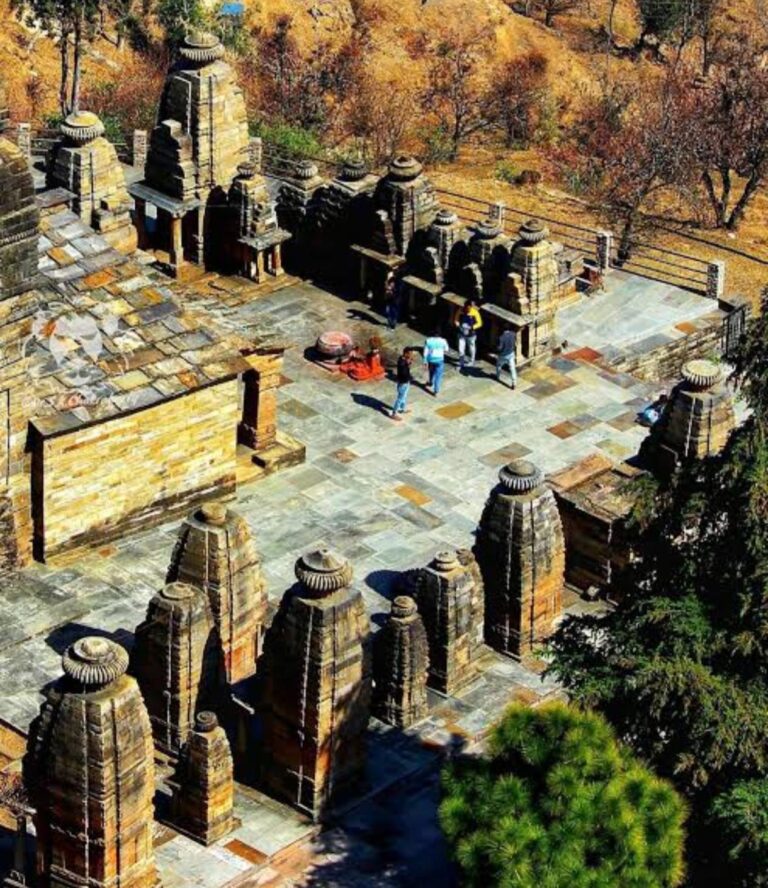
Figure 3: A Side-glimpse of the Katarmal temple-complex, especially the votive temples (Courtesy- Dr. S.K. Chakraborty).
The Principal Temple: Style and Architecture—
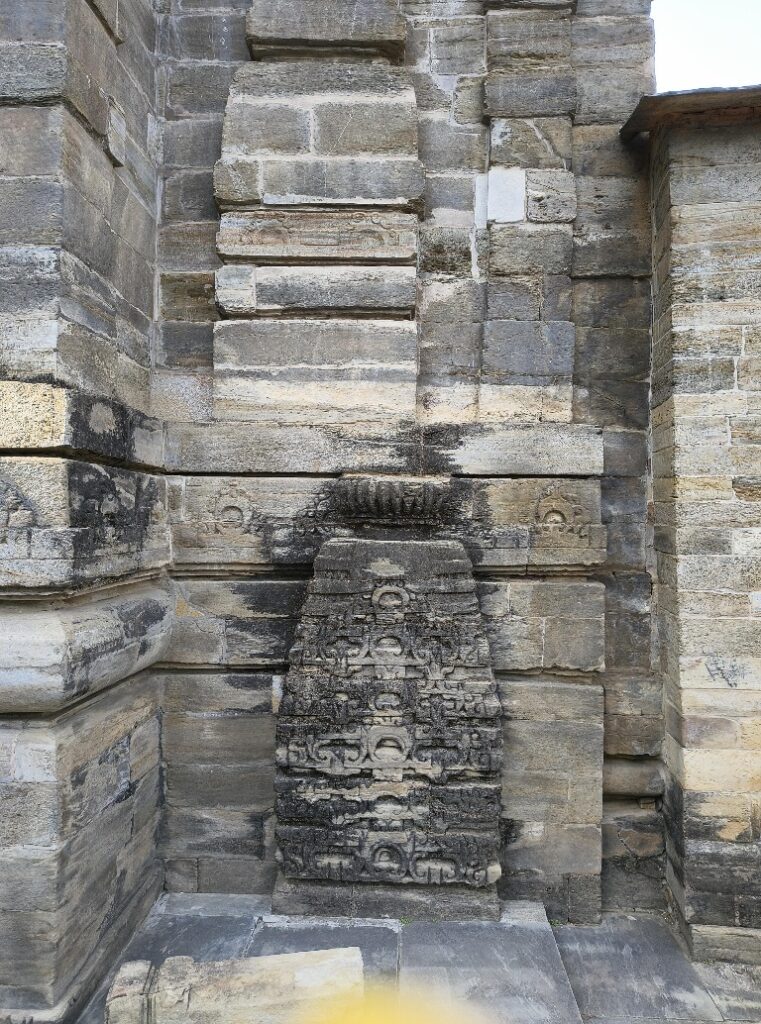
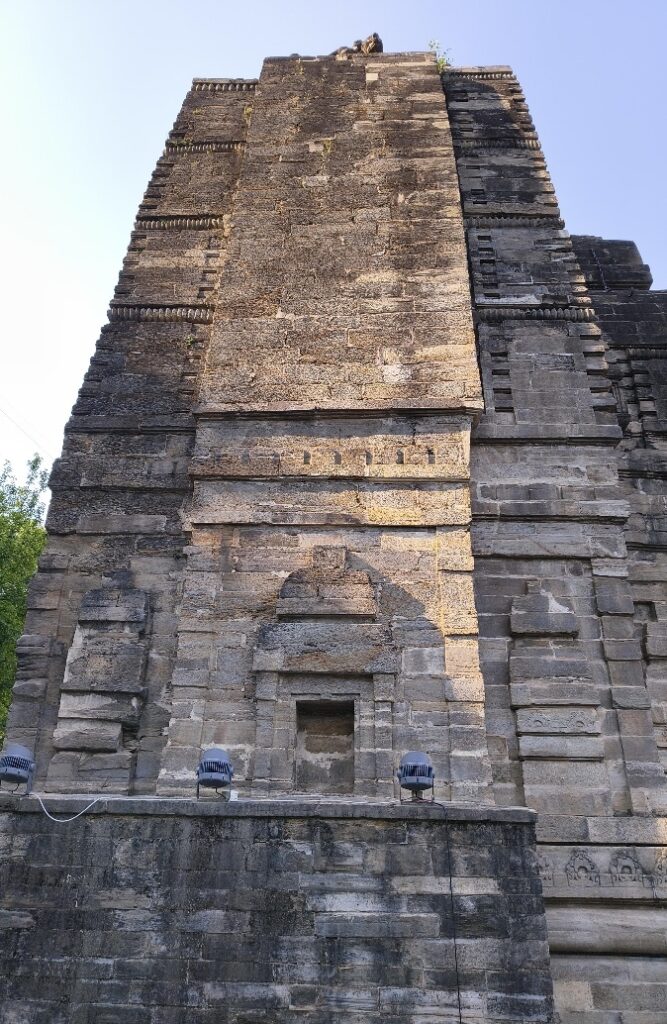
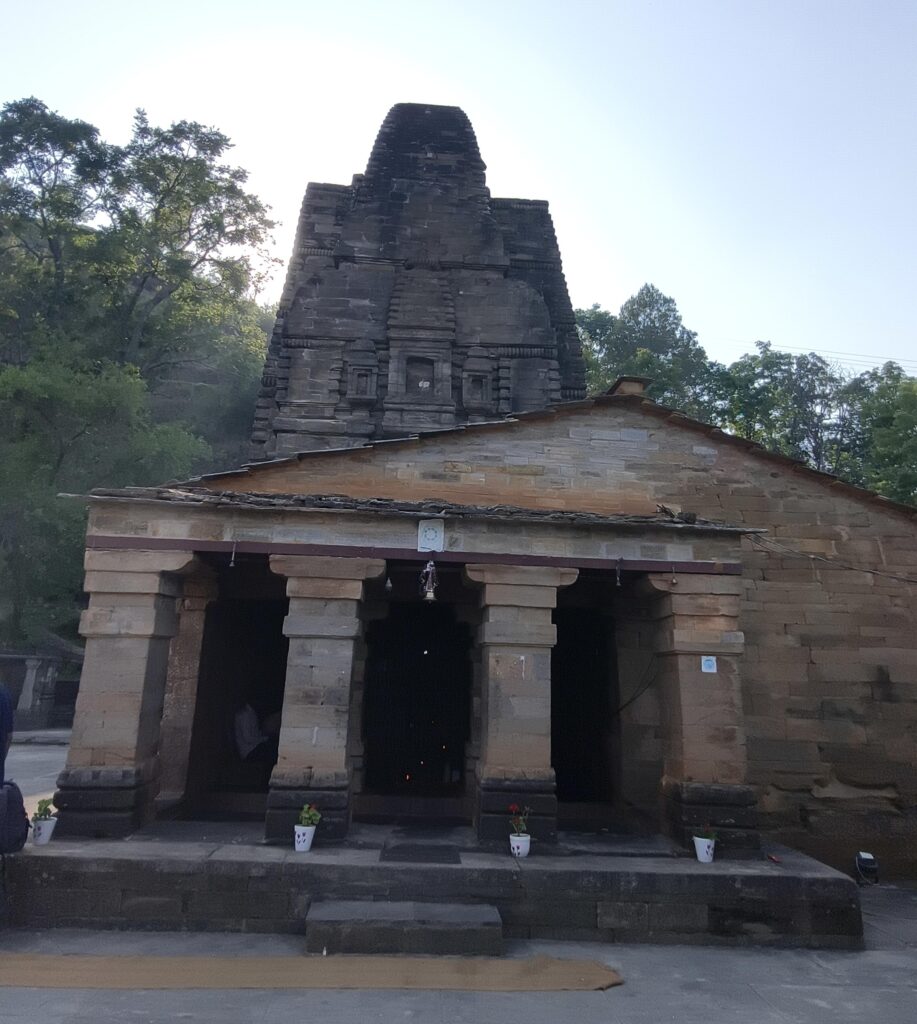
The main shrine of the Kaṭāramalla Sūrya Temple is an east-facing Latina style Nāgara temple erected on a high stone platform (Pēṣṭa) within a paved enclosure and surrounded by about forty-four/five subsidiary shrines. Architecturally, the sanctum (garbhagṛha) is tri-ratha on plan, though its projections are only minimally pronounced, with (to use Kalinga terminology), a prominent Rāha-paga, slightly visible Anurāha-paga, and no prominent Kōṇa-paga (cornice projections). The principal shrine consists of a square sanctum and a most probably later-added Maṇḍapa with a sloping or gabled roof around the entrance, designed in a way which geometrically concentrates the path of sunrays towards the deity inside. The Mukha-maṇḍapa is mostly darkened, a feature that does not add fear, but concentrates the devotee’s attention exclusively towards Lord Vṛddhāditya. A not-so hollow square-pit in front of the sanctum possibly earlier acted as a Yajña-vēdī. The outer-wall projections of the main temple, starting from below to above, feature the following parts— a large monolithic pabhāga (base-stone), followed by two baṅdhas lined beautifully by Kuḍus-gavākṣa motifs, while the jaṅghā features simplistic aedicular representations of the temple. The Śikhara shows Bhūmi-Āmalakas placed consecutively to mark differing elevation-levels, and provide support to the structure.
Figure 4: Kuḍus-gavākṣa motifs (left) and aedicular representations (right) on walls of the main temple (Source- the author).
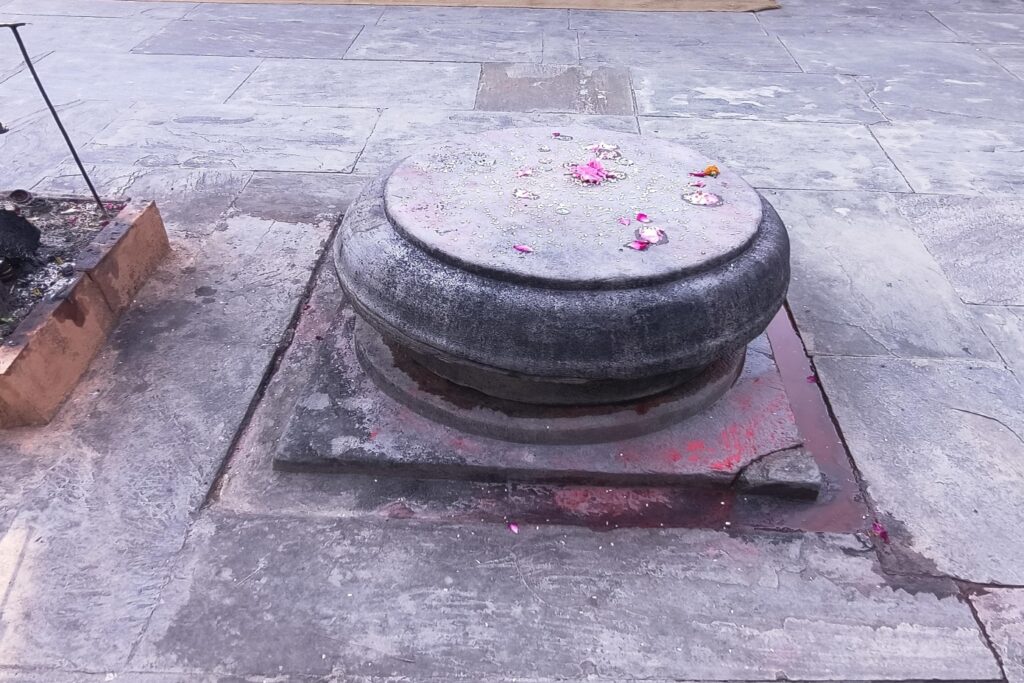
The temple stands at an elevation of approximately 2,116 metres above sea level, while the surviving curvilinear śikhara rises confidently above the surrounding shrines. Precise archaeological measurements of the main shrine’s height, breadth, wall thickness, and sectional dimensions are unfortunately not consistently published in accessible ASI or scholarly records, but the structure is visibly the dominant and tallest element of the complex, occupying the central axis of the sacred enclosure. Yet, some observational data exists in catalogues referring to whom could be useful herein—the principal shrine, also called the Bara Āditya temple, stands upon a raised stone jagatī approximately 1–1.5 metres high and is oriented eastward in accordance with traditional solar temple planning. The main shrine occupies an almost square ground plan measuring roughly 7.5–7.7 metres externally on each side, while the inner garbhagṛha is comparatively small, measuring approximately 1.1–1.2 metres square internally, resulting in quite exceptionally thick masonry walls of nearly 2.8–3 metres. The attached antarāla or vestibule projects about 1–1.5 metres outward from the sanctum, beyond which lies a modest entrance porch or maṇḍapa extending approximately 2–2.5 metres. The complete plinth and frontal projection together produce an overall east–west length of approx. 9–11 metres and a north–south breadth of about 6–8 metres, depending upon whether the moulded base and stair projections are included or not. Vertically, the temple rises from its moulded pīṭha through the massive jaṅghā walls into a lofty curvilinear Latina śikhara, the total preserved height being approximately 15–16 metres from the plinth level to the surviving upper section. The lower wall zone rises nearly 5–6 metres before the curving superstructure commences, while the crowning āmalaka and kalaśa, now partly damaged, would have added nearly another metre to the summit. Though it is debated whether the large polished Āmalaka, sitting in front of the shrine, was ever placed at the top. But, the consecration of the divine image necessitates such an act. Possibly, the Āmalaka, sometime later, came down rolling from the top, thereby incurring minimal injuries, but creating a gaping structural fault atop.
Figure 5: The Āmalaka of the Vṛddhāditya shrine, kept just in front of it (Source- the author).
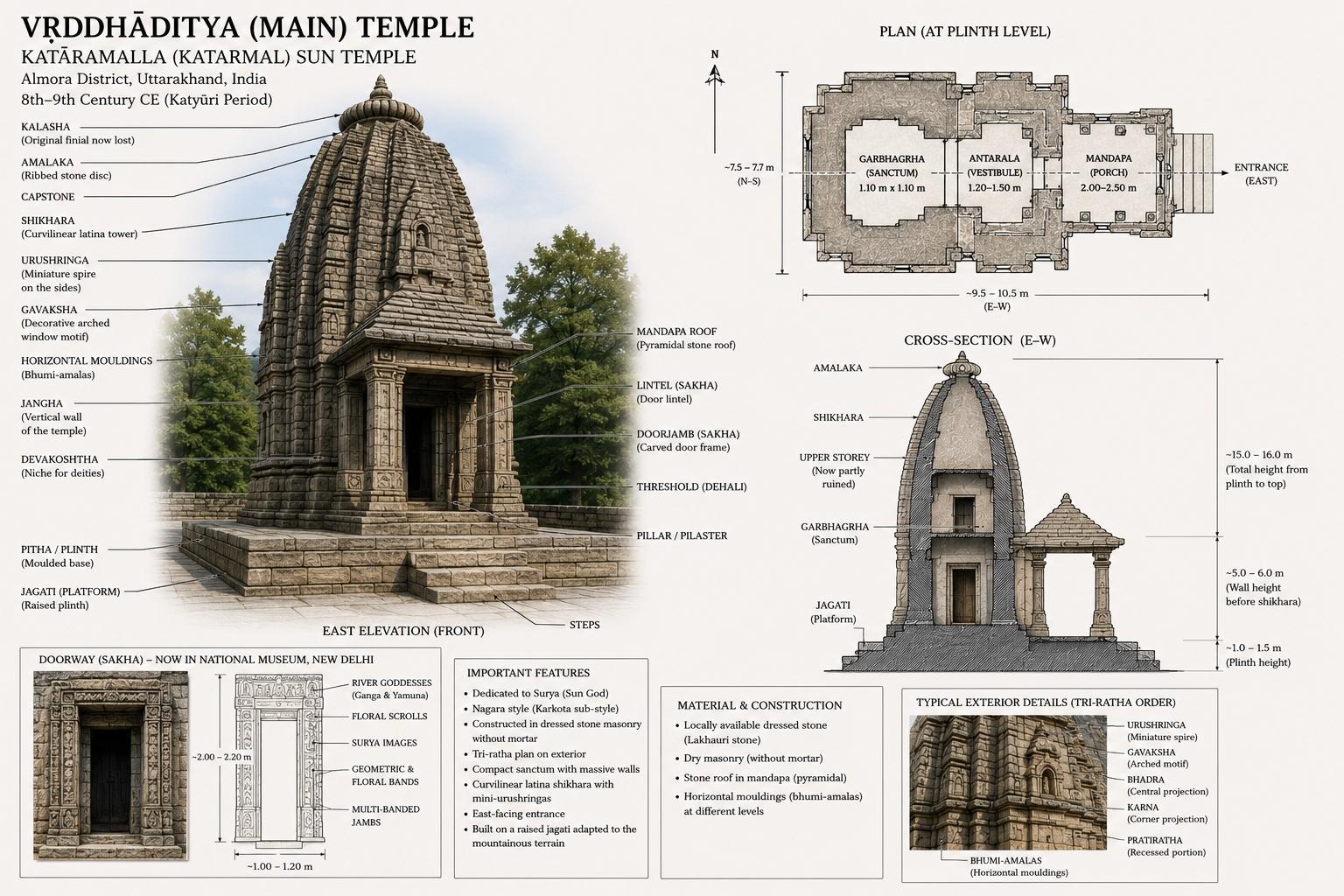
Figure 6: A diagrammatic view of the Vṛddhāditya shrine (Source- the author).
The Sacred Complex—
The archaeo-cultural site of Katarmal could be very broadly categorized into two constituents- the main Sun Temple, and the surrounding votive or secondary shrines; herein, we would not refer to them as secondary, as from an emic perspective, we must appreciate the importance they held in eyes of their patrons, benefactors and worshippers as well. Moreover, though it is not technically prudent to label the second category as ‘votive’, due to absence of definitive evidence, epigraphical or historical, but their numerical presence, small size, manner of arrangement, and limited intricate decorative outlook and repetitive execution makes it safer to presume their votive functions, especially when one, for the sake of argument, draws a comparative inference based on their pronounced resemblance with the votive temples of Jāgēśvara. Together, the Kaṭāramalla temple and the adjoined temples form the Katarmal complex. The total number of votive shrines is contested—Handa (2002) attests 44, while Katoch (2022) believes that 45 shrines earlier dotted the hallowed landscape. Nothing could be averred with certainty, given the fact that, before a dedicated restoration drive by ASI, the votive shrines were in a highly dilapidated stage, a condition that can still be envisaged based on the broken stone tessons and Āmalakas that adorn the margins the main shrine’s Pēṣṭa platform/base.
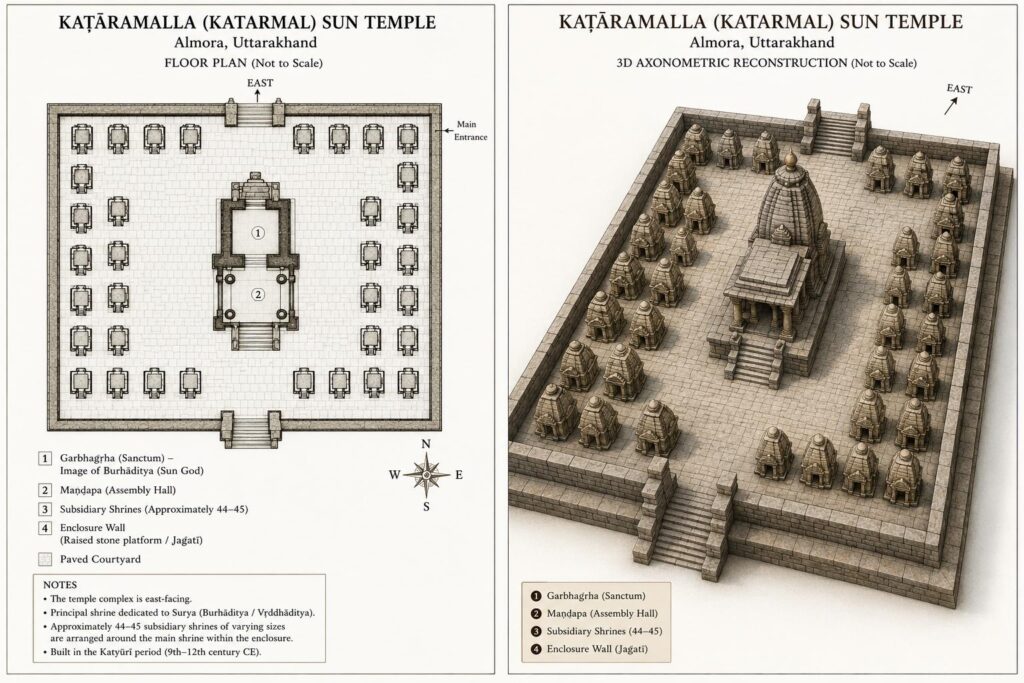
The votive temples mostly appear as aedicular, i.e. minimised/reduced versions of the central shrine, which could have been a consequence of deliberate hierarchical politics of Early Medieval India. The same phenomenon, however, could also be viewed in a different manner— the neat symmetrical arrangement of the votive shrines could have followed an calibrated spatial stratagem, where, when seen from above, they resembled a somewhat staggered, clustered layout emanating from the central shrine, as if metaphorically underscoring the corresponding cosmic episode on Earth. This, at best, could be said only about the earliest of shrines, and strictly not for the later-era irregular placements, which reflect continuing persistence of worship (possibly solar, though in communion with Śaivism and Vaiṣṇavism too) at Kaṭāramalla, along with consistent patronage, possibly as far as c. 16th Century CE. Architecturally, a majority of votive temples, to a considerable degree, follow the curvilinear Latina style, with additions and subtractions of parts based on funding and structural stability. The remaining votive shrines are built in the pyramidal Phāṃsaṇā style, where, in a bi-modal consecutive pattern, rooftop progressively diminishes upwards. Presently, no temple has any deity or idol placed in their sanctum, as all idols have now been moved to the Garbha-gṛha of the main temple, for want of security against thievery.
Figure 7: A diagrammatic and tentative re-construction of the entire temple-complex, especially the votive temples, based on architectural remains and spatial configuration (Source- the author).
The Divine Door—
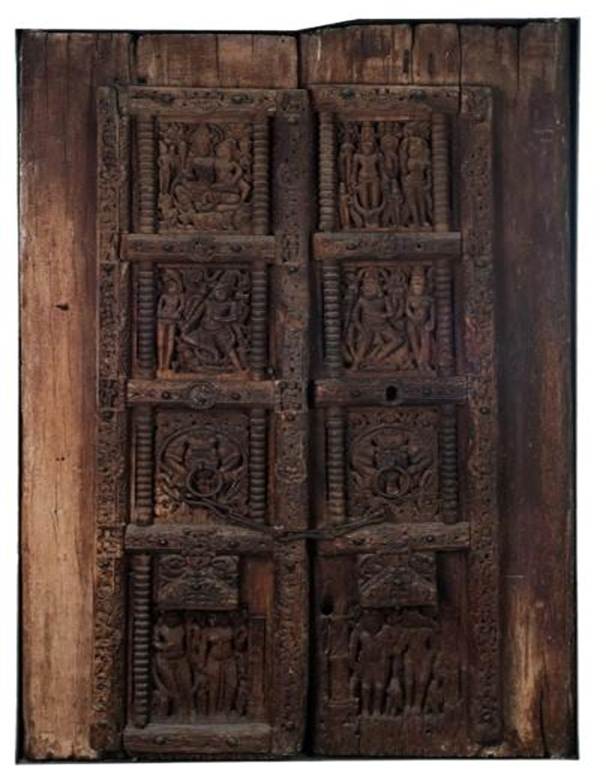
The Kaṭāramalla door is possibly one of the very few wooden items of our hoary antiquity to survive the depredations of the past, a consequence of it being made of shisham (Dalbergia sisoo) which provided it both longevity adamantine strength. The door is conceptually divisible into two ‘leaves’, on both front and reverse—it is the reverse-side that carries the Kaṭāramalla inscription, while the front side exhibits the two vivaciously carved panels depicting many gods and goddesses— Śiva, Pārvatī, Viṣṇu, Brahmā, Narasiṃha, Śrī, alongside other attendants and floral and geometric decorations. It is believed that this intricate artwork was later worked upon, whereas the original door was plain, an assertion that is rightly contested—on stylistic grounds, the featurette images are commonly dated to the reign of Kaṭāramalla, which makes their later dating somewhat cumbersome. However, stylistic parameters cannot be divorced from surficial pragmatics, as the nature of the canvass, and standard engraving gave the artist decidedly limited freedom. Even a preliminary glimpse of this ravishing panel, and its contemplative imagery gloriously narrates the diverse, pluralistic and multidimensional configuration of the religio-cultural milieu of the Katyūrī times. The richly carved doorway of the sanctum, now preserved in the National Museum, measures approximately 2–2.2 metres in height and about 1–1.2 metres in width. To ensure proper conservation, and prevent any invitation to thievery, the door was later removed from its parent-context, and housed at the National Museum, New Delhi, where it still sits silently, carrying in its panels and fibres rich textures of history and religion.
Figure 8: The Kaṭāramalla Door and its panels, presently housed at the National Museum New Delhi (Courtesy- Google Arts & Culture).
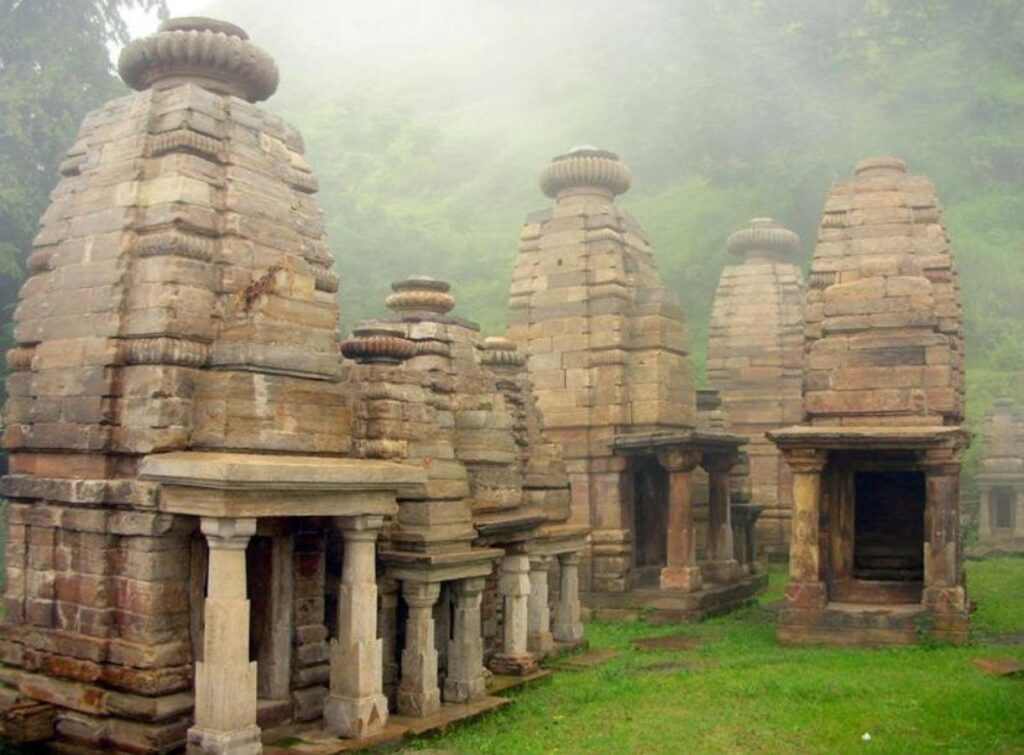
Figure 9: Overgrowth of vegetation in the Katarmal temple-complex (Courtesy- Uttarakhand Tourism).
Revival & Restoration: Preserving a Luminescent Heritage—
It is believed that the Kaṭāramalla temple lost its base of patrons and worshippers by the end of c. 16th Century CE, or by the opening decades of c. 17th Century CE. While it received continuing reverence from the locales, for some years, it vanished from the popular and Brāhmaṇical geo-cultural landscape of Kumāon, until the colonial gaze shifted to the mountains, bringing with it a bag of fortune full of both bane and boon. After the 1815 CE Treaty of Sugauli, which officially concluded the Anglo-Nepalese War, the alluring yet uncharted terrains of the Kumāonī hills began to be studied in earnest. E.T. Atkinson (1840-90 CE), a civil servant and lawyer by training, and a cultural antiquarian and entomologist by interest, firstly attempted to thoroughly study, record and analyze the history, geography and culture of Kumāon. His monumental work, and a colonial magnum opus—The Himalayan Gazetteer (published between 1881-86 CE), pioneered the systematic method of collecting, recording, and annotating the intangible past and tangible heritage of the hilly tracts of United Provinces (roughly, the modern Uttarakhand). His collated official reports with personal observations, and certainly knew of Kaṭāramalla temple, possibly through rural folklores or local guides, but whether he inspected it in person is a contentious matter. Later, after the institution of the Archaeological Survey of India in 1861 under Alexander Cunningham, co-ordinated efforts were made by colonial officers to expand the horizons of the archaeological history of India, initially though for the trail of ‘treasure and adventure’, which, under the insightful and inspired leadership of J.H. Marshall (ASI director: 1902—28) and R.E.M. Wheeler (1944—48), such excursions turned from being mere knightly advents to a quest for knowledge. Post-independence, the celebratory and enlightening works of D.D. Sharma and K.P. Nautiyal brought Katyūrī architectural marvels to the academic mainstream. Nautiyal coined the term Hēmādrī to aptly provide a suitable term for the Himalaya-based modifications in Nāgara temple-style, a condition equally applicable to Kaṭāramalla. A preliminary survey of the ground-condition of Kaṭāramalla was conducted by ASI in 2003, especially after the formation of the Dehradun Circle of ASI in the same year, which made it clear that the absorption of the temple-complex in the surrounding sylvan abodes did more harm than good—growth of a pipal tree just behind the terminal wall of the main temple, whose roots creeped-in through faults and crevices, not only posed danger to the structure itself, but also left it permanently scarred. It’s roots and branches had penetrated the masonry, and left gaping structural voids. Beginning in earnest in 2009, after a thorough preparatory assessment, the conservation-wing of ASI collaborated with CBRI (Central Building Research Institute), and launched a holistic restoration-drive, which improved pathway access to the site, and also included limited shrine repairs, protective sculptural conservation, and institution of security-related protective measures to guard against theft and deterioration. ASI, in a way, followed the principle of minimum intervention, i.e. stabilizing and conserving the surviving original structure rather than fully ‘re-constructing’ missing portions, which is a standard practice in archaeological conservation of medieval Indian temples, and rightly prevents them from becoming a Frankenstein’s monster locked between past aesthetics and a grotesque present.
Figure 10: A front view of the main shrine (Source- the author).
Conclusion—
Like the radiant convergence of the Sun, perhaps the Kaṭāramalla Sūrya Temple is a sacral site true to the cosmic nature of its chief-deity. When viewed from differing perspectives, the Kaṭāramalla temple-complex selects different meanings to symbolize— a patron’s pride, a dynastic emblem, the craftsman’s dream, a devotee’s haven, and a splendid residence of Vṛddhāditya Sūrya, the one who keeps depredations of senility at bay. The awestrucking architecture is sure to not only arrest your attention on the first glimpse, but also ardently make one fall in love with its monumentality at the very first sight. Besides convergence, the Kaṭāramalla temple is equally a monument of rarities— firstly, it is a Sun Temple (one out of five-six throughput the Indian subcontinent), that too exclusively dedicated to Sūrya, and that too to his rarest form, Vṛddhāditya, heard of elsewhere only in context of Kāśī. Interestingly, Kaṭāramalla is perhaps the only [prominent] Sun Temple where active worship still continues, to this very day. Special festivities are organized by the local populace on pious occasions of Sūrya Mahotsava/Mēlā Parva, observed in the Hindu month of Pauṣa (roughly December-January), when the Gāyatrī mantra is chanted, and prayers made for health and community well-being. Other occasions include Makara Saṅkrāntī, when jalārghya (water oblations) are offered to the presiding deity, and Uttarāyaṇa, which celebrates northward movement of the Sun, an astronomical phenomenon symbolizing auspicious beginnings.
The architectural finesse, deft workmanship, aesthetic artistry and above all, the surrounding serene scenery, tranquil, gentle and inviting, makes the visitation even more majestic in every sense of the term. While the Kaṭāramalla complex acts as a placid sanctuary for those who wish to meditate in reverence of Sūrya, even the most disinclined tourist would not fail to find a strange, welcoming calmness not experienced elsewhere, one that soothes sinews, pacifies the constant stress and strain that perturb the minds in this digital age. A feeling of enthrallment is the first that one most distinctively registers in one’s conscience while viewing Kaṭāramalla temple. True, it does not possess the grandeur of Bṛhadēśvara Temple, Thanjavur, or the organizational armada of Tirupati Temple, Tirumala, it has its own uniquely distinguished sense of singularity which is hard to define in words, but not that hard to experience, remember and register poignantly, and perhaps for eternity, in the contours of one’s heart, mind and soul. After a casual or a curious visit, to continue the journey ahead, you may leave the premises of the Katarmal temple-complex, but it never leaves you.
References:
Atkinson, E.T. (1881). The Himalayan Gazetteer, Vol. 1, Part 1. New Delhi: Cosmo Publications. https://archive.org/details/in.ernet.dli.2015.95851/page/n10/mode/1up.
Bronkhorst, J. (2016). How the Brahmins Won? From Alexander to the Guptas. Leiden: Brill’s Publications.
Handa, Devendra. (2007). Tribal Coins of Ancient India. New Delhi: Aryan Books International Ltd.
Handa, O.C. (2002). History of Uttaranchal. New Delhi: Indus Publishing Co.
Katoch, Y.S. (2022). Madhya Himalaya: Sanskriti ke Pad Chinnha. Tehri Garhwal: Bhagirathi Prakashan Griha.
Law, B.C. (1954). Historical Geography of Ancient India. Paris: Society of Antiquities, Paris.
Pande, B.D. (1993). History of Kumaon. Almora: Shyam Prakashan.
Parpola, Asko. (2015). The Roots of Hinduism: Early Aryans and the Indus Civilization. Oxford: Oxford University Press.
Sharma, R.S. (2005). India’s Ancient Past. New Delhi: Oxford University Press.
Srivastava, V.C. (1972). Sun-worship in Ancient India. Varanasi: Chowkhumba Prakashan.
Vidyarthi, L.P. (1961). The Sacred-complex of Hindu Gaya. New Delhi: Asian Publishing House.
The documentation presented here is the result of independent field study conducted by Arindam Chaturvedi. All rights to this work remain with the author and are published on Trip and Tales under his authorization. Trip and Tales holds no ownership over this content.
Trip and Tales sincerely thanks Arindam Chaturvedi for permitting the publication of his work for the benefit of readers and heritage enthusiasts.