
Where Rivers Shape Civilization
MAJULI
by
Vaishali Shakya
MAJULI
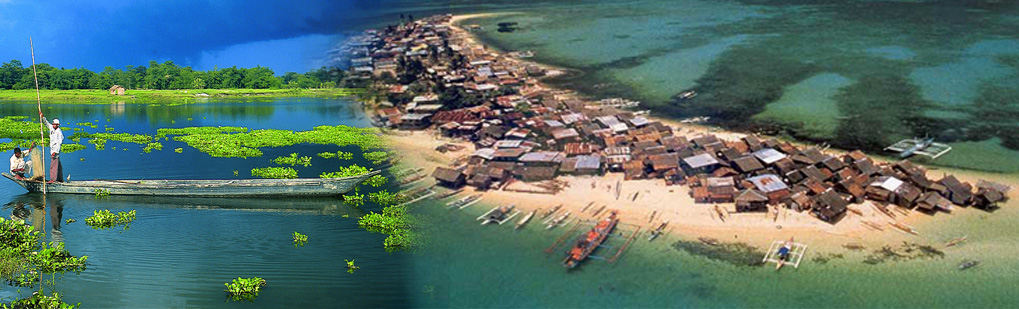
Previously, a long and narrow island existed along the two rivers, with two parallel rivers flowing on opposite sides. The Burhidihing River flowed to its south for centuries, while the Brahmaputra River flowed to its north. However, two seismic occurrences reshaped the topography around what is now Majuli Island. Numerous earthquakes shook the island from 1661 to 1696, and a deluge covered much of the island for 15 days in 1750. After the floodwaters receded, the Brahmaputra River split into two rivers, resulting in the formation of a new island. As a result, the new island was named Majuli (meaning “land in the middle of two parallel rivers”). [1]
Majuli is a river island on the Brahmaputra River in the district of Jorhat in the state of Assam’s upper Brahmaputra Valley. It has earned the reputation of being an important location due to several natural and cultural factors. The first is Majuli’s distinctive terrain as a river island encircled on practically all sides by the mighty Brahmaputra. This has contributed to an ecological setting in which a particular integration of man and nature has arisen, manifesting as a live panorama of manmade expressions and natural events. Second, and more importantly, the presence of many Satras, which are the monasteries of the Vaippzva abbots and are the centres of various religious and artistic activities, has made Majuli the hub of the Vaisrjava culture and tradition of Assam.
Geography
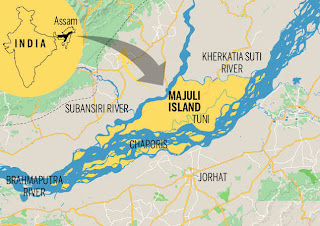
Map of Majuli Island
(Courtesy: https://librisnotes.blogspot.com/2020/01/)
Majuli’s geographical coordinates are 26O45.N to 27O15.N latitude and 93O45.E to 94O30’E longitude, with an average elevation of 84.5 metres above sea level. According to government records from 1950, 1971, and 1997-98, the total area of the island is 1246 square km, 924 square km, and 875 square km, respectively. Except for the northeastern corner, which is connected to the land of the Dhemaji district via a man-made land connection, it is encircled on all sides by the Brahmaputra’s water flow. The Luit or Lohit River flows along the island’s northern shoreline, which is the upper branching and former main channel of the Brahmaputra. The Kherkatiya Suti is its easternmost section. The current Brahmaputra mainline flows parallel to Majuli’s southern shoreline. Crossing these water bodies are the districts of Lakhimpur and Dhemaji on the north and Jorhat and Sivasagar on the south of Majuli. The current Majuli is a myrobalan-shaped plain region surrounded by the great Brahmaputra. Its physical geography is distinguished by the presence of numerous wetlands, static bodies of water, cultivable and grazing pastures, sand shores, and naturally developed drainage systems. The Tuni River, which flows from northeast to southwest over Majuli, is the only river. During the monsoon season, the water level rises to cover the majority of Majuli.
Natural Environment:
Majuli’s natural environment has been shaped by its riverine ecosystem. It is a fluvial geomorphology zone generated by alluvial deposits in the Brahmaputra River basin. As a result, it is a fertile area with alluvial sedimentation. Majuli’s lone river is Tuni. There are also many other channels, such as Mari Tuni, Sukan Suti, Khar Jan, Boka Jan, Dighali Jan, and so on. Another notable aspect of Majuli’s physiography is the presence of numerous inland wetlands (locally known as bils), particularly marshes, ponds, cut-off meanders, and other water-logged places. During the rainy season, these are generally full. These water basins, which appear to be wetlands, serve as colonies for numerous indigenous peoples while beautifying Maiuli. Migrating birds, some of which are threatened. They play a key part in preserving the faunal world’s richness in a world.
Population
Table 1: As per the Census information, the population of Majuli is as follows:
| Categories of People | Census Year 1991 | Census Year 2001 | Census Year 2011 |
|---|---|---|---|
| Total population | 135378 | 153362 | 167304 |
| No. of males | 70410 | 79490 | 85566 |
| No. of females | 64968 | 73872 | 81738 |
| Total no. of Scheduled Caste population | 19278 | – | 23878 |
| No. of SC males | 10133 | – | – |
| No. of SC females | 9145 | – | – |
| Total no. of Scheduled Tribe population | 57357 | – | 77603 |
| No. of ST males | 29052 | – | – |
| No. of ST females | 28305 | – | – |
| Population density | 146 per square km | – | 212.6 per square km |
Furthermore, Majuli’s population is ethnographically consisting of the tribal communities of Mising, Deuri, and Sonowal Kachari, as well as communities belonging to the larger fold of Assamese Hindus such as Koch, Nath, Kalita, Ahom, Brahmin, and Kaivarta. There are also Bengali and Nepali groups, albeit in small numbers, who relocated to Majuli in later periods. As demonstrated by data from the 1991 census. The tribal category accounts for 42.37% of Majuli’s overall population. It has been declared as a tribal constituency in the Assam State Legislative Assembly. In terms of religion, the caste-Hindu populace are Hindu-Vaisnavites, whereas the majority of tribal peoples follow their own traditional religious beliefs. The acculturation of tribal societies with the mainstream cult of Vaisnavism is still reported to be a continuing process that occurs in intricate patterns of cultural dynamics. A significant proportion of the tribal people have converted to Christianity. Among the Bengali-speaking populations, there are also a few Muslim households.
Habitat and Biodiversity
The pollution-free air of Majuli, in sharp contrast to the smog-ridden air of many of India’s metropolises, always astounds island visitors. With its rich flora and fauna, the island’s geography is dominated by sand dunes, wetlands, and verdant environs, some of which are endemic and indigenous to Majuli. Because the island is in the path of migratory birds, there are a lot of avian visits during the winter. The Siberian crane, Greater Adjutant stork, Whistling teal, and pelicans all come to dwell or rest for the winter. Even though the birds typically feed before flying off to their destination. During the day, wild ducks and geese visit the island to feed. There are also 18 islets around the island called chapuris, which serve as the breeding grounds for many kinds of birds.[2]
Ethnic composition
Majuli’s anthropological composition can be divided into two large kinds of human settlements. The tribal population consists of three communities: Mising, Deuri, and Sonowal Kachari. The non-tribal Assamese caste-Hindus category ‘Satras’ comprises communities such as the Brahmin, Kayastha, Ahom, Koch, Kalita, Nath, Chutiya, Kaivarta, and others. While all the communities in the latter category share cultural traits and traditions in terms of language, religion, festival, food habits, traditional costume, patterns, and other overtly visible cultural expressions (although certain rites de passage are distinctive to each of these castes and classes on a deeper level), each of the three tribal communities has its own distinct cultural elements.

The Tribal People
- Mising – In terms of population, the Misings are Majuli’s largest tribal group. Their villages are distributed throughout southern and central Majuli, with the concentration being highest in the Jengrai area to the north. They are members of the Tibeto-Burman linguistic family and share racial heritage with the Tani group of people in Himachal Pradesh (which includes the Adis, Nishis, Apatanis, and Hill Miris). The Misings are noted for their affinity for riverbank residence as well as their fishing and boating abilities. Apart from Majuli, they had settlements on the banks of the rivers Subansiri, Siyang, Dihing, Dibang, Dhansiri, Bharali, Buroi, and the Brahmaputra. They speak Mising, their original language, while Assamese is used as a secondary language for communication with non-Mising people. The moniker ‘Miri’ was used to refer to them by the other groups, but they now deny this designation and want to be known as the Mising.
- Deuris – In the former Chutiya kingdom, the Deuris were the sacred communities. They came from the Sadiya region of eastern Assam. The Deuris were divided into four clans: Dibongy, Tengpany, Bargoya, and Ptorgoya. The last of them is now extinct, possibly because of assimilation with the Tiwas of central Assam. Aside from Majuli, Deuris communities can be found in a variety of districts throughout eastern Assam. Majuli’s Deuris are Dibongy clan members. The Dibongiyas have their own language, while the rest of the Deuris speak Assamese. Majuli’s Deuris worship their traditional god, Kundimama.
- Sonwal Kachari – The Sonowal Kacharis have only one village in Majuli, which is called Sonowal Kachari Village and is in the northeastern portion of the island. Sonowal Kacharis is a sub-group of the Bodos, with the majority of the Sonowal Kachari population residing in the Dibrugarh District of eastern Assam. They were to mine gold from the Sovansiri River under the reign of Ahom. The Sonowal Kachari’s original mother speech was Bodo, but they now recognise Assamese as their mother tongue. Names and words from their former language can be discovered in their traditional tales and songs.
The Non-Tribal People
Those who represent the so-called mainstream Assamese culture fall into this category. This section’s social hierarchy may be considered as a loose imitation of India’s four-tiered caste system (Brahmin, Khyatrya, Baiya, and Südra in descending order). However, the caste system among Hindus in Assam in general is unusual in several ways.
Brahmin, Kayastha, Ahom, Koch, Kalita, Nath, Chutia, Kaivarta, and other non-tribal communities can be found in Majuli. Majuli has a significant concentration of Brahmins. They are thought to have originated in Kanauj, Orissa, Banaras, and Mithila prior to the establishment of the Ahom Rule in Assam in the 13th century A.D. In general, Assamese Brahmins have little in common with Bengali and South Indian Brahmins. Traditionally, Assamese Brahmins make a living from agriculture, however, they do not work in the crop fields. The Kayasthas of upper Assam, who, like the Brahmins, moved from Kanauj and Mithila, worked as writers and officers in the Ahom court. The Koches were once thought to be an indigenous tribe of western Assam. During the Koch era, many of the other tribes were converted to Kochism. Scholars believed that the Kalitas were a class rather than a caste, while the Naths were affiliated with the occupation of weaving. They believe they are descended from royalty and practise the “sacred thread ceremony.” Since pre-Ahom times, the Chutiyas have possessed a royal kingdom in the eastern section of Assam. The Kaivartas are a scheduled caste with fishing as their primary occupation, in addition to agriculture and trading.
Education
With the influence of the British, the system of formal education in the modern sense began to grow in Majuli, as it did in many other parts of the country, in the late nineteenth century. Prior to that, however, Majuli’s many satras played a crucial role in providing traditional education. They were not only in charge of teaching and disseminating specialised traditional knowledge pertaining to various visual and performing arts, but they were also involved in the upkeep of tols (traditional Sanskrit-teaching schools) for the teaching of Sanskrit and the preservation of a tradition of writing in vernacular language. Wealthy satras such as Auniati, Natun Kamalabri, Dakhinpat, and Garmur have supported the creation of sophisticated educational institutions such as schools and colleges not only in Majuli but also throughout the state. Modern educational institutions began to be developed in Majuli thanks to the efforts of motivated individuals and, at times, direct support from Satra institutions.
Heritage

Natural Heritage
Floral heritage: Majuli presents a rich ecological space of bio-diversity. It includes an interesting floral landscape of marshy topography preserving rare species of various plants:
- Some species of cane such as “raidang”.
- Some species of reed called “eikara”.
- Some species of bamboo such as “bholuka”/ “nalkhagari”.
- Some species of pith such as “kurula”.
- Some species of silkworm raring tree- “majankari”.
- A large body of medicinal herbs (manimuni) and shrubs (bahak tita)- a hub of ethnomedicine.
Faunal heritage: The riverine ecology has endowed an interesting faunal landscape in addition to the common ones:
- Rare species of river dolphin called “khihu”.
- Rare species of fish such as “khil gharia”.
- Rare species of bird “haitha”.
- Varieties of rare migratory water birds such as “panikauri”.
- Varieties of orchids of unique species such as “kapouful”.
- Some rare species of butterflies.
Human Heritage
The Satra Institution – The satras are Vaisnava monasteries, which are the residences of Vaisnava monks known as bhakats and are iconic of Assam-Vaisnavism. The establishment of satras in Assam can be traced back to the Neo-Vaisnavite movement in the 16th century, led by Sankaradeva (1449-1568). The satras were founded primarily to spread the Vaisnava religion among the ordinary people. To achieve their goals, the satras developed their distinctive traditions of literature, music (both vocal and instrumental), dance and drama, painting, manuscript writing, and various genres of craftsmanship and architecture, resulting in a distinct whole known locally as Satry culture. The satras have had a huge impact on people’s social and cultural lives; they played an important role in Assam’s social, cultural, and political history. Every caste-Hindu household in Assam has traditionally received religious ordination from a single satra.
Some important satras of Majuli –
- Natun Kamalbari Satra – Badul Ananda, a follower of Sankaradeva and Madhavadeva, built the Kamalabari Satra at Majuli in 1673. In pre-British times, this satra got royal assistance from the Ahom kings and eventually emerged as a highly influential satra. However, in the early twentieth century, Ghanakanta Deva Goswami, the satra’s pro-Satrdhikr, had split and left the satra with a few of his supporters. In 1936, he founded the Natun Kamalabari Satra (Natun = new) on the banks of Majuli’s Tuni River. Because of water and erosion, the ancient Kamalabari Satra later relocated its campus to the Jorhat district’s southern bank – Titabar region. The Natun Kamalabari Satra adhered to traditional Kamalabari customs such as celibacy and Nikä samhati. The Kamalabaris are well-known for their expertise in Satriy music, dance, and drama. Their works have been widely publicised in the media, and some of their performers have garnered accolades from the Government of India’s Sangeet Natak Akademi.
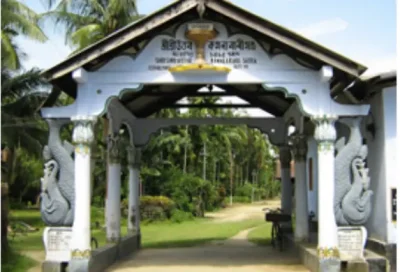
- Auniati Satra – Niranjanadeva founded Auniati Satra in 1653 with royal help from Ahom king Jayadhvaj Sinha. Due to flooding and erosion, the satra had to be relocated several times. The current Auniati Satra campus is in Majuli’s Kamalabari Mauza. It belongs to the Brahma Samhita and is celibate. With its highly regarded collections of illustrated manuscripts and other works of delicate craftsmanship, this Satra is one of Assam’s largest and wealthiest. The Satra has just constructed a new campus in the Kaliapani district of Jorhat District on the Brahmaputra’s southern bank. This setup was made as a backup plan in case its Majuli campus gets degraded.
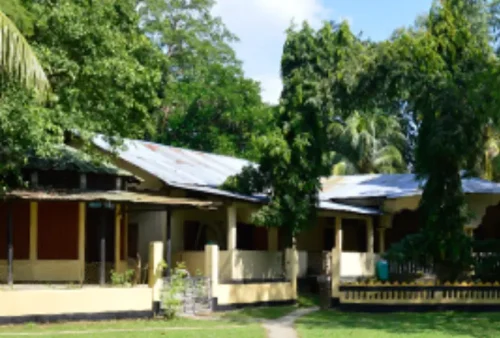
- Garmur Satra – Jayaharideva, the martyr of the Damodariy cult, founded the Garmur Satra between 1715 and 1744. Since the times of Ahom king Siva Sinha, this Satra has received royal support. As celibacy was the rule in ancient times, several changes were made later. Garmur Satra is one of Assam’s most well-known and prosperous satras. Satrdhikr Pitambar Deva Goswami, its late founder, was a reformer of society, activist, and liberation warrior for the country. In the past, the Satra was also known for its fine works of wood carving.
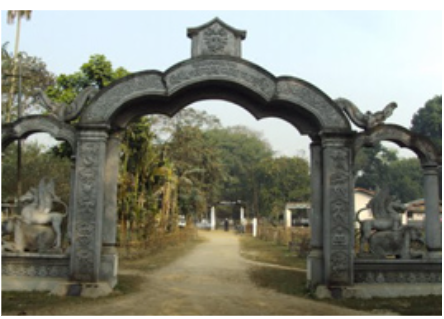
(Courtesy: https://nexplore.org/destinations/Assam/majuli-satra.php)
- Dakhinpat Satra – Banamalideva built Dakhinpat Satra in the middle of the 17th century with the royal patronage of the Jayadhvaj Sinha. Banamalideva was Damodaradeva’s successor, and he founded several Satras throughout Assam. Since its inception, Dakhinpat Satra has been held in high regard by a wide range of people. It has various branch-Satras spread around Assam. Dakhinpat Satra, like Auniati Satra, has built a stand-by campus in Jorhat’s Sotai neighbourhood.
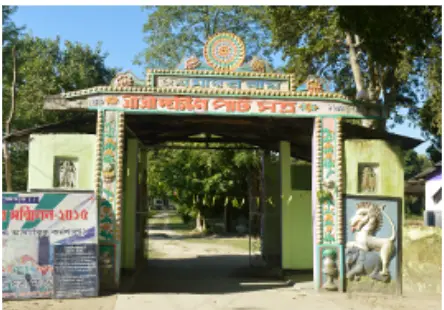
(Courtesy: https://nexplore.org/destinations/Assam/majuli-satra.php)
Repository of Vernacular Architecture
- Vernacular Architecture – Vernacular architecture is the art of displaying the traditional built environment of a particular region’s inhabitants. The inhabitants’ traditional, ethnic, and basic approach to creating constructed environments to develop the label of vernacular, which is specific and vital to the region. Vernacular architecture evolves over time to reflect the traditional, climatic, cultural, and historical setting in which it is found. It has been condemned as inappropriate and unprocessed, but it also has supporters who emphasise its importance in the current context. Majuli embodies a profusion of culture, linguistic diversity, and a breathtaking array of arts and crafts. The vernacular artefacts and building spaces distinctive of Majuli’s traditional communities have emphasised the unique picture of identity. Majuli’s indigenous architectural style adapts to the environment, integrates with the geography, and vibrates with ethnic communities’ cultural trends, lifestyle, spiritual, and religious parameters. These visual narratives communicate the language of skill and craftsmanship, cultural appreciation, local materials, and building science approaches.
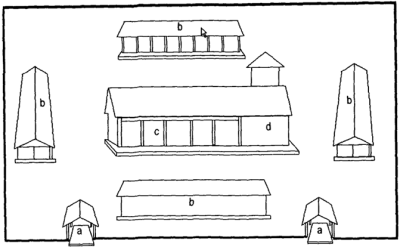
Layout of Satra Campus (a) batcora , (b) hati, (c) namghar, (d) mainkut.
(Courtesy of SodhGanga)
For example: A typical satra’s campus is in vernacular architecture made up of four architectural sections: Băţcora, Haţi, Namghar or Kirttan-ghar, and Maniküt[1]. These are discussed further below.
- Batsara /Baţcora (Sattara Gate): A baţcora is a Satra’s foyer or entry. Karpat is another name for it. A bațcora or karpat is a tiny open house at the entrance to a Satra’s campus, built with a roof supported by four decorative pillars. According to Sarma, the “Batcara of a Satra is a miniature imitation of the toran-garha of the Hindu temple.” It separates the Satra Arena from the other settlements in the area. In Satriya tradition, prominent visitors as well as guests are greeted in Batcora.
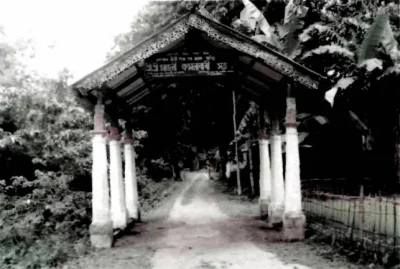
(Courtesy of SodhGanga)
- Hati: The path from the batcar goes to the hatis, or cloisters where the devotees live. In a full-fledged satra, four haţis surround the namghar from four directions. Each of these cari-hatis (four cloisters) is named for the direction it faces in relation to the Namghar, such as püb häţi (eastern cloister), paschim haţi (western cloister), uttar haţi (northern cloister), and dakkhin hţi (southern cloister). A single haţi is an extended structure comprising a sequence of remnant huts or compartments. Each of these divisions is referred to as bah. A bah is a space for one or many devotees. On the other hand, a single devotee may use one or more chambers depending on his standing.
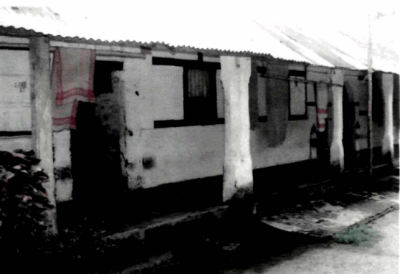
(Courtesy of SodhGanga)
- Namghar (Prayer Hall): It is a large hall with a gabled roof and an apsidal façade. A central nave runs through the namghar from the entrance door in the west to the manikut (sanctum sanctorum) in the east. On both sides of the nave, there are two rows of timber pillars (khuţas) that separate the nave from the chapels. A namghar’s walls are left with perforated wood carvings called jalis, which operate as windows for the passage of light and air. Although the namghar’s primary function is to house devotees for choral prayers and hymns, it is also utilised by devotees for gatherings, discussions, and dramatic and musical performances.
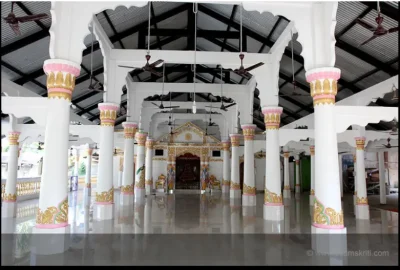
(Courtesy: https://www.esamskriti.com/a/Assam/Majuli-Satras-and-Landscape.aspx)
- Manikut (Houses of Jewels): The sanctum sanctorum of the satra institution is the manikut, which literally means “house of jewels.” It is connected at the namghar’s eastern end. The deities, either in the form of idols or the Holy Scripture (the Bhagavata), are set on wooden pedestals (asanas) inside the manikut. This is considered the most sacred area in the entire satra complex.
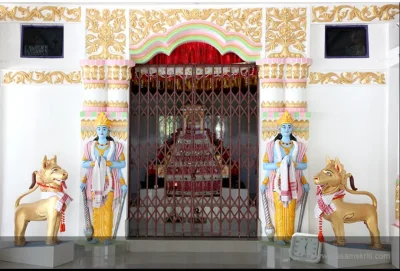
(Courtesy: https://www.esamskriti.com/a/Assam/Majuli-Satras-and-Landscape.aspx)
Some other examples of vernacular architecture present in Majuli are –
- Bharal Ghar (granary)
- Chang Ghar (Pile dwelling) of the tribes.
- Dalang – a bamboo and wood footbridge over streams.
- Jeura-Japana – a bamboo enclosure of a campus.
Repository and Preservation of Intangible and Tangible Cultural Heritage
- Singing and Music tradition – A Staras devotee’s highly elaborate daily observances include various prayer services; singing of songs specific to the time of day; offerings to the deity; recitation, exposition, and listening to portions of defined scriptures; implementation and performances of specified items of dance, drama, and instrumental orchestra; and enactment and performances of specified items of dance, drama, and instrumental musicians.
For example:
- Krishna Janmashtami: This is Lord Krishna’s birthday, which is celebrated on the eighth lunar day of the dark moon in the month of Bhada (July-August). This is symbolised by the placement of new sacred clothing on the wooden pedestals in manikut, followed by song and choral-prayer chanting.
- Pal-nam: This is a significant Satriya ritualistic event that includes group prayers and choral singing. It is frequently witnessed between July and August, and between October and November. The duration ranges from a few days to a month.
- The Misings have their rich musical tradition which is reflected in the different varities of Mising folksongs. Some such varieties are mibu-ābāng (songs of the priest), oi-nitom (songs of love and yearning), kaban (songs of lament), midāng-nitom (songs of marriage), bini-nitom (lullabies), etc.
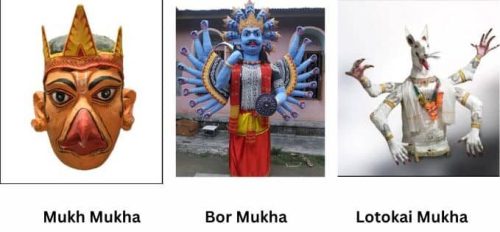
Mask-Making Tradition – For ages, Natun Chamagurisattra in Majuli has been an important part of the sattriya culture of mask manufacturing. Chakrapani founded the Chamagurisattra, which has since split from its parent sattra, Prachin Chamaguri sattra, in 1663. Natun received a piece of the bhaktas from the original satra in 1923. Despite the fact that women are not prohibited from producing masks, it is still a male-dominated art form. Members of the Sattra Management Committee have dedicated themselves to mask-making, including notable people like Koshakanta Dev Goswami, Umakanta Dev Goswami, Rudrakanta Dev Goswami, and his sons.[1]
There are three types of mask production-
- Mukh Mukha – These are face masks and worn only on the face.
- Lotokai Mukha – These are face masks but allow movement of eyes, lips and hands.
- Bor Mukha – Covers the entire body and is nearly life-size or greater. These masks can range in height from 2 to 5 metres, and the performer can wear them above the waist.
(Courtesy: https://www.northeastbullet.com/mask-making-in-majuli/)
As the needs of the play dictate, the craftsmen might add or subtract materials from the masks’ bodies.
- Sattariya dance tradition – The Sattriya dance form employs numerous hand gestures and foot positions. It also has its own musical style, based on traditional ragas and the talas (rhythm) of borgeets (devotional songs created by Sankardeva and Madhavdeva) and one-act-play songs. Tala is the most prominent character in sattra music. The drums mridanga, khol, nagara, tambourines, or khanjaris, as well as the cymbals bartal, patital, khuti-tal, or manjira, are all utilised in that circle to preserve the beat. Before they may perform, vayanas (drummers) and gayanas (cymbalists, singers) must acquire a variety of useful talas, particularly in dramatic representations.[1] It also includes art of dance like; Chali nritya, Rasht nritya, Bhortal nritya, Sutradhari and Ojapali.
- Ankia Nat (Bhaonas) – Ankia Nats are one-act dramas that are performed in Assam, India. Another creation of the great Sankaradeva is this classic theatrical form. The bhaonas are based on Bhagavata stories and are performed with a plethora of dances, songs, music, and dialogues in the Brajabuli language. However, at later times, modern Assamese language is also used, and new subjects other than those from the Bhagavata are observed to be formed. There are other scripts written by various Vaisnava gurus in addition to the anika-nats written by Sankaradeva and Mädhavadeva.[2] Because of their ability to draw an audience, bhonas were potent weapons for promoting Neo-Vaisnava principles among the ordinary masses. Although this style of propaganda is no longer identified with bhonă in modern times, its worth and acceptance as a form of entertainment combined with religious purity remains in Assamese rural society. Ankia Nat was created for common people in mediaeval Assam, the vast majority of whom were believed to be illiterate. As a result, an explanation was inserted at each subsequent stage of the drama. The Sutradhar was responsible for a variety of activities, including production, direction, and delivery of commentary of the entire drama.
- Putla Bhaona – Assamese string puppetry is known as Putala Nach, and it is done in three main places. Lower Assam refers to the form Putala-Bhoariya, which is influenced by the popular folk form Bhoariya. Puppetry in Lower Assam is influenced by another folk art, Bhaona, and is also known as Putala-Bhaona. Sankaradev, a 15th-century social reformer and saint-poet, employed diverse performance arts to preach Vaishnavism, fusing several folk forms, one of which was puppetry. The second location is Majuli Island (Upper Assam), where miniature wooden puppets are utilised in the style of Sankaradev’s Ankia Nat form. The third location is Kalaigaon in Darrang district (North Assam), where puppeteers perform songs in Bangla, Assamese, and Karbi.[3]
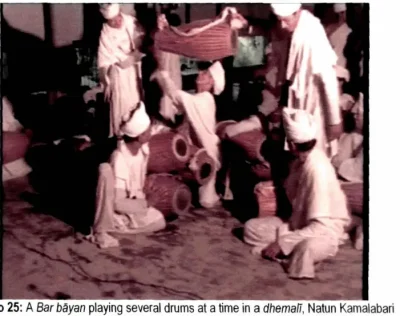
- Gyan – Bayan – The gayans (singers) and bayans (instrumentalists) are the specialised abbots of the satras entrusted with the duty of performing and teaching the aforementioned arts. They not only execute the various objects on occasion, but they also pass on their knowledge to the younger learning bhakats. A group of performers is sometimes referred to as a gayan-bayan. Senior gurus who attain higher perfection are referred to as barbayan and bargayan. They held high-ranking roles both inside and outside the satras.\
(Courtesy of SodhGanga)
- Khanikars – The khanikars of the satras were the people in charge of carrying out various visual arts and craftsmanship operations. They were varied artists with abilities such as painting, cane and bamboo work, wood carving, mask creation, and so on.
- Mati Akhora – The Mati Akhora is a stage that prepares the body for other dance forms by using yogic postures that are specifically matched with dances that are commonly done by children. In Bharat’s Natyashastra, the Mati Akhora practised in Majuli Satras is known as Karan. There are 108 karans in Bharat’s shastra and 70 postures in Mati Akhora.
- Oral Tradition – Aside from the many performing and visual arts listed above, Satras are extremely rich repositories of verbal arts, which include myths, stories, tales, proverbs, and riddles. Also known as Oral Literature or Folk Literature, these things are distinguished by their transmission from one generation to the next through oral-aural performances. Many such oral narratives are passed down to devotees within satras. There are tales about various gods and goddesses and their divine activities, as well as traditions about bygone gurus and their remarkable powers. How did a specific satra get its name? How did a certain musical instrument come to be? How did a certain räga (tune) come to be? All of these questions have answers in the form of interesting and explanatory narratives.
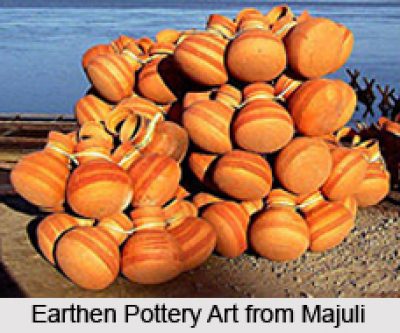
- Salmora pottery tradition – Salmora, a terracotta village, is another major location in Majuli with an invaluable living tradition. Salmora village is well-known for its centuries-old terracotta business, which is run by the Kumars, who are mostly from the Kalita and Koch families. Terracotta craft is also commonly done in Dhubri, particularly in Asharikandi village, Goalpara, and Kamrup. The Kumar family are thought to have been established in Salmora by the Ahom Kings to ensure the supply of clay products to the Satras who enjoyed royal patronage. The Kumars of Salmora hamlet make a variety of household containers and toys shaped like animals and humans. The women are normally in charge of constructing the terracotta objects, while the males are in charge of digging out the clay, firing, and selling the products.
The tedious procedure of terracotta craft production is divided into several stages, beginning with the collection of clay (Kumar Mati) and ending with the firing of the finished goods.[1] Those are:
- First stage – The first stage of clay collection is known as Khani-Diya.
- Second stage – The second stage is the Mati-Sijuwa phase, in which the clay is combined with sand.
- Third stage – Kholani Diya is the third phase, in which the clay and sand combination is given diverse shapes.
- Fourth stage – Peghali Diya, the final stage of the manufacturing process, denotes the act of burning the items. The firing process takes around eight hours to complete.
(Courtesy: https://www.indianetzone.com/4/majuli.htm#google_vignette)
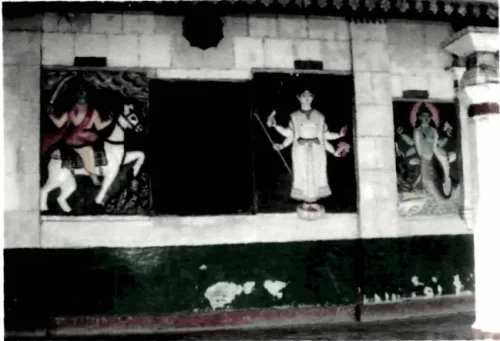
- Wood carving – Images of gods, wooden asana (pedestals) inside the manikița, sarai (platter on a stand), and thogi (platter for preserving the Bhagavata) are among the wood carvings in the satras. Among the various godly depictions, the Garuda kneeling with folded hands is the most common. Other figures of this type are dvarpala (gatekeepers), Hanuman, Jaya-Bijaya, and others. Such works frequently feature the use of colours and paints, and in certain cases, the use of ivory and metal. Aside from these pieces, wood-carving specimens can also be seen on the perforated jalis on the walls of the kirtan-ghar.
Woodwork on the wall of Kirtan-ghar (Dakhinpat Satra)
(Courtesy of SodhGanga)
- Woodcraft – Cane, bamboo, and pith work is prevalent throughout Assam. Certain Majuli satras are noted for producing bicanis (hand fan), kath (mat), and other items. Satriya artistry has earned distinction for the creation of mukhas (masks) used in bhaona and ras-lila performances. Masks are created to personify both human and animal characters. They are constructed from bamboo skeletons that have been plastered with mud and textiles. They are then painted with colours prepared locally, such as herngul (vermilion), haital (yellow), nil (blue), and so on.
- Basketry tradition – basketry tradition includes baskets such as bisani, dhara, pati, pasi, kharahi, saloni, akashbanti.
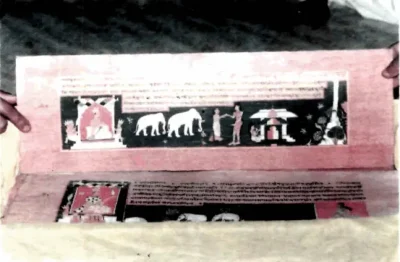
- Manuscripts and paintings – The Satriya painting can be seen in painted manuscripts and other painted embellishments such as the kirtan-ghar, manikuta, and hatis walls and ceilings. These decorations include painted representations of creepers, floral themes, gods, animals, birds, mythological creatures, and so on. A significant tradition in the satras is the fabrication and illustration of manuscripts made of saci-pat, folios created from the bark of the Saci tree (Acquilaria Agallocha), and tula-pat, ginned and pressed cotton into flat sheets. These manuscripts include colourfully drawn paintings alongside their words. Local stylizations are used to paint human characters from epics, animals, palace interiors, outdoor landscapes, and so on. All manuscripts are not illustrated, and the tradition of manuscript painting has been discovered to be extinct. Anadi Patan (Camaguri Satra), Sundarakanda Ramayana (Bengena ati Satra), Bhakti Ratnavali (Kamalabari Satra), Hastvidyarnava (Auniati Satra), and Bhagavata XI (Dakhinpat Satra) are some of the notable illustrated manuscripts discovered in the Majuli satras.
(Courtesy of SodhGanga)
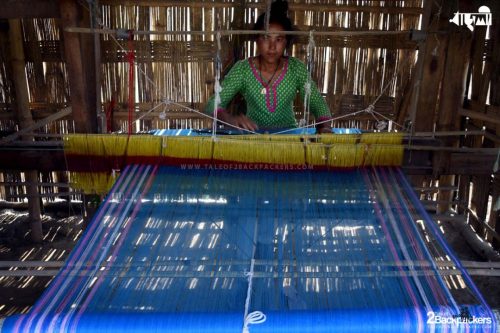
- Weaving tradition – Mising women are very skilled weavers. They make vibrant and intricately designed fabrics on looms that appear to be basic. Traditional female apparel, scarves made of end silk, draperies, shawls, bags, and other textile products are produced by them. These are frequently illustrated in vibrant colours and decorated with human figures, flowers, butterflies, and geometric patterns.
(Courtesy: https://www.taleof2backpackers.com/majuli-travel-guide/)
- Bell metal work – Some well-known works are Sarai, borbata, bankhai, banbati, dunari.
- Festivals – Majuli, as the land of Satras, has treasured its rich cultural life from the mediaeval ages, and the inhabitants of the land are inextricably linked with religion, particularly Vaisnavism and the Satras of the region. Almost all customs, functions, and festivals are overseen by the Satras, and even Bihu, a secular festival, is co-organized and planned by the inmates. Palnam, Ras-Lila, Janmashtami, Barsik-Bhaona, and Bihu are the most well-known.[1]
- Ras Lila – Ras Lila, also known as Krishna Lila, is a one-of-a-kind traditional performing art form in Majuli, India. It uses music and dance to portray the story of Lord Krishna’s life, inspiring spectators and the spiritual lives of the Satra community. Raslila, founded by Srimanta Sankardeva, is an annual festival held on the Purnima full moon day between October and November. Various artefacts, musical instruments, music, dance, masks, and paintings are used in the performance to create an atmosphere of Assamese classical music and dance.
- Phalgutsav yatra – The Hindu festival Phalgutsav originated in Sankardeva’s birthplace of Bardowa ‘Than’, Barpeta Satra. The event, also known as dual-Yatra, takes place in February and March. Lord Krishna is said to have played with colours with followers and associates in his birthplace Gokula. The celebration consists of a raucous parade of Lord Krishna’s idol inside a temple-like dwelling, which is attended by the Satra and community. Natives make prayers and sacrifices while playing colours during the parade. The writings of Sankardeva and Madhavadeva’s recounting of the event are important components of the celebration.
- Barsik-Bhaona – The Vaisnavite festival commemorates annual theatre performances centred on the life of Lord Krishna. Following Bhagwata’s prayer reading and Maha-prasad distribution, the festivity begins. The Vaisnavite theatrical performance, Bhaona, contains numerous musical instruments like flute, harmonica, manjira, and ‘Khol’. Except for a few tribes, the event is held between May and June, with flexibility in April or July, and is eagerly attended by all native people in every hamlet.
- Bihu – Bihu, the National festival of Assam, is celebrated three times a year, including Bohag Bihu (Rangali Bihu) in April, Kati Bihu in October, and Magh Bihu in January. Bohag Bihu is the most popular, observed by all casts and religions of Assam with passion. It is a Secular festival, with a touch of Vaisnavism. The festival begins with the Sacred Bath (Snan), followed by cow feeding, recitation of verses and prose from religious scriptures, and performance of Bihu songs and dance. Magh Bihu is celebrated on the day of ‘Makar Sankranti’ or Sankranti, which is the close of the season of harvesting winter crops, mainly bao and Sali, and the availability of food items like milk, curd, butter, rice, fish, vegetables, fruits, gur, nuts, and spices. After harvesting, the festival is celebrated with refreshments and nourishments, including Pitha, a delicious edible.[2]
- Musical instruments – Khol (drum) and tāl (cymbals) are the primary musical instruments of Satrīyā music which are most frequently used. There are varied tāls of different sizes and names. Other musical instruments are tokārī (a stringed instrument), ghanta (bell), kanh (gong), dabā (a variety of big drum), negera (kettle drums), śaikha (conch), kālī (long pipes), etc.[3]
Traditional Transportation
Majuli is a small island in a river. There are no taxis, buses, or vehicles available for travel in Majuli. Tourists must rely on boats to explore the island and river. Majuli Island is culturally diverse, mostly rural, and home to traditional arts, skills, and practises. Among all of these traditional talents, boat building stands out. Boat building expertise of some Majuli groups is regarded as a living heritage because they have retained this art since the time of Ahom dominance and continue to practise it today. This living tradition, also known as “intangible cultural heritage” or “living culture,” surely supplies Majuli villages with a “sense of identity”–identity as boat builders. Majuli is the world’s largest inhabited river-made island. The Majuli residents rely heavily on their boats. Majuli is famous for its boat-building industry. Some island residents build boats for a living. Salmora, Dakhinpat, and Bargaya in Majuli are well-known for their boat-building business. The boat-making industry is especially well-known in the Auniati, Natun Kamalabari, and Bhogpur Satras. Majuli has a lot of promise for the boat-building sector.[4] It is also home to several agro-based companies, including a rice mill, a mustard seed oil mill, and a wheat mill. Water transport is the district’s most important viable and economical mode of transportation. During the monsoon season, this industry is critical for meeting the need for boats as a mode of communication. Every home in the Salmora region relies on the boat manufacturing industry for a living, every house is built on water and every household owns a boat. They also built larger vessels to transport their pottery to different states. Boating as a form of recreation in the attractive wetland ecosystems should be considered by the Tourism Department to develop these as tourist attractions, which will benefit the local economies.
Problems and Threats
- Natural Threats –
- Earthquakes create havoc for the island – The Brahmaputra valley has been subjected to several earthquakes and floods due to its location in the seismic zone between the Himalayan and Patkai-Naga-Arakan belts. According to historical documents, the Brahmaputra was positioned north of Majuli in the 17th century. Due to earthquakes, the Brahmaputra River migrated southward, resulting in a flood in 1735. The Subansiri River channel shifted 6.5 kilometres due to the catastrophic flood of 1950. Western Majuli has been damaged by the Brahmaputra’s living channels, causing it to divide into fragments, including the Ahotguri Mouza and a large section of southeast Majuli.
- Erosion and shrinking of the island – Due to heavy water currents, the River Bramhaputra and its tributaries have been migrating southward, causing serious soil erosion. The peculiar environmental setting of the eastern Himalayas, strong monsoon regime, weak geological formations, quick channel aggradations, vast deforestation, and intensive land use pressure enhances this erosion, culminating in bank cutting and engulfment of nearby settlements. During floods, the oscillatory behaviour of the Brahmaputra and its tributaries causes bank erosion, leading human settlement centres to relocate. Majuli, an Indian region, has reduced from 1,245 square kilometres in 1950 to 552.65 square kilometres in 2005, with an average annual loss of landmass of around 12.59 square kilometres. The erosion problem has gotten worse, resulting in new depositions and blown-off land, affecting nearly 3000 families.[5]
- Social and Cultural Problems – Traditional societies in Majuli have seen substantial changes because of urbanisation, industrialization, and modernity. These elements, when combined with the influence of Western markets, have resulted in the loss of knowledge, values, conventions, and practices related to arts, crafts, performances, and creative activities. These changes are not restricted to Majuli but are pertinent to Assamese society as a whole. Majuli’s many traditional cultures, which include satras and tribal and non-tribal domains, are evolving to meet the demands of an increasingly technocratic and market-oriented society. Despite considerable modifications in traditional traits, Majuli’s distinct traditions have survived due to the island’s physical isolation and strong institutionalised systems. Local awareness and visitor exposure have aided in the preservation of these distinguishing features. A comprehensive conservation policy, on the other hand, cannot undermine the social dynamics of the region, assuring the preservation of the island’s rich heritage.[6]
- Economic problems – Between 1950 and 2016, Majuli, an Indian rural island, saw severe land loss, with the river claiming 107 of the 210 Cadastral Villages. This has resulted in a severe decrease in the island’s agricultural community, prompting many inhabitants to leave the island, either as agriculturalists in other districts, to seek work in industrial centres, or to become refugees on their own land. Internally Displaced People (IDPs), typically in squatter settlements, find work as agricultural labourers under an agreement in which the labourers are paid half of the land’s produce and the owner keeps the other half. This agreement provides a source of income but is insecure because the landowner can terminate the labourers at any time.[7]
Conclusion
Majuli Island stands as one of the most remarkable confluences of nature and culture in the Indian subcontinent. Its riverine geography, which both defines and threatens its existence, has shaped a civilisation of extraordinary depth from the spiritual grandeur of its Satras and the vibrancy of Sattriya dance to the quiet mastery of its weavers, potters, and boat-builders. The island’s tangible and intangible heritage are inseparable from the lives of its people, making it a living cultural landscape rather than simply a geographical formation.
Yet Majuli is under existential pressure. Erosion, seismic activity, and the broader forces of economic and cultural change threaten to erode not just its physical landmass but the traditions that have made it unique. Protecting Majuli’s heritage requires a combination of environmental intervention, community engagement, and cultural documentation that honours the people who have carried these traditions across generations. The story of Majuli is, ultimately, the story of resilience — of an island and its people that have survived flood and earthquake, and continue to create, perform, and believe.
References
- Amal Burman, Madhumita Roy and Arpan Dasgupta. 2020. “Vernacular architecture of Majuli, Assam – meaning, model and metaphor in integrating the environmental, socio- economic and cultural realms.” July 07: 12. https://docslib.org/doc/4671828/vernacular-architecture-of-majuli-assam-meaning-model-and-metaphor-in-integrating-the-environmental-socio-economic-and-cultural-realms-1-amal-barman-2-dr.n.d. “Art and Culture of Majuli: History and Growth.” Qub.ac. Accessed November 23, 2023. https://www.qub.ac.uk/Research/GRI/mitchell-institute/FileStore/Filetoupload,896396,en.pdf.
- B. K. Pandey, Yogesh Chandra Tripathi and Prosanta Hazarika. 2010. “REPORT ON BIODIVERSITY AND BIORESOURCES OF MAJULI ISLAND.” Rain Forest Research Institute, Assam, 112. https://www.researchgate.net/publication/361409962_Report_on_Biodiversity_and_Bioresources_of_Majuli_Island.
- Das, Bikash. 2017. “An overview of the economic condition of Majuli, the largest inhabited river island of the world.” International Journal of Interdisciplinary and Multidisciplinary Studies. 04: 06. https://www.ijims.com/uploads/5fe8a179724153d066a811bikashdas.pdf.
- Dey, Debasish. 2021. “Living Heritage and Ethnographic Practices of Boat Builders in Majuli Island, Assam.” Heritage: Journal of Multidisciplinary Studies in Archaeology 9: 32. http://heritageuniversityofkerala.com/JournalPDF/Volume9/64.pdf.
- IndiaNetZone. n.d. “Vaishnavite Culture of Majuli.”
- https://www.indianetzone.com/81/vaishnavite_culture_majuli.htm#:~:text=Majuli%20is%20the%20hub%20of%20the%20Neo%20Vaishnavite,several%20monasteries%20in%20Majuli%2C%20which%20are%20called%20Satras. n.d. “Majuli.” City Population. https://www.citypopulation.de/en/india/admin/assam/760__majuli/.
- Majuli and the “satras”. https://steppingoutofbabylon.com/en/2016/08/majuli-and-the-satras/. n.d. Majuli: Melange of Culture Amidst the Brahmaputra. Accessed November 23, 2023. https://indianculture.gov.in/stories/majuli-melange-culture-amidst-brahmaputra.
- MATI AKHORA – Performance at Uttar Kamalabari Satra in Majuli Island, Assam. September 06. https://www.youtube.com/watch?v=7bWqoXSnTqY.
- Nayyar, Sanjeev. 2019. Majuli Satras and Landscape. https://www.esamskriti.com/a/Assam/Majuli-Satras-and-Landscape.aspx.Puppets of India: Putala Nach from Assam. October 25. https://www.sahapedia.org/puppets-of-india-putala-nach-assam-0.Rajkhowa, Tulashi.
- 2021. “A STUDY ON BIODIVERSITY AND ITS CONSERVATION IN MAJULI.” International Journal of Creative Research Thoughts 11. https://ijcrt.org/papers/IJCRT2110301.pdf.
- Ronaldo, Y. Wee. 2015. “Majuli: Massive River Island of the Brahmaputra.” April 25. https://www.worldatlas.com/articles/majuli-massive-river-island-of-the-brahmaputra.html.
- Roy, Avijit Sahay and Nikhil. 2016. “Shrinking Space and Expanding Population: Socioeconomic Impacts of Majuli’s Changing Geography.” Focus on Geography. American Geographical Society. doi:10.21690/foge/2016.60.3f.
- Sharma, Angshuman. 2022. “THE TRADITIONAL MASK MAKING PROCESS OF NATUN CHAMAGURI SATTRA, MAJULI: A PEEP INTO THE ECONOMIC BASIS.” July: 10.
- https://www.researchgate.net/publication/362246071_THE_TRADITIONAL_MASK_MAKING_PROCESS_OF_NATUN_CHAMAGURI_SATTRA_MAJULI_A_PEEP_INTO_THE_ECONOMIC_BASIS.
- Singha, Drhubhajyoti Sahariah and Kuleswar. 2002. “Majuli at the Crossroads: A Study of Cultural Geomorphology.” (Space and Culture, India.) 2: 12 – 20. doi:http://dx.doi.org/10.20896/saci.v1i2.26.
- “SodhGanga.” INFLIBNET. http://hdl.handle.net/10603/97356.
- Talukdar, Sushanta. 2010. “Dance of the Monks.” Frontline. September 24.
- https://frontline.thehindu.com/other/article30181832.ece.
This document is the result of independent research conducted by Vaishali Shakya and is based entirely on secondary sources, including books, research articles, and published materials. The author did not undertake a field visit to the site during the course of this study.
Trip and Tales sincerely thanks Vaishali Shakya for permitting the publication of her work for the benefit of readers and heritage enthusiasts.