
Lucknow's Forgotten Club
Rifa-e-Aam
by
Ananya Asthana
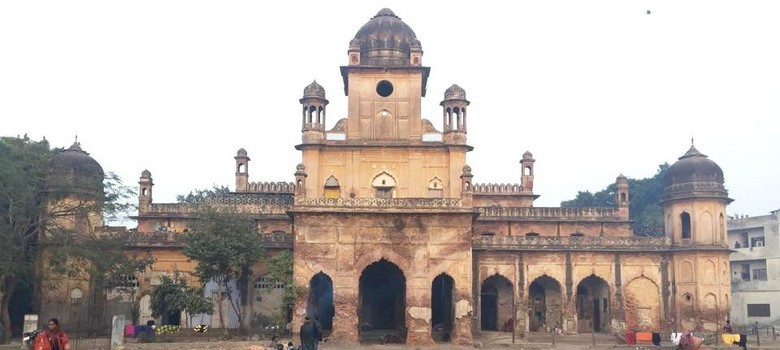
Tucked behind a fleet of buses in the middle of a ground in the densely packed built fabric of Golaganj area in Lucknow stands a beautiful yet melancholy monument. One look at the structure and you know that it is not an ordinary building. You would look around for an information board or any signboard indicating its protection status but you wouldn’t find any because why would a protected heritage site be in this condition. But why would a private owner leave such a huge structure abandoned. Then whose heritage is it?
The lakhori bricks peeping from portions of broken plaster, algae covered blackened domes, and disfigured chhatris narrate a sad story quite ironically for a building named “Rifa-e-Aam”. In Urdu language, Rifa means happiness and aam means common, which means Rifa-e-Aam literally translates to Happiness of the Common People.
The architecture of the building has a borrowed vocabulary of the European along with Mughal and Rajputana architectural elements, with its characteristic domes, chhatris and multi-foliated arched corridors. Remains of the original Burma teakwood flooring in the hall and green and red terrazzo flooring can still be seen. The simple rectangular planning has translated into a dynamic elevation due to the terraces at different levels.
The origins of Rifa-e-Aam remains debated till date. The earliest mention is of Rifa-e-Aam being a charitable trust started by Nawab Asaf ud Daula during the construction of Bara Imambara for the welfare of the people. During the reign of Nawab Nasir ud din Haider a similar trust was set up to distribute alms and funds among the poor. But the mention of a Rifa-e-Aam Club only comes up in the late nineteenth century.
The most popular story goes that during the British rule in Lucknow, once a Taluqdar was mistreated and denied entry into a British Club on the basis of his attire. The Taluqdar took this humiliation so personally that he built a Club which would go on to become one of the earliest Public Buildings in Lucknow as well as the first Club exclusively for Indians during the British rule in Lucknow, a time when slogans of ‘Dogs and Indians not allowed’ were hung outside British Clubs, restaurants and streets.
The club soon became the hub for cultural and recreational activities of the Lucknow elite, who would gather here for parties and discuss politics, art and literature. In 1912, the Club was patronized by the great writer Munshi Premchand who started a literary club here and later it also became the site where The Progressive Writers Association was established on 10th April 1936 under the leadership of Sajjad Zahir and Ahmed Ali. It became the hub for writers and poets who would collect here to exchange ideas and thoughts regarding the nationalist movement and fought the freedom struggle with their revolutionary writing.
The Club represented the voice of dissent and revolution against the British rule, Rifa-e-Aam has hosted and witnessed numerous political meetings and gatherings. It was in this very Club where the historic Lucknow Pact was signed between the All India Muslim League and Indian National Congress in 1916, in the presence of Mohammed Ali Jinnah and Mahatma Gandhi. Mahatma Gandhi again visited the building to give a speech on Hindu-Muslim unity on 15 October 1920 and on 26 April 1922 Jawaharlal Nehru and Vallabhbhai Patel made speeches at the club encouraging local people to intensify the Swadeshi Movement.
For a few decades after the independence the Club continued to be a hub for artists, writers and performers who would collect here for rehearsals and practices. Slowly the Club members got disintegrated and the structure was left abandoned. Soon it fell prey to illegal and anti-social activities which eventually caught the Government’s attention. Several attempts and proposals by authorities and a stay order later, the structure today still lies abandoned, disputed, unprotected and partly encroached. The ground in front of the structure serves as a private bus stand, a workshop for wooden doors and windows and a marriage lawn in the wedding season.
The condition and negligence of Rifa-e-Aam today represents the bias and politicization of heritage in today’s day and age. No direct gains in the vote bank and absence of any religious association could be a reason why a secular public building of such high historic importance lies in shambles today. A ray of hope for the Club came when it made it to one of the many proposals of the Smart City Mission for Lucknow which suggests it be restored and reused as a Community Club under the supervision of the Municipal Corporation.
The adaptive reuse of Rifa-e-Aam Club as a Community Club is almost a literal reinterpretation of it in the modern times but lacks in matching up to the spirit and the social relevance of it. The Club may have started as a recreational hub for the elite of the city to indulge in camaraderie, but Rifa-e-Aam stands for much more than just that. It has represented the voice of revolution and rebellion, a place that harboured revolutionary thoughts and ideas, witnessed many iconic historic moments of the freedom struggle, was the birthplace of some the most influential writing movements in the field of literature and also provided a platform to voice the woes and plights of the common man. Rifa-e-Aam was a platform for dissent.
The story of Rifa-e-Aam is not a well written one and definitely not a popular one amongst the locals as most of the Lucknowites are unaware of the glorious past of this structure. Heritage conservation is not just about conserving the monument but also preserving its history and legacy. Lucknow doesn’t need another Golf Club or a Rotary Club, what it needs is a Jantar Mantar; a place where people can gather and voice their opinions, a place where they can voice their dissent. A place where people can come and read about the freedom movement in Lucknow, pay homage to the legacy of Munshi Premchand and many other revolutionaries and moreover where people would be told about the story of the life and times of Rifa e Aam.
While the optimist in me is hopeful that probably this time things will look up but the pessimist in me fears that it would remain one among the many attempts to save this valuable structure. Well, I’ll let the optimist in me win this argument one more time and keep hoping that one day the lost glory and splendour of Rifa-e-Aam Club will not only be restored to its original magnificence but its story will outreach every citizen of the city who would proudly call themselves the custodians of this heritage.
References:
• Jones, R. L. (1985). A Fatal Friendship: The Nawabs, the British and the City of Lucknow . Oxford University Press.
• Mishra, A. (1998). Lucknow; A Fire of Grace. HarperCollins Publishers India.
• Taqui, R. (2013). Lucknow Monuments; Conservation, Methodology, Problems and Solutions. New Royal Book Company.
• Stark, U. (2007). An Empire of Books: The Naval Kishore Press and the Diffusion of the Printed Word in Colonial India. Permanent Black.
• Uttar Pradesh District Gazetteers Vol XXXVII. In V. C. Sharma. Government of Uttar Pradesh.
• Tandan, B. (2001). The Architecture of Lucknow and its Dependencies, 1722-1856. Vikas Publishing House Pvt. Ltd.
The documentation presented here is the result of independent field study conducted by Ananya Asthana. All rights to this work remain with the author and are published on Trip and Tales under her authorization. Trip and Tales holds no ownership over this content.
Trip and Tales sincerely thanks Ananya Asthana for permitting the publication of her work for the benefit of readers and heritage enthusiasts.