
Three Forsaken Sarais on the Old Grand Trunk Road in Punjab:
An Analysis
by
Pratibha Sharma
sharmapratibha220@gmail.com
Dept. of AIHC&A
Panjab University, Chandigarh
Abstract
Sarais or Caravansarais have been an integral part of public facilities for travellers along the major routes in the Indian subcontinent since the ancient period. The old Grand Trunk Road is one of world’s oldest and longest road that has linked Central Asia with the Indian subcontinent. Sarais were constructed all over the roadway and some of them are still extant today. Many sarais have become protected monuments and are developed into tourist spots, but others have been left abandoned. In this paper, three such sarais in Punjab, namely sarais at Rajpura, Sarai Banjara and Sultanpur Lodhi are discussed. Coordination with the local communities including
community archaeology initiatives is required for better preservation of our monuments and heritage.
Keywords: Sarais; Abandoned Monuments; Punjab heritage; Community Archaeology; Preserving heritage.
Introduction
A Sarai or a Caravanserai is an inn for caravans, merchants and their wares found in cities and along routes in most Islamic lands. It is usually a secure rectangular building with an open courtyard surrounded by stables, lodgings, and storerooms. Traditionally, massive gates
protected the entrance, which contained the porter’s room, and a space was reserved for a mosque1. In the Indian subcontinent, sarais have been a vital element of public facilities that provided shelter and rest for travellers along major routes. The sarais acted as well-supplied halting stations for travellers, merchants, and the armies. The establishment of sarais also gave the locals access to services and economic opportunities, which led to development of towns and cities around many sarais built in isolated places2. The sarais played an important role in the development of Punjab. They were often built by royal decree or by other patrons. Establishment of safe halting places on the major trade route allowed for better internal and external trade, and military campaigns. It helped in better movement of merchants, travellers, and the army. It led to development of the local economy at these stops and the growth of towns and cities along the trade routes. The sarais were a means of facilitating movement throughout the Mughal empire and were locations of economic interaction; thus, the production and control of these spaces became an act of economic control and power production3. It also enhanced the image and reputation of the emperors and stood as evidence of their pious nature for their people. For a merchant or trader, the sarai became an economic distribution centre and a marker on a journey of economic function, for an individual with political power, the sarai may become a revenue generator, for a pilgrim on a religious journey, the sarai become a sacred place of rest and prayer and for the local population, it may be a locus of unwanted and exploitative foreigners4. The activities carried out at the sarais, the functions of the sarais reflects the multiple roles of the sarai in political, economic, and social structures and how these were embedded with political, social, economic, and religious meaning.
The Grand Trunk Road has a long and continuous history. Panini, the sixth century B.C.E. grammarian, mentions the Uttarpatha that could correspond to the Grand Trunk Road5. According to Megasthenes, the Royal Road of the Mauryas used to run in eight stages from Purushupura (Peshawar) to Pataliputra in the 3rd century B.C.E6. Ashoka improved this by planting trees and digging wells along all roads7. The first specific reference to sarais is found during the reign of Muhammad bin Tughlaq (1324-1351 A.D.), who contracted sarais between Delhi and his capital Daulatabad8. Sher Shah Suri rebuilt the Royal Road of Chandragupta Maurya and realigned it with Sonargaon at Rohtas, widened it and constructed Sarais every two kos. It is said that Sher Shah Suri build 1700 sarais in the Indian subcontinent9. He is credited with the revival of the road and has become synonymous with the Grand Trunk Road today which is also known as the Sher Shah Suri Marg in certain areas. Mughals followed in the footsteps of their predecessors and further developed the system of having halting places along major routes. Jahangir in particular issued orders to construct sarais, mosques, wells, and bridges along the highways. He also built kos minars at every kos for direction and distance10. The British occupied Punjab in 1849 and spent the early years of their occupation on realigning the highway11. The new highway mostly followed the previous alignment and ran parallel to it at certain places.
Part of the Grand Truck Road, specifically the Agra- Lahore highway, passed through Punjab and acted as the gateway to India for centuries. It continued to play an important role for the Mughals. Lahore acted as the capital of the Mughals under Akbar from 1584-1598 AD. Jahangir was buried in Lahore and his son Shah Jahan was born in Lahore. The Royal Road from Agra to Lahore thus became one of the most essential routes for the Mughals and they extensively built and beautified it. Remnants of this highway including sarais, baolis, bridges and kos minars still exist in Punjab. There are monumental sarais like, Sarai of Nur Mahal, Doraha Sarai and Dakhni Sarai, that are beautiful masterpieces and are often considered the epitome of Mughal architecture. Apart from these well-known sarais, there are remains of various other sarais that were not as fortunate in their survival along the old GT road. These sarais have fallen victim to time and are unprotected. The author visited various sarais of Punjab along the old GT Road in 2023. The sarais of Punjab were previously surveyed by Subhash Parihar in 2007. Since then, their condition has changed and especially the sarais that are not protected by any authority have been left to crumble. In the present paper, three sarais at Rajpura, Sarai Banjara and Sultanpur Lodhi will be explored. These sarais are not protected monuments and have been crumbling away. These monuments are important remnants of our history and heritage and are in dire need of protection and preservation.
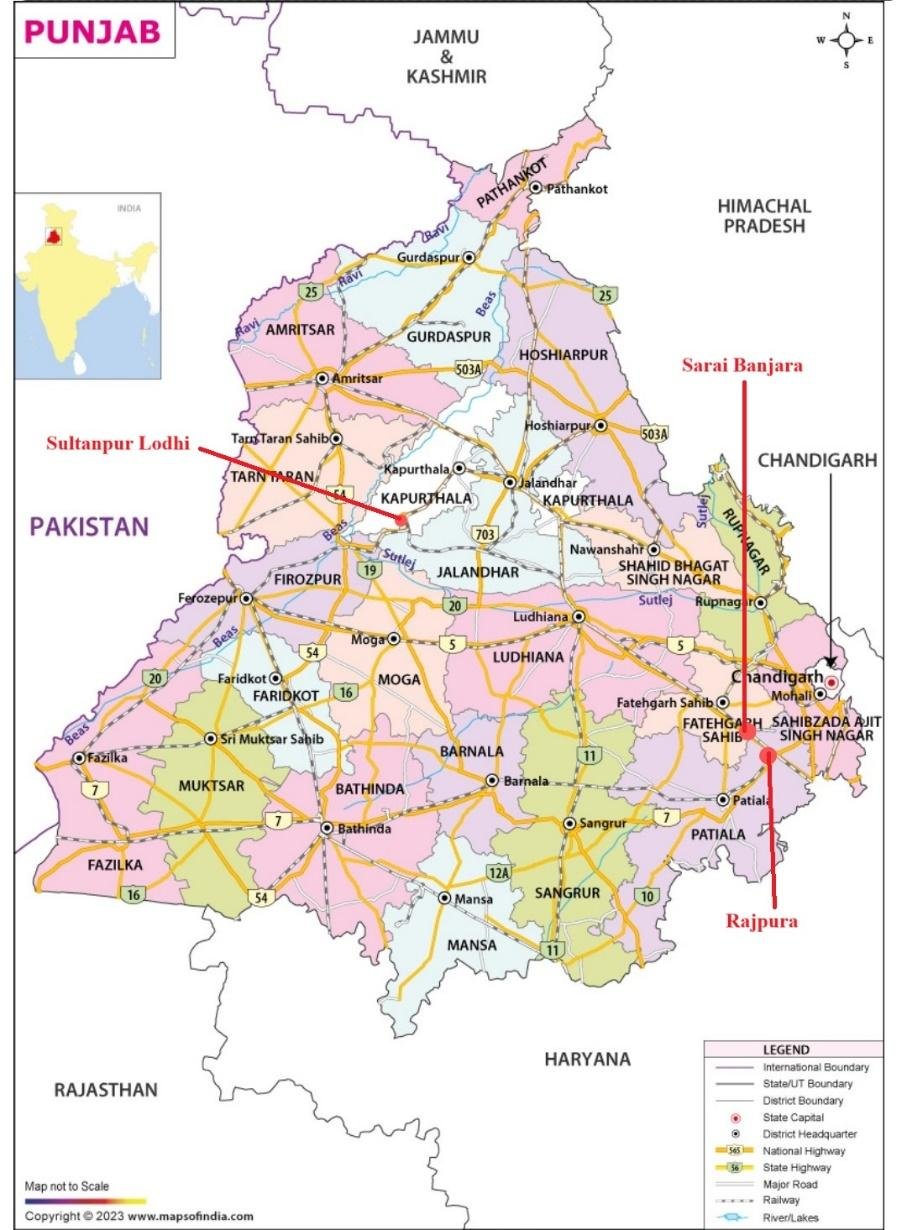
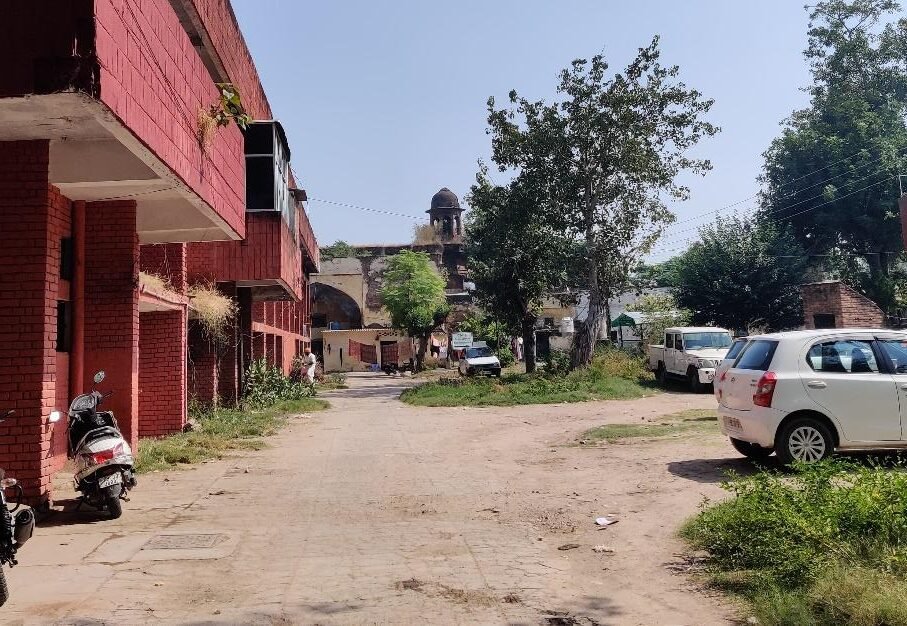
Sarai at Rajpura, Patiala
The sarai locally known as Sarai Raja Todar Mal is located near the bus stand at 30.484226, 76.595171 in Rajpura, Patiala. It follows the general sarai pattern and consists of a fortification wall measuring 142 x 132 m. around its periphery13. The eastern gateway has been bricked up and the western gateway opens to the courtyard. The gateway consists of octagonal bastions on each corner that are covered with a fluted dome, surmounted with an inverted lotus moulding. A large cusped arch forms the opening and the façade is panelled. The gateways have rooms arranged in two storeys and the western gateway has huge wooden doors. There are rows of twenty-six rooms with flat ceilings on each side of the courtyard, each room measuring 3 m sq. and has a 2.4 m. deep verandah in front. All the rooms of the sarai have alcoves in their walls14. There are no decorations in the sarai except for some soft stalactites on the soffit of the entrance arch. There are no inscriptions, but Parihar dates it to the reign of Shah Jahan or later based on architectural style15. There are references to this sarai as Raja Sarai and Sarai Hajjam Todar Mal in literature16. Raja Todar Mal was the Diwan of the sarkar of Sirhind, appointed during the thirteenth year of Shah Jahan’s reign in 1639 and died in 1665. If Raja Todar Mal was the patron of this sarai, it was built between 1639 and 166517. There is no protecting body for this sarai. The western gateway stands tall but parts of it have crumbled. There is overgrown vegetation around the fortification wall and people live within its enclosure. There is a dargah near its eastern gateway that has been bricked on and people have constructed structures all over the sarai courtyard. There are no information boards regarding the monument anywhere.
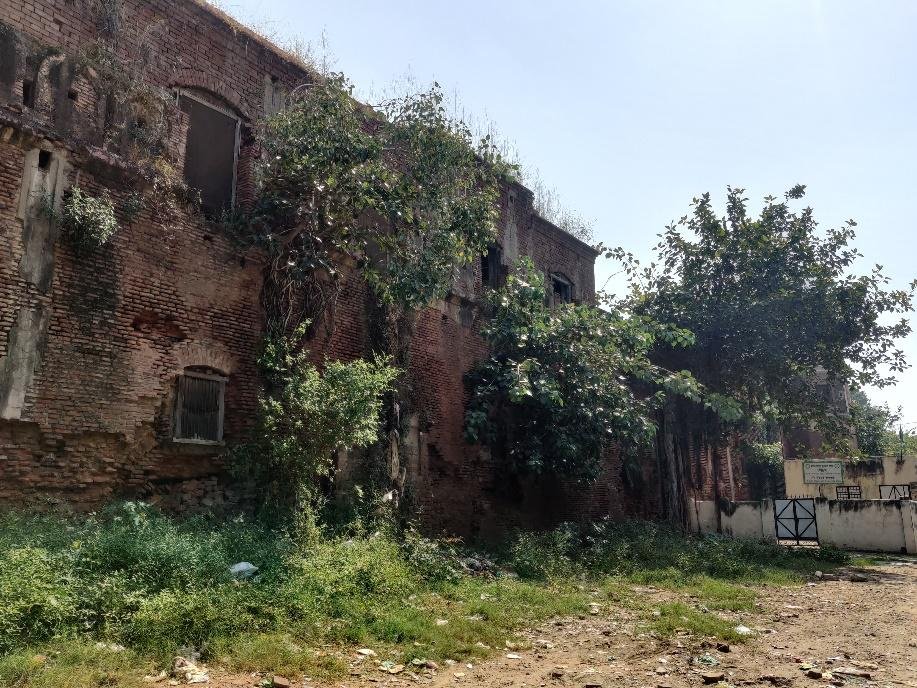
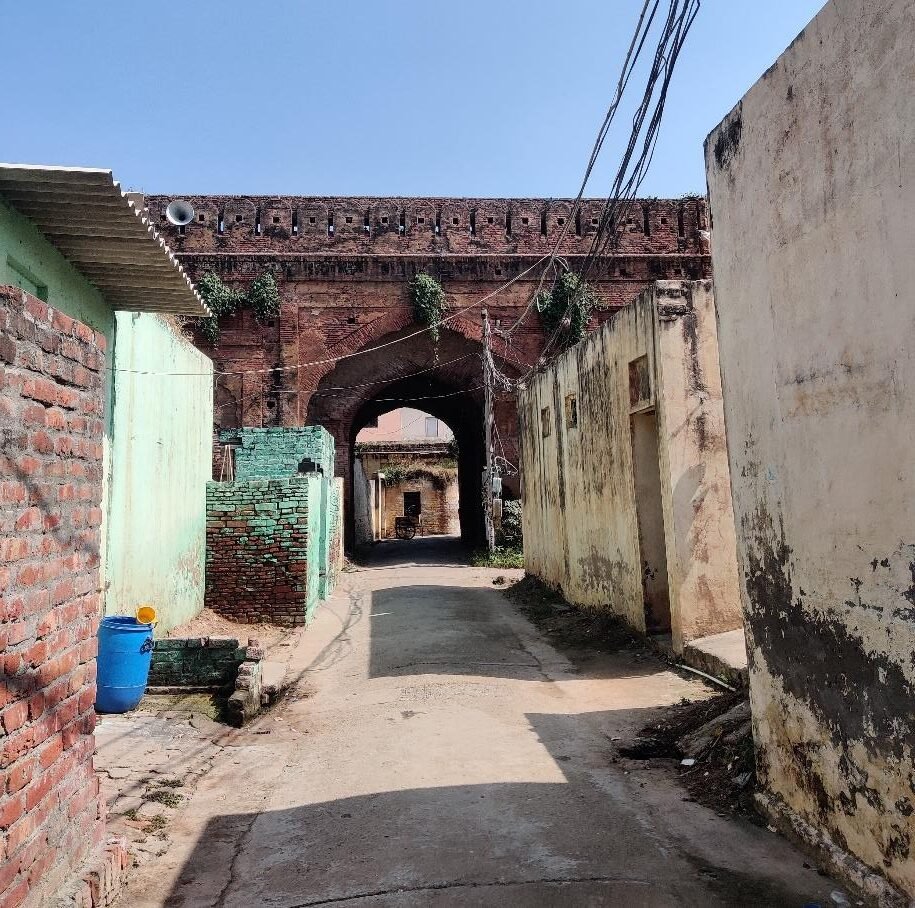
Sarai at Sarai Banjara, Fatehgarh Sahib
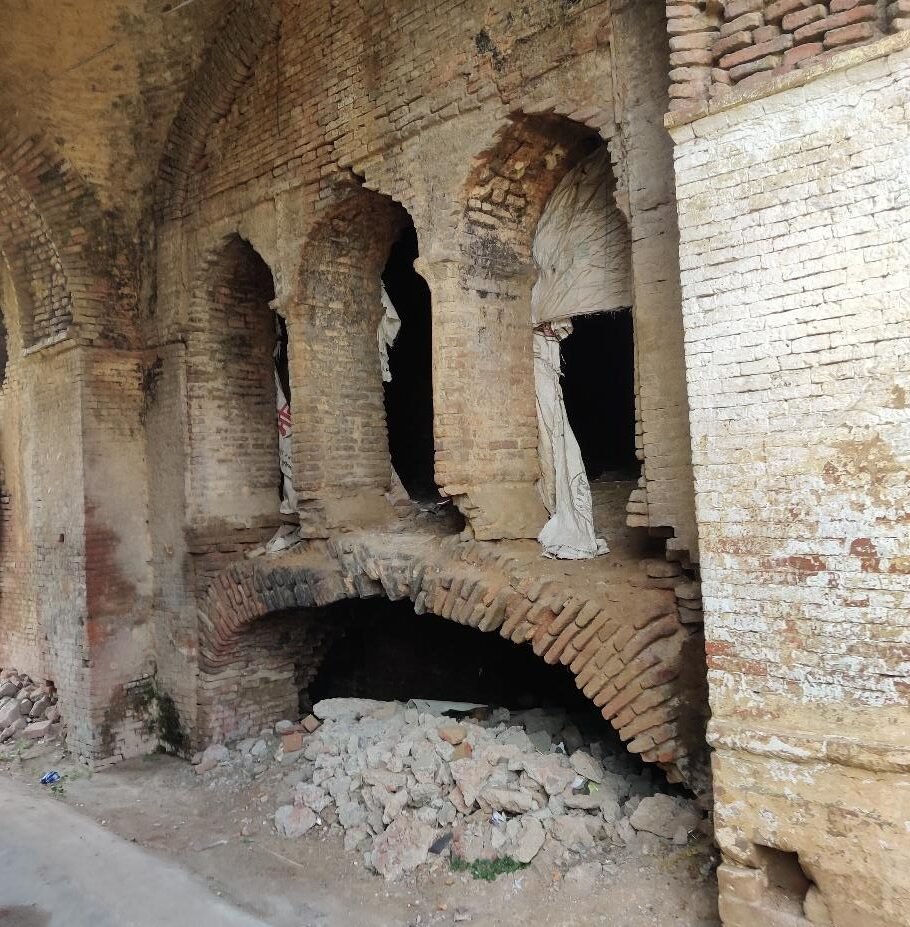
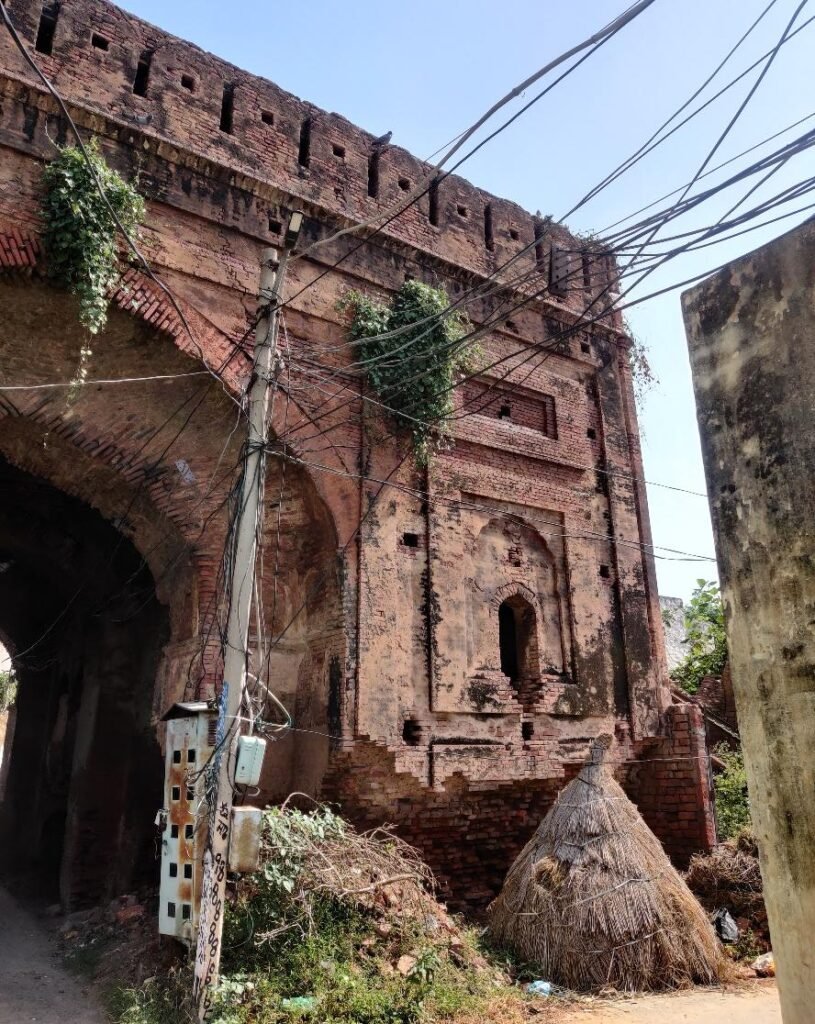
This sarai is located in the midst of the village Sarai Banjara at 30.542707, 76.519092. The gateway covers the plinth area of 13.1 m x 10.6 m and is 8.2 m. tall. The ground floor of the building has a 4.2 m broad passage entered under cusped arches and consists of verandah on each side19. The façade of the gateway was finished in fine brickwork having thin joints and an octagonal pilaster at each corner. The parapet of the gateway is marked with battlements. The mosque measures 8 m x 5.4 m outside and 6.8 m x 3.2 m inside20. A sarai at this location was referred as ‘Aluwa Sarai’ by Jahangir in 1606, 1621, Rai Chaturman in 1759. William Finch referred to it as ‘Hollowa Saray’ in 1611 and Mohan Lal referred to it as Sarai Banjara in 183121. Parihar dates the structure architecturally to late seventeenth or early eighteenth century and theorizes that there was probably a sarai here during the sixteenth- seventeenth century and later was reconstructed by some traders that gave it the name ‘Banjara’ that means trader.22 Only one of its gateways exist today and it is also crumbling down. People have constructed structures all around the gateway and there is vegetation on its back side. The inner chambers of the gateway are collapsing. There are no boards indicating the name and history of the structure. There was a mosque reported here by Parihar in 2007 but no such structure was noticed by the author during her visit in October 2023.
Sarai at Sultanpur Lodhi
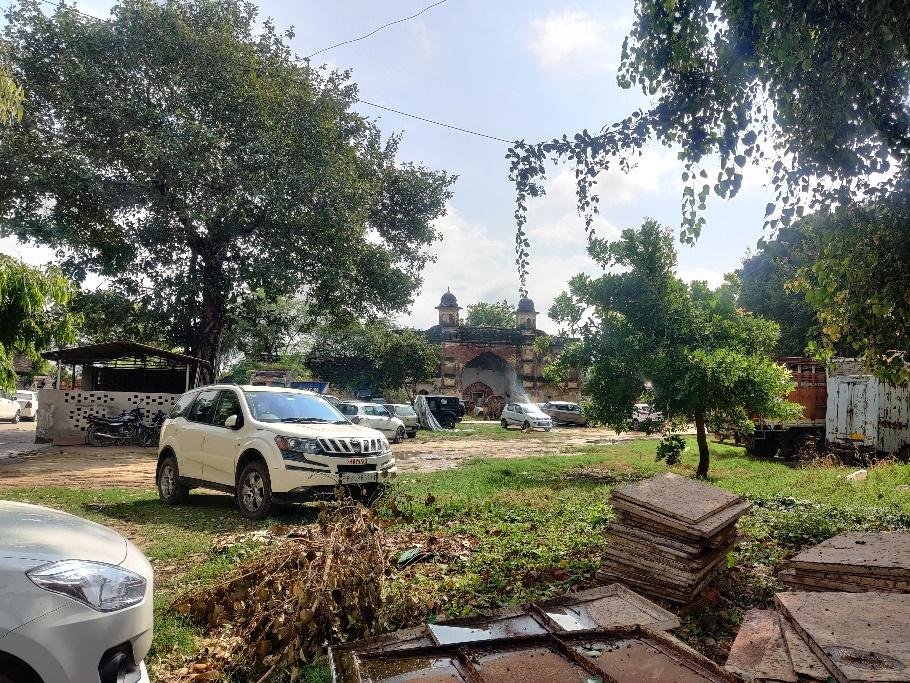
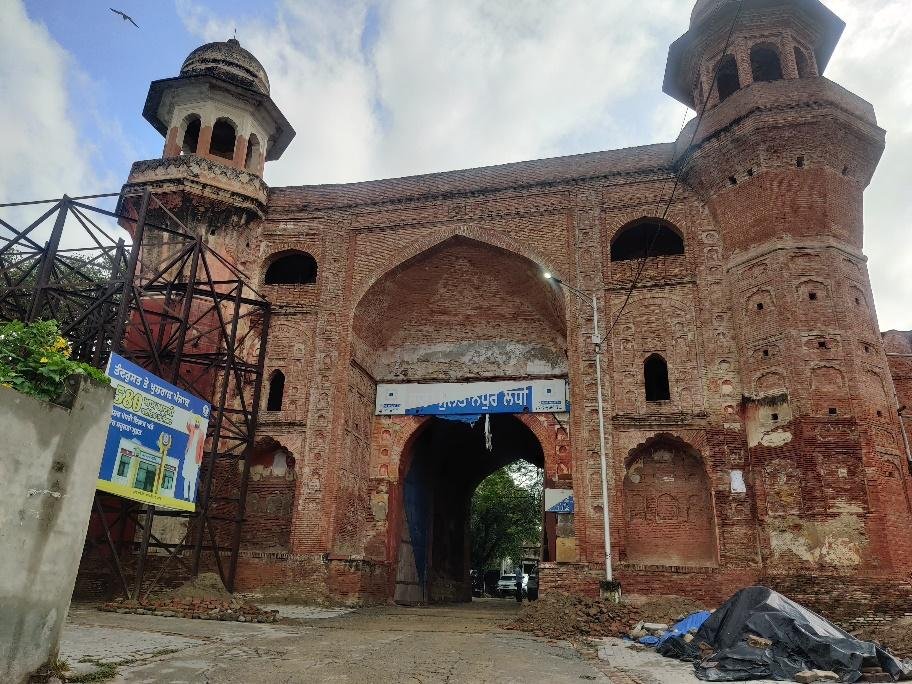
The sarai is located in the middle of the town at 31.214763, 75.190353. The sarai perimeter measures 149 x 147 m from outside and consists of an octagonal bastion of 2.2 m at every corner. Unlike most sarais, this sarai has only one gateway on its northern side. It measures 19.6 m across, 12.6 m deep and 11.6 m high up to the parapet. The entrance arch is 4.2 m broadand is set in a taller half- domes outer arch. Each corner of the gateway consists of an octagonal bastion of 1.2 m side that spreads out at the top forming a platform for the octagonal copula above23. The gateway consists of rooms of different sizes placed in three storeys. Each corner bastion consists of an octagonal chamber of 1.2 m side24. The mosque has a façade which is 13.7 m across with three archways, the central one being 1.6 m wide and the side ones one meter wide. The façade of the gateway has sunken panels of various shapes and sizes. The soffit of the entrance arch has moulded net patterns and panels of paintings depicting flowering plant and vase and flower motifs. There are some remains that indicate that the sunken panels were originally pained with design of bricks outlined with imitation mortar joints25. The sarai bears no inscription, Parihar however dates it to the reign of Shah Jahan or later based on its architectural similarities with Dakhni Sarai and Sarai Amanat Khan26. The sarai now hosts a police station and its gateway and the enclosing wall is currently undergoing some renovation. The gateway appears to be in decent condition but there are no boards indicating anyinformation about the sarai. Along with the police station, the area within the sarai acts as a parking and consists of a religious structure. The mosque is also currently undergoing some construction. There are various structures constructed within the sarai enclosure.
The sarais eventually fell out of use with the decline of the Mughal empire. Under the British, these monuments were rediscovered, and their histories were reclaimed. Sarai of Nur Mahal inPunjab in particular received greater scholarly attention. This sarai is one of its kind in its panelled decoration and use of red sandstone. It was built by empress Nur Jahan and reflects the authority and influence of the most powerful woman in Mughal history. This sarai along with others like Dakhni Sarai near Nakodar and Shambhu Sarai near Rajpura have been conserved and listed as protected monuments under the government of India. They have been beautified by constructing gardens inside the courtyard and have been developed for tourism. Sarais at Nur Mahal, Dakhni and Doraha lie near major cities of Ludhiana and Jalandhar and have become famous tourist spots. During the author’s visit to these sarais on 9 September 2023, they were bustling with tourists. Even though they lack information boards providing history and details on use of the sarais, they are visited and enjoyed by people, perhaps because of their monumental architecture, beautiful decorations, and peaceful gardens.
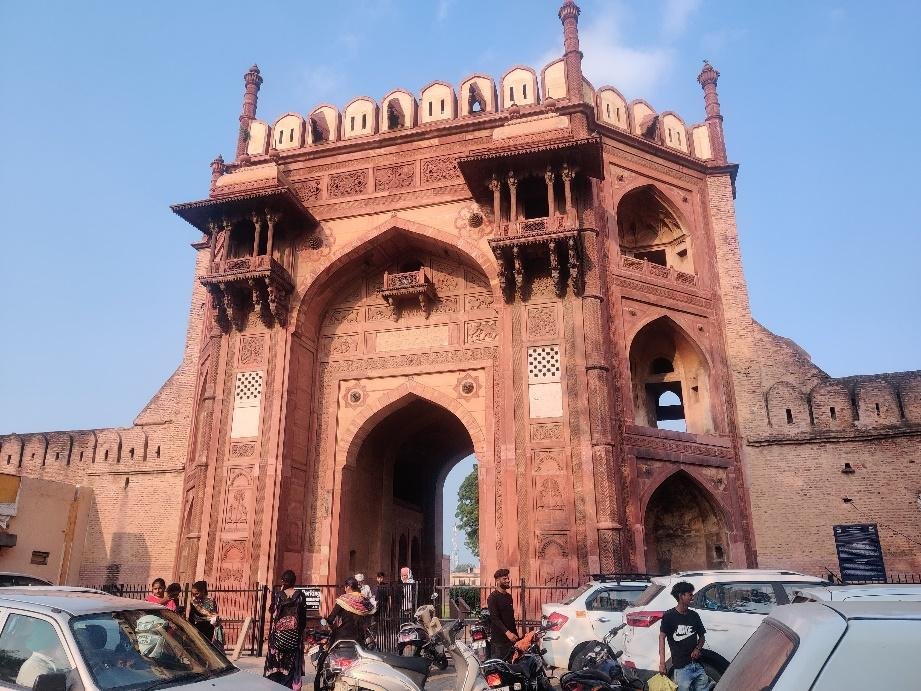
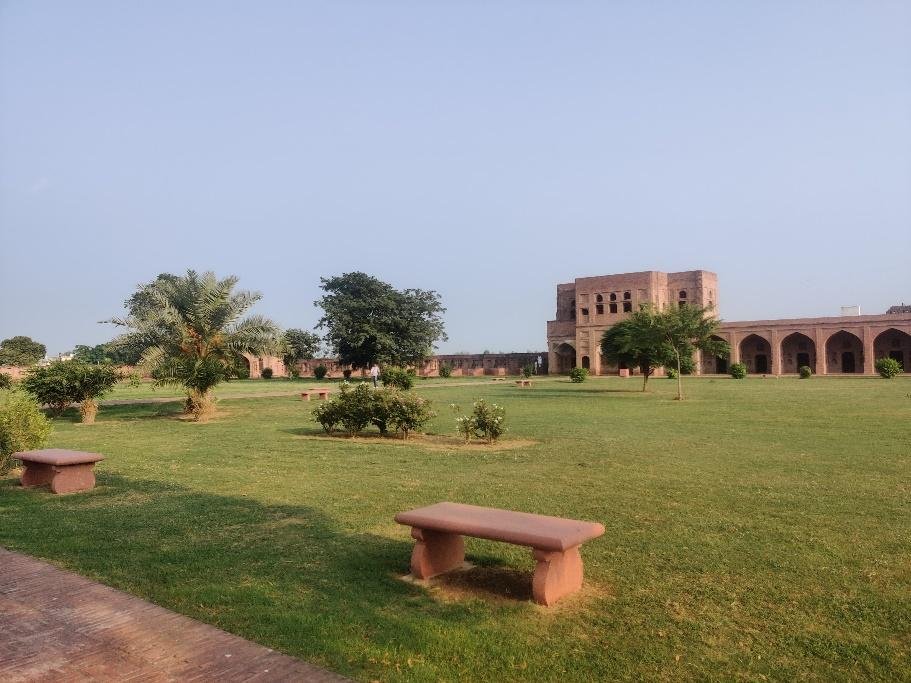
On the author’s visit to Rajpura sarai and Sarai Banjara on 13 October 2023 and Sultanpur Lodhi Sarai on 16 October 2023, it was clear that these monuments are not being protected by any authority. These monuments are left abandoned and with time have crumbled away. People have been constructing and living within the sarai enclosures at Rajpura and Sultanpur Lodhi, where portions of the sarai have been used as Tehsil court and Police Station respectively. Sarai Banjara was in the most degenerate condition, where only one of its gateways still stands and its walls are actively collapsing. These sarais, however unsightly today, are still part of our heritage. They are remnant of the historical importance of Punjab and the Grand Trunk Road, and its role in the development of Punjab as we know it today. They should be protected andpreserved before they collapse and cease to exist altogether. Even if these monuments cannot be beautified with elaborate gardens because of encroachment within the sarai complex, they can be renovated and maintained. Boundaries can be created at these sarais, separating the local population and the monuments to avoid causing any inconvenience to the locals. Information boards with historical facts about these monuments and the areas they are located in are required to provide basic information and reach a wider population. These sarais fall within a 90 minute range from Sarais at Nur Mahal and Doraha and big cities like Ludhiana, Jalandhar,and Amritsar. They can be developed into tourist spots and promoted specifically for their local history and traditions. It would create more economic avenues for the local people and could lead to overall development of the area. The locals can be involved to help preserving these monuments and continuing their legacy.
Community outreach programs aimed at educating people about the history and importance of sarais and their role in the regional history of Punjab can be organized. Locals can be trained to work as tour guides at these monuments. Workshops on conservation of monuments can be coordinated with professionals to involve the local community into the preservation of monuments specifically targeting the local artisans to create more employment opportunities.Educational school trips can be organised to foster knowledge about history and heritage into children from young age. Opportunities for adaptive reuse of monuments can be explored, where parts of historic building could be converted into cultural centres or museums, generating income for maintenance. Since neglect is the biggest reason behind deterioration of these monuments, a schedule for regular maintenance and cleaning can be developed by involving the locals with employment incentives. The local communities can serve as custodians, helping to maintain and protect the monuments by also generating employment opportunities and fostering a sense of responsibility among them.
These rest stops of the past are sites of historical importance, and it is our duty to protect them and preserve them for the future generation. If we do not interfere now, they will collapse and perish completely along with their history. There are various such abandoned monuments throughout the country. A more liberal attitude towards involvement of the community in preservation of monuments is required for better results. The public needs to be educated in a way that promotes embracing our heritage irrespective of religious inclination. We need to encourage a sense of ownership and pride amongst the local communities. By spreading awareness regarding importance of our shared history and the need to preserve it for the future generations, we can advocate for more support from the local communities, leading to better coordination and better preservation of our monuments. Preserving our monuments and heritage requires a concerted effort from government authorities, communities, and other stakeholders. It is only through collaboration and coordination among them that these invaluable cultural assets can be safeguarded for the future generations.
Notes and References
1 Jonathan M Bloom and Sheila S Blair, The Grove Encyclopaedia of Islamic Art and Architecture, Oxford University Press, New York, 2009, p 353.
2 S. R. Dhar, “Caravanserais Along the Grand Trunk Road in Pakistan: A Central Asian Legacy,” in Vadime Elisseeff (ed), The Silk Roads Highways of Culture and Commerce, UNESCO Publishing, Paris, 2000, pp 158-184.
3 Jennifer L. Campbell, Architecture and Identity: The Occupation. Use and Reuse of Mughal Caravanserais, PhD Thesis, University of Toronto, Toronto, 2011, p 6.
4 Ibid., p 25
5 V. S Agarwala, ‘Preface’, in Moti Chandra, Trade and Trade Routes in Ancient India, Abhinav Publications, New Delhi, 1977,
6 S. R. Dhar, Op cit., pp 158-184; J. W. Mcrindle, Ancient India as described by Megasthenes and Arrian, Trubner & co, London, 1877, pp 50, 86.
7 E. Hultzsch, Corpus Inscriptionum Indicarum Vol 1, Inscriptions of Ashoka, The Director General ASI, New Delhi, 1991, pp 2-5.
8 S. R. Dhar, Op cit., p 160.
9 Abbas Khan Serwani, ‘Tarikh-i-Sher Shah’, in H M Elliot and John Dowson (eds), History of India as told by its Historians, vol 4, Trubner & co, London, 1872, pp 417-18; S R Dhar, Op cit., p 161.
10 K. M. Sarkar, Op Cit., p 49; Alexander Rogers (tr), The Tuzuk-i-Jahangiri, Henry Beveridge (ed), Royal Asiatic Society, London, 1909, vol 1, pp 7-8; S. R. Dhar, Op cit., p 162.
11 S. R. Dhar, Op cit., p 163.
12 Maps of India, Punjab Map, Retrieved November 22, 2023.
13 Subash Parihar, Land Transport in Mughal India: Agra- Lahore Mughal Highway and its
Architecture, Aryan Books International, New Delhi, 2007, p 203.
14 Ibid., 203
15 Ibid., 203
16 Subhash Parihar, Op cit., p 203; Jadunath Sarkar, The India of Aurangzib: Topography, Statistics, and Roads, Compared with the India of Akbar, Bose Brothers, Calcutta, 1901, p xcix.
17 Ibid., 203.
18 All photographs taken by the author.
19 Subhash Parihar, Op cit., p 205.
20 Ibid., pp 206-207.
21 Ibid., 208; William Foster (ed), Early Travels in India 1583-1619, Oxford University Press, London, 1921, p 158; Jadunath Sarkar, Op cit., p 172.
22 Subhash Parihar, Op cit., 208.
23 Ibid., p 254.
24 Ibid., p 256.
25 Ibid., p 257.
26 Ibid., p 258
The documentation presented here is the result of independent field study conducted by Dr Pratibha Sharma. All rights to this work remain with the author and are published on Trip and Tales under her authorization. Trip and Tales holds no ownership over this content.
Trip and Tales sincerely thanks Pratibha Sharma for permitting the publication of her work for the benefit of readers and heritage enthusiasts.