
Soundalga Buruj
A forgotten fortification of the Deccan frontier
by
Soham Bhande
The Karnataka-Maharashtra border region is filled with historic forts, temples, settlements and military landscapes, yet many of these sites remain largely unknown outside their local communities. Among them is the surviving Soundalga Buruj, located in Soundalga village of Nippani Taluka in Belagavi district, Karnataka.
Today, the monument stands quietly among the modern village settlement, surrounded by vegetation and traces of a much larger structure that once existed here. What survives is a massive cylindrical bastion built of basalt and lime mortar, but the remains around it suggest that this was once more than just a single tower. The site appears to have formed part of a larger fortified settlement connected with the military landscape of the Deccan frontier.
During my exploration of the Soundalga Buruj, I found a monument that immediately stood out from the surrounding landscape. Its massive stone walls, narrow defensive openings, ruined upper structure and elevated position provide a glimpse into a period when this region was an important military and political frontier.
The Soundalga Buruj
The Soundalga Buruj is situated at approximately 16°28’23.4″N 74°20’56.0″E , on slightly elevated ground overlooking the surrounding plains. Its position near the Karnataka-Maharashtra frontier was strategically important, as the region historically functioned as a corridor for military movement, administration, communication and trade.
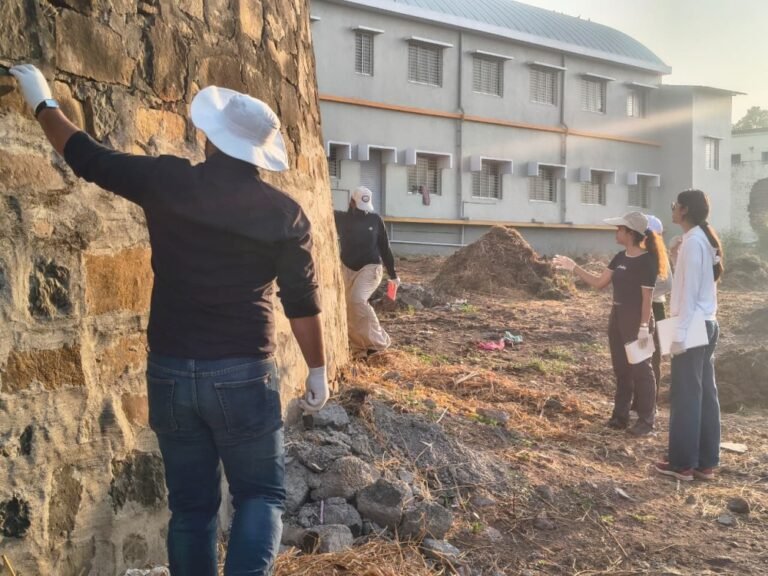
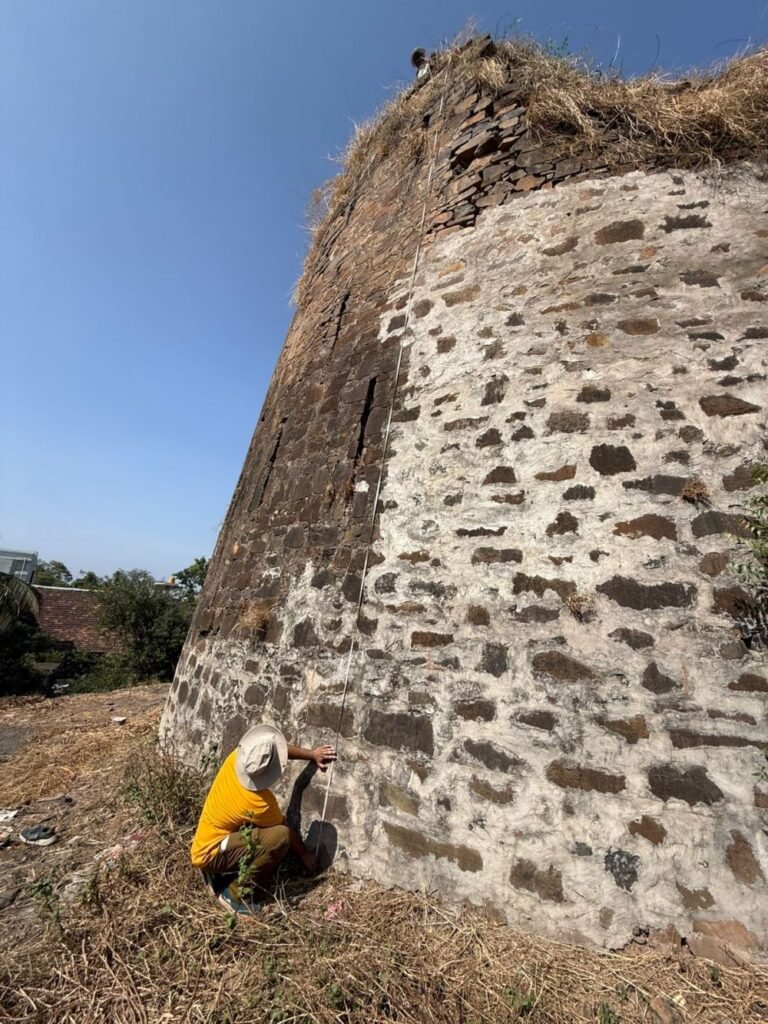
The surviving structure is approximately 34 feet in height and has a basal circumference of nearly 4485 centimetres. It occupies an area of around 160.19 square metres. The bastion is constructed primarily from locally available basalt blocks bonded with lime mortar. Its circular plan and thick masonry walls give it a massive appearance even in its present ruined condition.
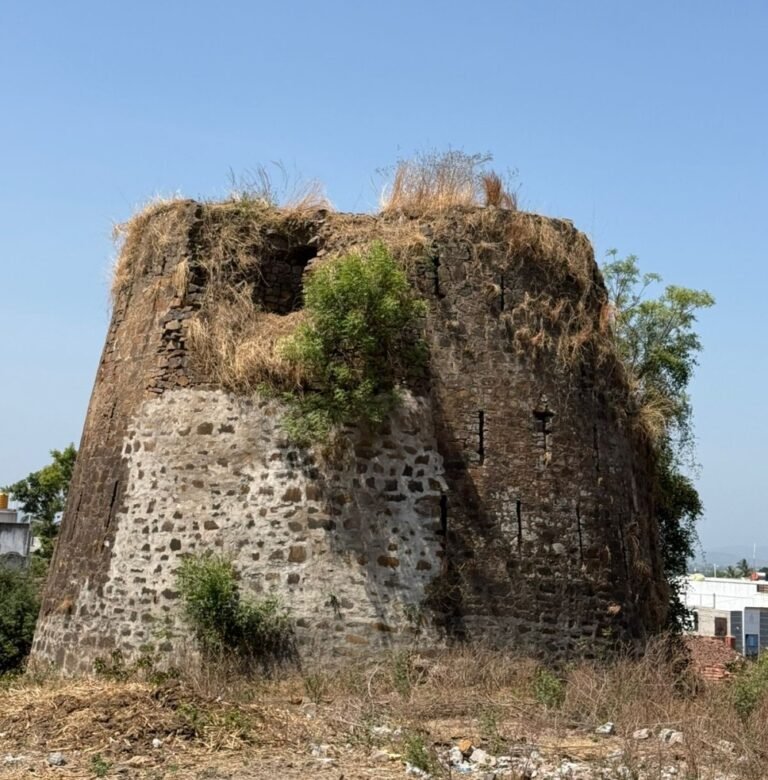
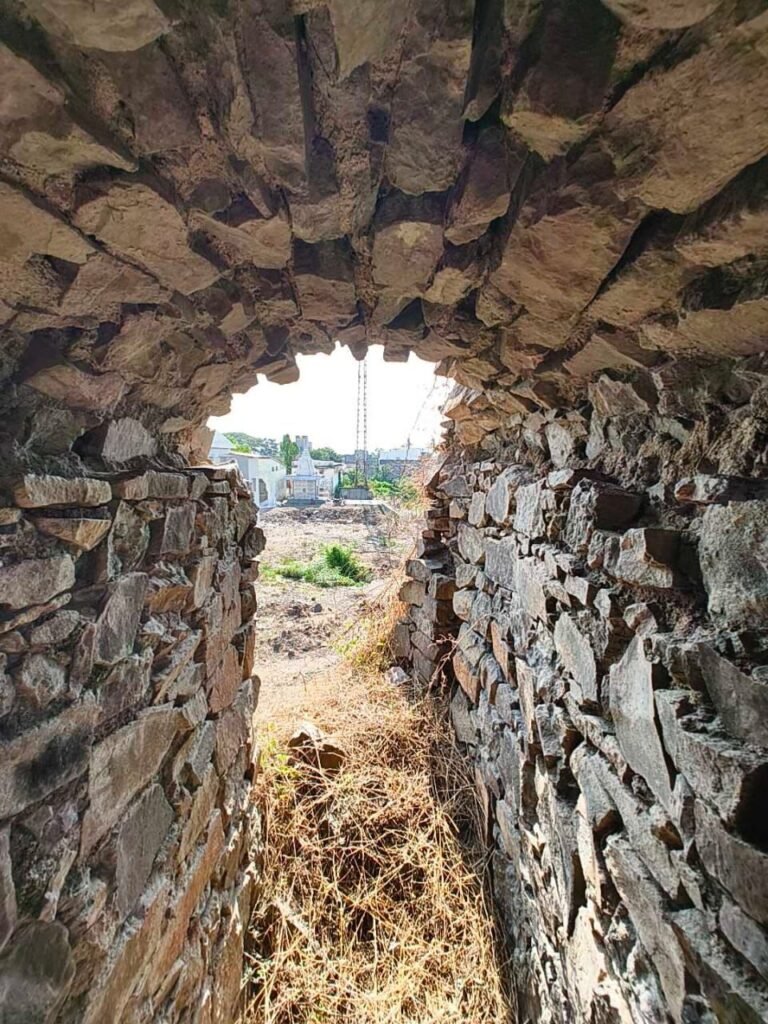
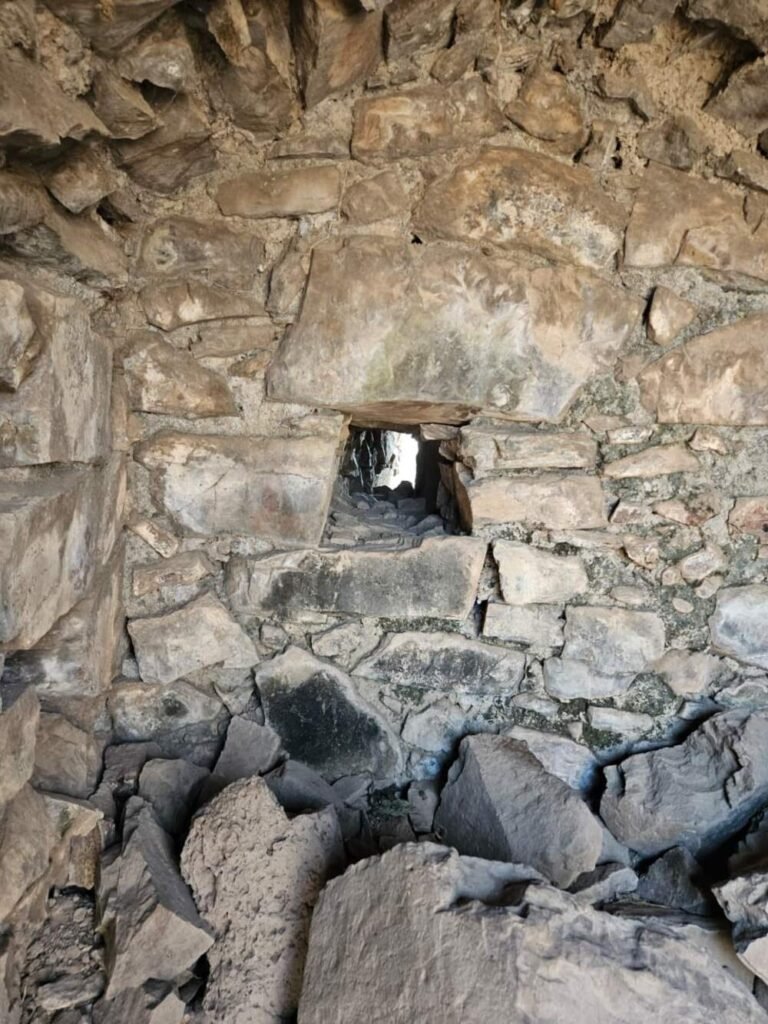
The structure also contains several narrow slit openings along its outer walls. These openings
were designed for observation and defence and are characteristic of military architecture adapted
to the use of firearms and artillery. The external openings are narrow, while the internal portions
widen considerably, allowing defenders to observe and engage targets while remaining relatively
protected.
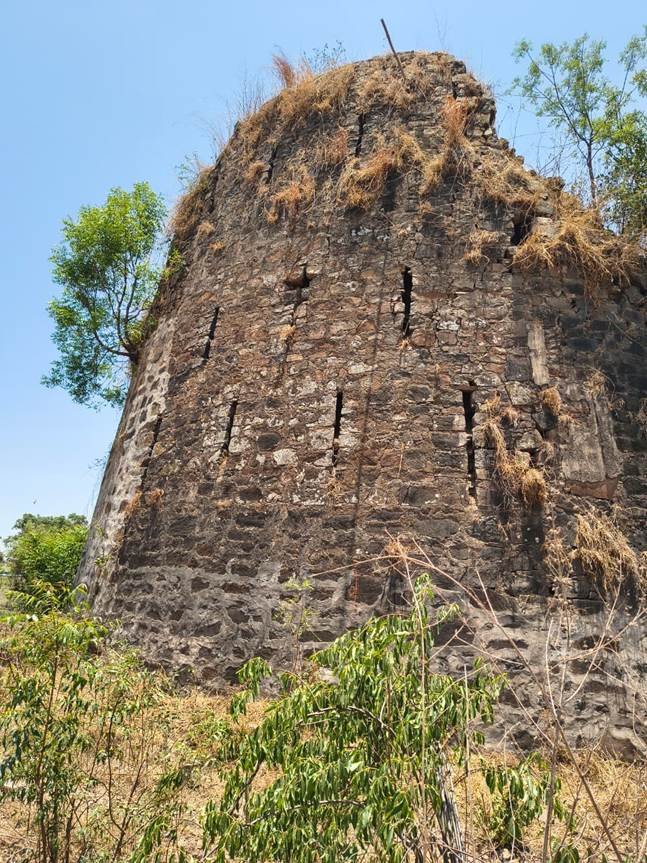
These features provide an interesting insight into the defensive planning of the structure.
A Bastion of the Deccan Frontier
Soundalga was situated within a historically important frontier zone between northern Karnataka and southern Maharashtra. The region witnessed the influence of several political powers, including the Bahmani Sultanate, the Adil Shahis of Bijapur, the Marathas, Kolhapur State and later the British administration.
Historical records such as the Gazetteer of the Bombay Presidency: Belgaum District and the Belagavi District Gazetteer provide information about the political and geographical importance of this region. Archival compilations relating to the Marathas and local Desai-controlled territories also help place Soundalga within the wider political landscape of the Deccan.
The architecture of the surviving bastion also provides important clues. Its basalt masonry, lime mortar construction, circular form, defensive slits and elevated position show similarities with other Deccan military structures.
The Soundalga buruj is comparable with Solapur Bhuikot Fort, Yellur Fort and Vallabhgad Fort. While these are considerably different in scale and setting, they share several defensive features such as basalt masonry, bastions, defensive openings, elevated positions and systems designed for surveillance and protection.
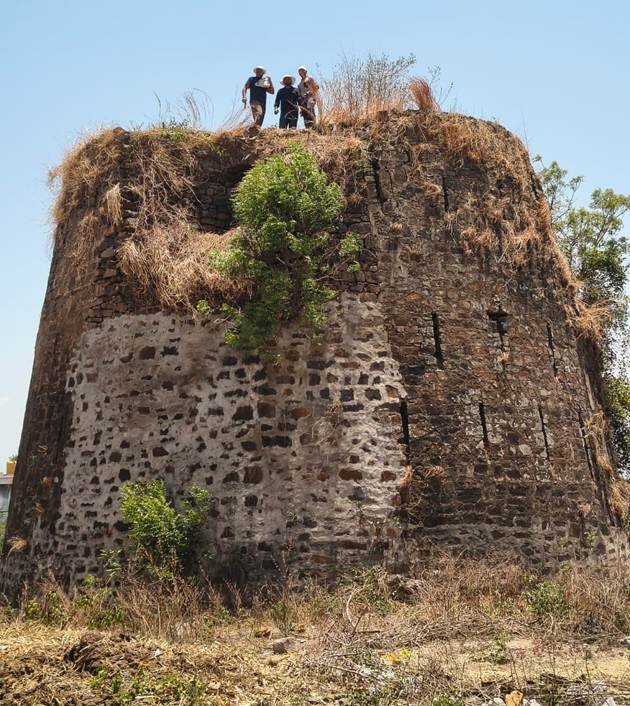
Unlike major forts such as Solapur Bhuikot, however, Soundalga appears to have been a smaller frontier outpost or surveillance centre. Its compact cylindrical bastion may have formed one part of a much larger defensive system that has largely disappeared today.
What lies beyond the surviving Bastion?
One of the most interesting aspects of Soundalga is that the buruj does not stand completely isolated.
Around the structure are several archaeological and cultural remains including moat-like depressions, temples, a hero stone, subsidiary masonry structures and traces of former defensive alignments. Together, these remains indicate that the present bastion may be only a small surviving part of a much larger fortified settlement.
Local residents remember a fortification consisting of approximately four to seven bastions connected by defensive walls.
The remains of moat-like depressions can still be seen around portions of the settlement. Modern settlement expansion and agricultural activity have gradually altered and filled several sections, but traces of the former defensive landscape remain visible.
The relationship between the surviving bastion and these peripheral remains is particularly important because it changes the way we understand the site. Soundalga was probably not simply a standalone military tower, but part of a larger settlement containing defensive, residential and religious spaces.
Temples and a Hero Stone
The archaeological landscape around the buruj also includes religious structures.
The Lakshmi Temple and Hanuman Temple are situated within the vicinity of the former fortified area. According to local traditions, both temples were originally located within the fortification itself. The Lakshmi Temple is also associated with the remains of a Deepmala or lamp tower, fragments of which are believed to survive nearby.
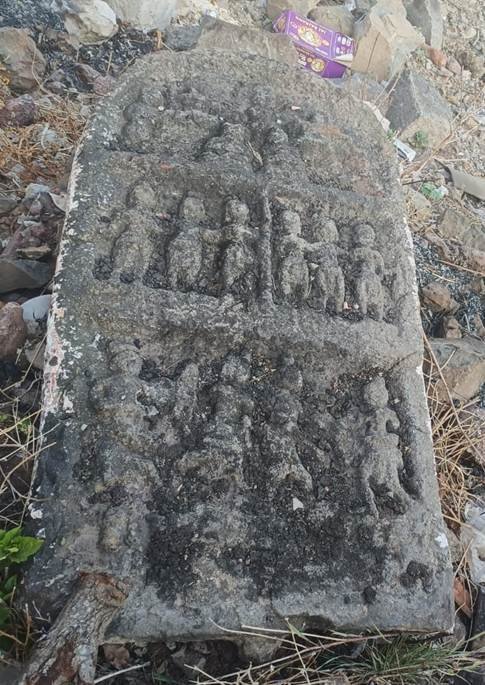
Behind the Lakshmi Temple is a weathered hero stone, locally known as a Virgal. Hero stones are important archaeological remains for understanding martial traditions and commemorative practices in the Deccan. The Soundalga hero stone is presently only partially exposed, but its presence adds another layer to the history of the settlement.
The Lost Fort of Soundalga
Walking through the present village, it is difficult to imagine the extent of the original fortified settlement.
Local traditions suggest that several bastions were once connected by defensive walls, enclosing portions of what is now the modern village. Over time, many of these walls were dismantled and the stone was reused for houses, compound walls and public buildings.
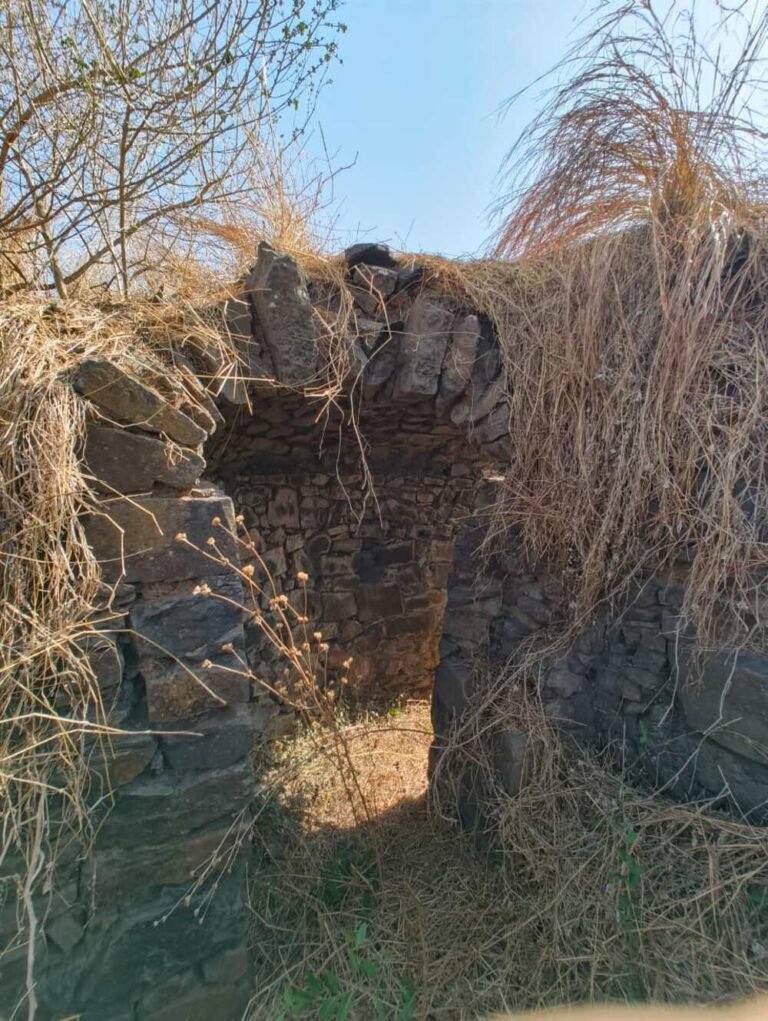
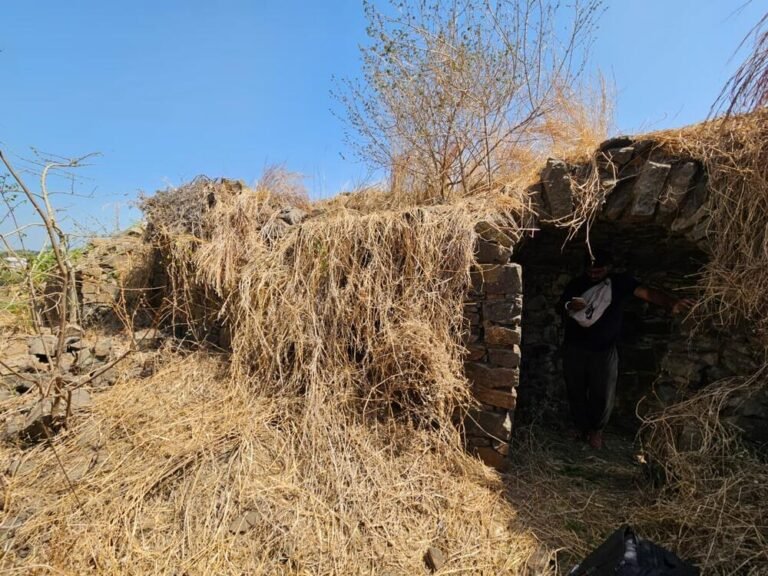
Field observations also identified a damaged rectangular masonry structure made from basalt, located close to the surviving bastion. The structure contains doorway and window openings and may have functioned as a residential unit, storage area, guard chamber or auxiliary building connected with the fortification. However, its exact function remains uncertain without archaeological excavation.
This is one of the most interesting aspects of Soundalga. Even though most of the fort has disappeared, its archaeological landscape still preserves small fragments that can help reconstruct the original settlement.
Stories Preserved by the Village
Perhaps the most fascinating part of Soundalga is not found in the stone walls but in the memories of the people living around them.
According to local tradition, the name “Soundalga” is associated with the words “Sau”, meaning one hundred, and “Dal”, meaning troops or army. Villagers connect the name with the story of a military contingent of around one hundred soldiers that once occupied the settlement and was later killed during a conflict.
The story is preserved as part of local memory and is also associated with the later belief that the place became connected with misfortune or a bad omen. While such traditions cannot independently establish the exact historical chronology of the monument, they are valuable for understanding how the community remembers the site and its past.
Another local tradition speaks of a hidden underground passage on the western side of the bastion. According to villagers, this passage may have served as an escape route from the fortified settlement. Today, the supposed passage is blocked by soil, vegetation and collapsed material.
Whether such a passage actually survives below the structure can only be established through proper archaeological and subsurface investigation. For now, it remains an intriguing part of the oral history surrounding Soundalga.
A Fort Slowly Disappearing
Like many lesser-known heritage sites, Soundalga Buruj is facing serious threats.
The surviving masonry has been affected by vegetation growth, weathering, moisture, root penetration and structural instability. Large sections of the upper masonry have collapsed, while some basalt blocks have become displaced. The original lime mortar has also deteriorated in several places.
Modern cement repairs can also be seen on portions of the structure. Such repairs may appear to provide immediate protection, but that cement can be incompatible with historic lime-mortar construction and may trap moisture within the masonry.
The surrounding landscape is also under pressure from settlement expansion, debris dumping and the reuse of old fortification stones. These changes have already resulted in the disappearance of much of the original fortification system.
Why Soundalga Matters
Soundalga Buruj may not have the enormous walls or famous history associated with some of the major forts of Karnataka and Maharashtra, but that is precisely what makes the site interesting.
It represents the remains of a lesser-known frontier military landscape. The surviving bastion, moat-like depressions, temples, hero stone, subsidiary structures and oral traditions together provide evidence for a settlement that was once much larger than what we see today.
The archaeological interpretation of the site suggests that the surviving structure belonged to a localized Bhuikot or land-fortification tradition. Its circular bastion, thick basalt walls, defensive slits, elevated position and surrounding defensive features indicate a military and surveillance function within the Belagavi–Nippani frontier.
Standing beside the massive walls of the buruj, it becomes clear that the monument is only one surviving fragment of a much larger historical landscape. The rest of the fort may have disappeared, but traces of it continue to survive in the landscape and in the memories of the people of Soundalga.
Forgotten Fort, but not a Forgotten History
The Soundalga Buruj is a reminder that history is not always preserved in grand monuments.
Sometimes it survives in a ruined bastion, a weathered hero stone, an old temple, a depression in the ground or even a story passed down by villagers.
The surviving structure at Soundalga provides a rare glimpse into the military landscape of the Karnataka–Maharashtra frontier and the smaller fortifications that once formed part of the wider defensive systems of the Deccan.
For anyone interested in archaeology, history, forts and the lesser-known heritage of Karnataka, Soundalga offers an interesting journey into a forgotten chapter of the Deccan.
Standing beside its weathered basalt walls, one can still imagine the larger fortification that once occupied this landscape, and wonder how much of its story is still waiting to be discovered beneath the modern village.
Acknowledgements
I would like to express my sincere gratitude to the Tehsil Office, Nippani, and the Gram Panchayat of Soundalga village, along with the local residents of Soundalga, for their cooperation and support during the field investigation.
I also acknowledge the Indo Archaeology Research Institute for providing logistical support, coordination and project management during the research and documentation process.
I am grateful to all the on-field and off-field team members who contributed towards field observations, measurements, photography, archival research and documentation of the Soundalga Buruj and its surrounding archaeological landscape.
References
- Belagavi District Gazetteer. Bengaluru: Karnataka Gazetteer Department, Government of Karnataka.
- Deloche, Jean. 2007. Studies on Fortification in India. Pondicherry: Institut Français de Pondichéry.
- Eaton, Richard M., and Phillip B. Wagoner. 2014. Power, Memory, Architecture: Contested Sites on India’s Deccan Plateau, 1300–1600. New Delhi: Oxford University Press.
- Gazetteer of the Bombay Presidency: Belgaum District. 1884. Bombay: Government Central Press.
- Gazetteer of the Bombay Presidency: Kolhapur District. 1881. Bombay: Government Central Press.
- Joshi, S. K. 1985. Defense Architecture in Early Karnataka. New Delhi: Munshiram Manoharlal.
- Mate, M. S. 1959. Maratha Architecture: Civil and Military. Pune: Deccan College Post-Graduate and Research Institute.
- Nippani Parisarada Stalanamagalu. Shodhganga@INFLIBNET.
- Oral narratives and field observations recorded during a survey conducted at Soundalga village, May 2026.
- Selections from the Records of the Bombay Government,
- Maratha Series, Vol. 8. Bombay: Government Central Press.
Additional Field Photographs
The documentation presented here is the result of independent field study conducted by Soham Bhande. All rights to this work remain with the author and are published on Trip and Tales under his authorization. Trip and Tales holds no ownership over this content.
Trip and Tales sincerely thanks Soham Bhande for permitting the publication of his work for the benefit of readers and heritage enthusiasts.