
Silent Storytellers
Spiti Valley’s Rock Art Revealed
by
Dr. Ekta Singh
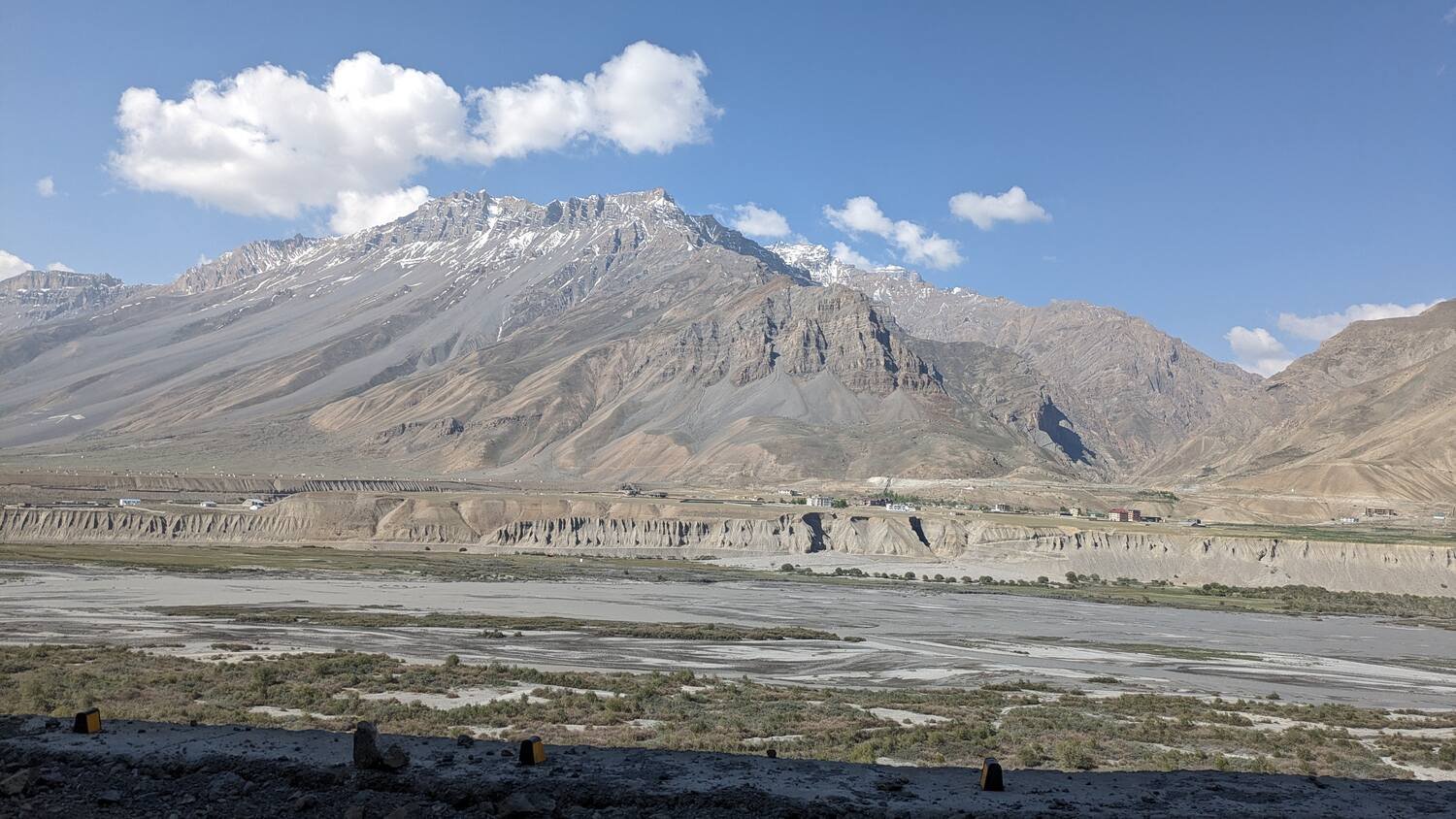
The majority of travellers to Spiti are here for serene landscapes, monasteries, moonscapes and a road that appears to end at the sky (Fig 1). Few know that scattered over this Cold desert on Boulders beside the river, on cliffs on the hill, and in silent rock shelters, is one of the most extraordinary open-air art galleries in the Himalayas. Long before Tabo Monastery was founded, somebody was already here, pecking figures of ibexes and hunters into stone. This is the rock art of Spiti: thousands of years of human existence, pounded and painted onto the surface of the mountains themselves.
Kunzum La to Sumdo and Beyond: An Open-Air Gallery
What is unique about Spiti’s rock art is not one spot, but its enormous distribution. Petroglyphs, which are figures pecked or carved into boulders, are found along practically the whole length of the valley, from Kunzum La in the north down to Sumdo on the Kinnaur border. Often, they are on boulders that pass unnoticed by passers-by, without understanding what is behind the lichen. The trail doesn’t even finish at the border of Spiti. A few locations continue into adjoining Kinnaur, including around villages like Sumra, Shelkar and extending till Rogi village. A reminder that these valleys were part of a much bigger network reaching toward Ladakh and Western Tibet (Francke, 1914; Handa, 2012; Dowad & Norbu, 2017).
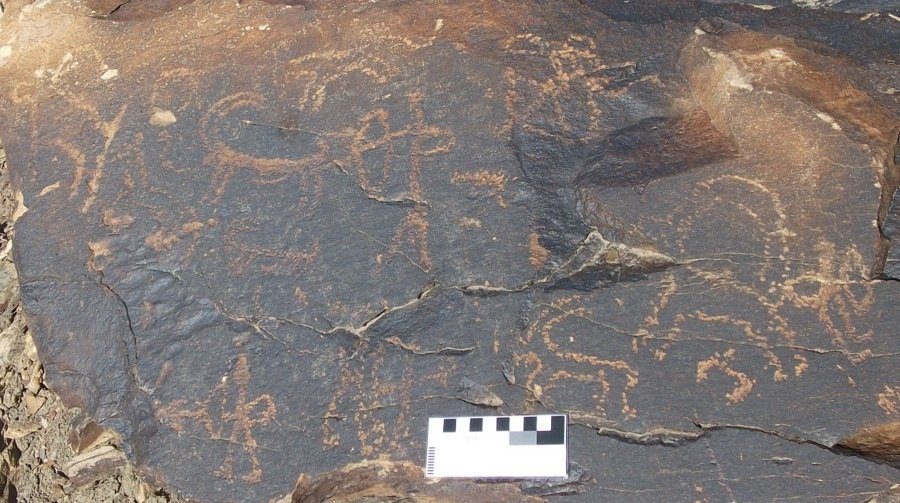
The dictionary of these open-air settings is easily recognised even if the sense is not: one can notice the sun, the moon, the stars and trees- the vocabulary of nature everywhere. Hunting scenes where horse-riders are found with bows and arrows targeting blue sheep or ibex (Fig 4), followed by dogs in a few scenes; another image where one is even holding the reins of another rider’s mount, like a guide (Fig 2). Right-facing and left-facing swastikas, signs of two different belief systems sharing the same rock; dots, circles, squares and triangles pecked into stone; handprints and mask-like faces; and, superimposing the oldest carvings, later Buddhist stupas and Tibetan inscriptions are proof that these boulders were visited over centuries.
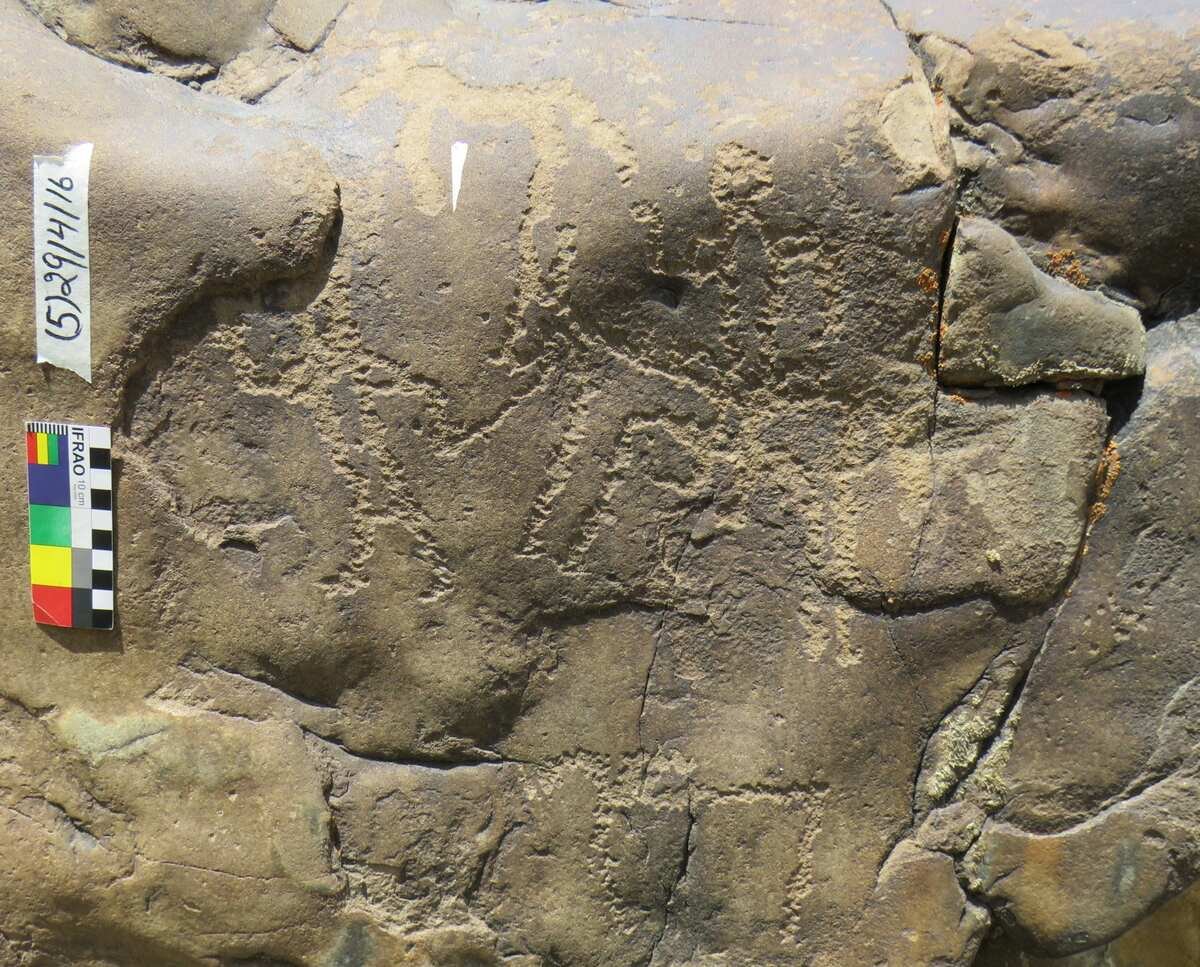
And then there’s the fauna. Again and again, the ibex and the blue sheep, the bharal, still grazing these hills, appear, along with yak, dogs and horses. But there are animals like tiger, deer and even a Bactrian camel, carved thousands of kilometres from their natural habitat (Dowad & Norbu, 2017). These are not errors. They are clues.
Caves of chalk and ochre: The Upper Spiti Painted Shelters
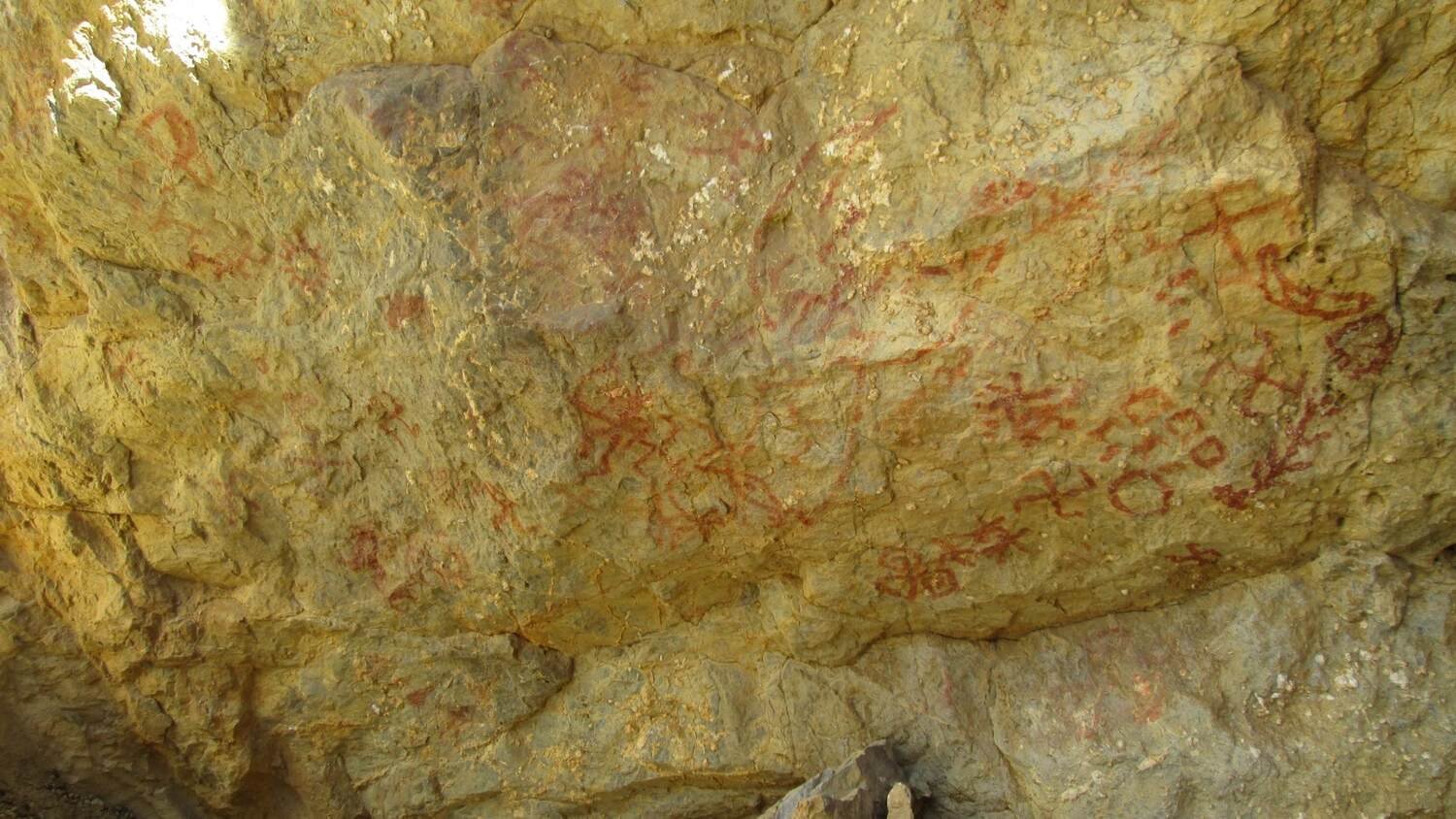
Engravings prevail on the wide valley floor, whereas the paintings of Spiti the pictographs are virtually an exclusively high-country phenomenon. Most are hidden in caves and rock shelters high above Kaza, at altitudes often above 4,000 meters. Here, ancient artists painted swastikas, suns, trees and human figures, etc (Fig 3). The scenes showcase figures, some mid-hunt, some with arms raised, some caught in what appears to be a dance, using red ochre and a chalky white pigment.
In a cave near Chicham Village, poetically termed “the open mouth of the devil,” walls extend over a hundred feet and are emblazoned with red and white swastikas, suns and dancing figures. At a high shelter above Sumling, artists painted human figures with swords and shields beside sun and crescent-moon motifs in a site so precisely placed that residents are claimed to have formerly followed the seasons by watching where the setting sun impacted the surrounding peaks. Similar painted shelters may be seen near Hikkim, Tashigang and Kee, each with its own mixture of suns and swastikas in red and white.
Symbols in Transit: Contact with Ladakh and Central Asia
Now this is when it becomes very interesting. Many animals and themes carved into the rocks of Spiti are not a part of its nature at all. The wild yak and deer depicted in the engravings do not occur in the inhabited Spiti valley, but they are native to Ladakh and the Tibetan plateau. If such creatures appear here at all, this would suggest that the symbols, and potentially the painters, came from somewhere else, bringing meanings that outlived the animals themselves.
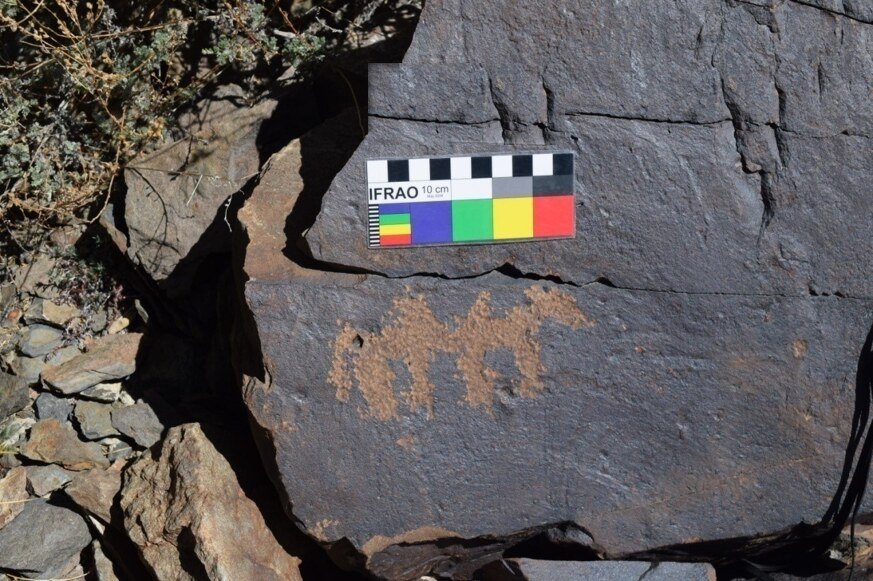
Scholars have traced the “tiger attacking its prey” motif at Sumdo to near-identical images from Ladakh (Francfort et al., 1992). This belongs to a larger “Animal Style” found throughout Eurasia and is associated with the nomadic steppe groups like the Saka, Siberian and Andronovo-related groups, who migrated along the Indus Valley into Ladakh and Western Tibet during the Bronze and Iron Ages, roughly the second and first millennia BCE (Francfort et al., 1992; Bruneau & Vernier, 2010; Dowad & Norbu, 2017). Spiti sites have mask-like “mascoid” figures that are comparable to Imagery in Ladakh and Tibet, which researchers link to Bronze Age societies as distant as southern Siberia (Vernier, 2016; Francfort et al., 1992). In this perspective, a double-humped Bactrian camel carved at one site only makes sense (Fig 5), an animal from Central Asian trade routes, not the Spiti River.
Before Buddhism came to Spiti in the tenth century CE, Spiti was part of the Zhang Zhung empire, a pre-Tibetan cultural area that stretched from Western Tibet to Mount Kailash, the centre of Bon devotion. Most of Spiti’s sun, moon and swastika symbols are thought to be of this ancient Bonpo style (Bellezza, 2008; Thakur, 2008, 2011). Together, the rock art situates Spiti not as a remote dead-end valley but as a real crossroads, connected by high passes to Ladakh, Zanskar, and Western Tibet and through them, at a distance, to the nomadic world of the Central Asian steppe.
A Heritage Disappearing and How to Save It
This legacy, for all its magnitude, is swiftly fading. Already an estimated 70 per cent of rock art rocks in Tabo alone have been lost, broken apart, buried or cleared for the very apple orchards that now characterise the region’s economy. Road construction and field levelling have obliterated sites elsewhere, and several sites noted by early explorers are now lost. The bigger problem is one of awareness: many engravings have passed unnoticed for generations by the very people who live beside them, while exposed paintings just flake and fade with the weather (Singh, Bodh, & Saklani, 2017).
The cure is not difficult: identify and number boulders for continuing monitoring, develop local awareness so locals recognise what they are standing on, and reassure private landowners that reporting a site won’t cost them their land. Signage at accessible areas, and legal protection of significant clusters, possibly a special “Rock Art Sanctuary” would go a long way to give this heritage the stature it deserves.
The People Behind the Discovery
Almost none of this would be known today if not for the work of the Spiti Rock Art and Historical Society (SRAHS), created by Dr. Tsering Norbu and Michael Dowad together with a small dedicated group of local villagers. Long before any formal academic research came in the valley, this local team were the first to trek the length of Spiti, from Kunzum Pass to Sumdo, discreetly identifying and recording locations of petroglyph and pictograph that had lain undiscovered for ages (Dowad & Norbu, 2017). Since then, their fieldwork has been a guiding and supporting force for researchers from institutions such as the Indira Gandhi National Center for the Arts, HNB Garhwal University and the Himachal State Museum, and much of what we know today about the spread and chronology of Spiti’s rock art is built on the foundation they laid.
The Society continues to record new sites, monitor old ones and spread the word amongst local communities about the worth of the boulders found scattered throughout their own fields and orchards. For anybody wishing to visit these places in a responsible way, or to find out more about ongoing documentation and conservation work, contact Dr Tsering Norbu and the SRAHS team, still the most knowledgeable guides to this treasure.
Experience It in Person
Many of these rocks are in plain sight along the highway, in orchards, in the trek to a cave shrine, waiting for those ready to look down as well as up. A local guide can help with both identifying them and travelling properly on land that is often privately owned or fragile.
Next time you’re chasing monastery views or the perfect shot of the Spiti river, slow down somewhere between Kunzum La and Sumdo. A bow-wielding hunter, a mother with her children, a tiger carved by hands from a world thousands of kilometres away, somewhere on a peaceful boulder, is still waiting to be seen.
References
Bellezza, J. V. (2008). Zhang Zhung: Foundations of civilization in Tibet: a historical and ethnoarchaeological study of the monuments, rock art, texts, and oral tradition of the ancient Tibetan upland. Austrian Academy of Sciences Press.
Bruneau, L., & Vernier, M. (2010). Animal style of the steppes in Ladakh: A presentation of newly discovered petroglyphs. In L. M. Olivieri, L. Bruneau, & M. Ferrandi (Eds.), Pictures in transformation: rock art from Central Asia to the sub-continent (pp. 27–36).
Dowad, M., & Norbu, T. (2017). Spiti river valley rock art: A preliminary study. Himachal State Museum, Shimla, 1, 40–108.
Francfort, H.-P., Klodzinski, D., & Mascle, G. (1992). Archaic petroglyphs of Ladakh and Zanskar. In M. Lorblanchet (Ed.), Rock Art in the Old World (pp. 147–192). Indira Gandhi National Centre for the Arts.
Francke, A. H. (1914). Antiquities of Indian Tibet (2 vols.). Archaeological Survey of India.
Handa, O. C. (2012). Himalayan rock art. Pentagon Press.
Singh, E., Bodh, V. K., & Saklani, P. M. (2017). Contesting antiquity and development: A report on the rock art preservation in Spiti Valley, Himachal Pradesh. Revue d’Etudes Tibétaines, 41, 86–102.
Thakur, L. S. (2008). Bonpos of the Western Himalaya. South Asian Studies, 24(1), 27–36.
Thakur, L. S. (2011). Archaeology of an extinct religious tradition: Bonpos of the Western Himalaya. Oxford University Press.
Vernier, M. (2016). Zamthang, epicentre of Zanskar’s rock art heritage. HAL Open Archives. https://hal.archives-ouvertes.fr/hal-01399322/
The documentation presented here is the result of independent field study conducted by Dr Ekta Singh. All rights to this work remain with the author and are published on Trip and Tales under her authorization. Trip and Tales holds no ownership over this content.
Trip and Tales sincerely thanks Dr Ekta Singh for permitting the publication of her work for the benefit of readers and heritage enthusiasts.