
Projections of Life
Classical love discussions at Ajanta
by
Gaurangi Sharma
Philosophies of concepts like Liberation, enlightenment have always found deep grounds in the Indian diaspora, deeply ingrained in the religious ethos of religions. Along with these, the affiliated beauty and other subject matters also find their place in these philosophies, where their scale varies and so does their intensity of occurrence. One such theme is of Sensuality and Projection of “Kama” in the circle of life.
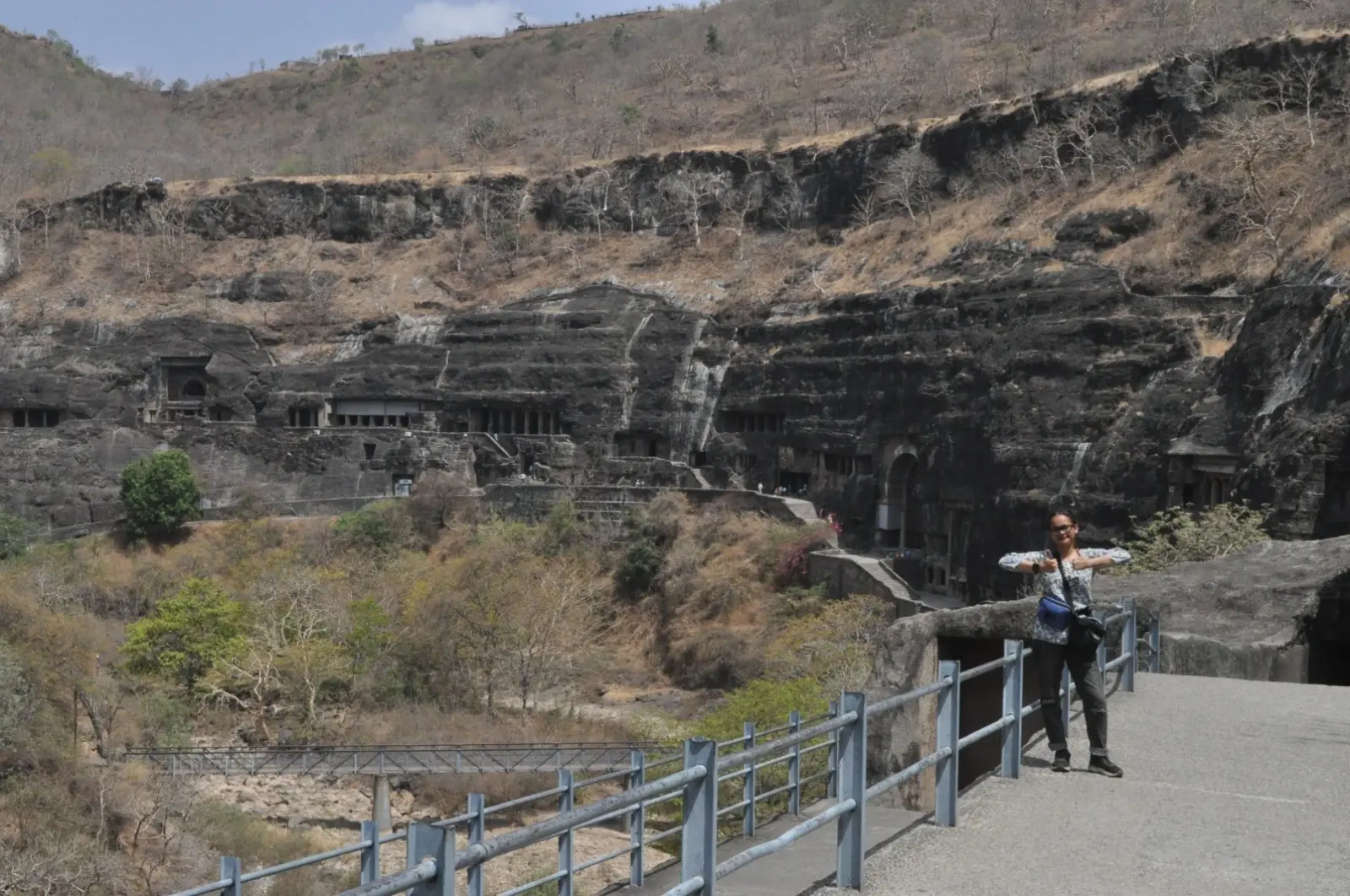
The UNESCO World heritage site, Ajanta Caves is not aloof to such projections. Located in Aurangabad, Maharashtra the caves were discovery at the hands of a hunting trip, but this discovery paved way into a long-drawn history of 2000+ years, through the elaborate and mammoth sized carvings and paintings that seize the time and the admirer’s watchful eye together.
There are about 30 rock cut caves in Ajanta, carved directly into the rigorous cliffside in a semi-circle shape. These caves are dedicated to Buddhism, starting from early 2nd Century BCE. There are both finished and unfinished projects here, but the complex has 2 majorly classified type of caves;
- The Chaityas, these are essentially prayer halls with large stupas as the middle attraction along with highly vaulted ceilings. These are divided by pillars, for the circumambulation (pradakshina) and communal worship
- The Viharas, historically began as monsoon shelters for Buddhist monks, these structures evolved to become residential cells, along with different activities such as mediations, rituals etc.
While the Chaityas are mostly renowned for their sculptures, with depiction of Buddha in various poses, his life and its cycle. The Viharas are complexes that house the lavishly designed and beautifully crafted frescoes/ murals from the Jataka Tales, the life stories of Buddha, his teachings and his previous births.
-The methods of creation-
- Entirely rock cut architecture, direct chiselling, top to bottom
- Interiors were evenly structured as well, to hold the plaster
- Dry-Frescos or tempera included steps of wall preparation with rough plaster made of entirely natural ingredients such as jute, cow dung etc. A thin layer off lime plaster was then applied to smoothen the surface
- The artists carefully drew the initial layouts using red ochre, filled with underpainting and then added depths and 3d effects using different pigments; rich, organic and naturally sourced. The striking colours range from hues of red and others to heavy impregnations of solids such as black.
- Since the colors were organic, the binding materials towards the walls and painting was also organic, with gums derived from animals or plants.
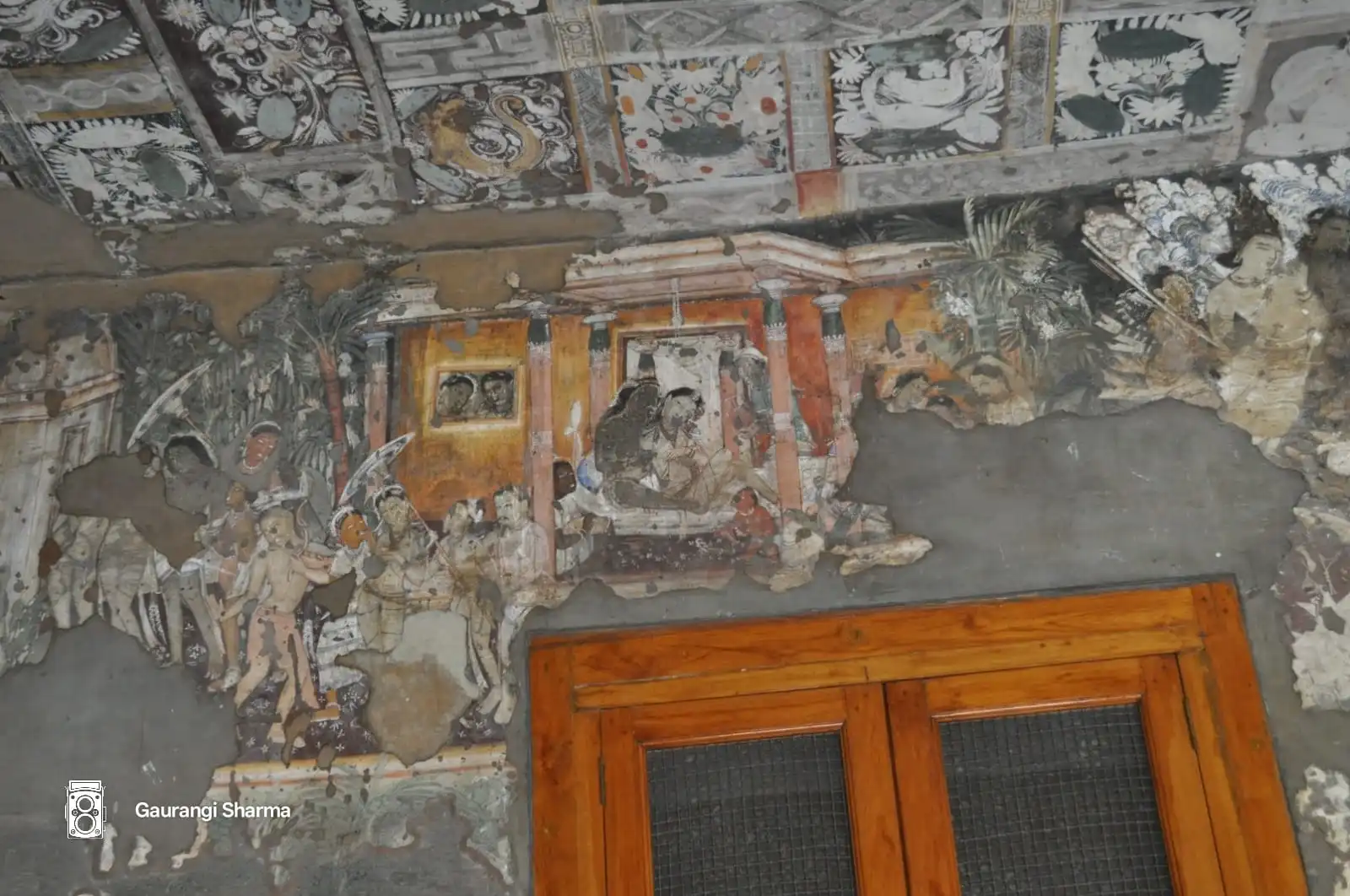
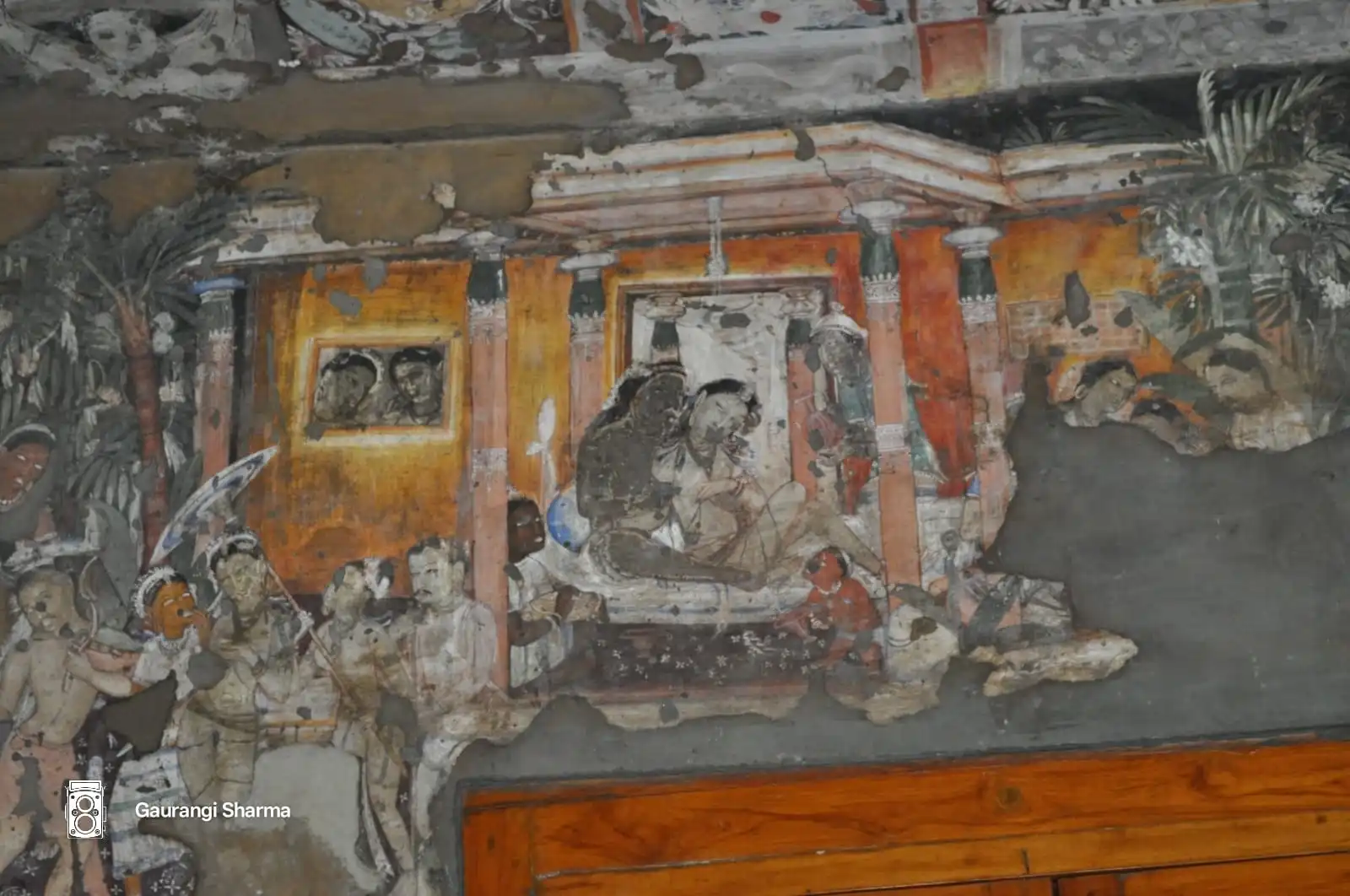
Cave 17 is one such VIHARA, aged to be from 5th century CE, and houses the best and largest preserved collection of these murals. While the whole complex has many interpretative depictions of the different Jataka, this particular cave alone has 5 of them. It is also the cave that caught my eye into the unexpected depiction of love and sensuality.
While visiting these gigantic caves, one has general understanding of stupas, Buddha and paintings of his life, but the fact it housed such depictions as well is quite unanticipated. While these are limited, they are no less beautiful. These depictions are not ‘erotic’ but rather a sensual blend. The sensitised caressing seamlessly blends with the rather philosophical ideas the Jataka tale depictions aim on conveying.
The 5th century art as murals on the walls of an amorous couple, within a moment of tender dalliance, with the background lush with people observing them. The couple itself is seated in a rather open area, surrounded by greenery. This portrayal explains a lot about the depictions of court, intimacy and royalty through its artistic freedom. The cave has other open lavish portrayals, of what pleasure was in the courtly world. These moments are filled with affectionate embraces, natural autonomy rather than explicit seduction, entwined postures and passion.
-Sensuality and its philosophy in ancient India-
Kama, has always found its place in the different philosophies of our past, through different lenses. What has remained perpetual that it has not been just limited to flesh and it extends to the intertwining of the mind and the soul. In Hindu philosophy, it finds a deep foreground, with it being attributed to an important part of the life, which ought to be completed as a duty in the material world. Same form of reverence can be seen in the Buddhist teachings, as the artistic freedom showcases the human portrayals in grace rather than a sin. Kama is not about just ‘lust’ in the philosophy of the religion, it has classifications, form-sound-scent-taste-touch. It is about the pathway to liberation and control of our senses. In Buddhism as well, the concept in not condemned, neither it is inherently evil. But it is scrutinised as a fleeting source of happiness, more so a trap, and with foundational training, the mind can be trained to stay out of it.
Kāma-chanda or the mental craving for experiment of these forms of sensations can limit a human and making ‘it’ weak, inevitably leaving us to experience suffering and dissatisfaction. The practice of renunciation can help us find profound and stable peace. The two concepts find a middle ground in the teachings where ‘balance’ is the key. The ultimate answer to mortality is renunciation, the key concept of Buddhism, hence, the preachings recontextualise that lay practitioners may continue to indulge in such experience at early stages, but it should be ethical and mindful, so that the impermanent nature of life is understood while living it.
Therefore, the paintings such as these, help us ponder by letting us go beyond the colours of artistic expression, they help us understand the root of the religion, and gain from the different ideas that it is emitting. The symbiosis of sensuality and art in ancient Indian history is not a new concept and can be abundantly found. But projections from such depictions help us understand the value of balance and its gravity in the ancient times.
References;
Bhante, D. J. (2025). The concept of Kāma (Lust) in early Buddhism. International Journal of Sanskrit Research, 11(2), 71-74. anantaajournal.com
Dey, M. C. (1925). My pilgrimages to ajanta and bagh. Thornton Butterworth
https://vmis.in/ArchiveCategories/collection_gallery_parent?id=317&siteid=0&minrange=0&maxrange=0&count=24
https://jatakastories.div.ed.ac.uk/stories-in-art/cave-17-saddanta-jataka
Spink, W. M. (2007). Ajanta: History and development: Volume 5. Cave by cave. Brill
The documentation presented here is the result of independent field study conducted by Gaurangi Sharma. All rights to this work remain with the author and are published on Trip and Tales under her authorization. Trip and Tales holds no ownership over this content.
Trip and Tales sincerely thanks Gaurangi Sharma for permitting the publication of her work for the benefit of readers and heritage enthusiasts.