
Living Heritage of Majuli
The Role of Assam’s Satras in Artifact Preservation
by
Reetirisha Kashyap
Introduction
Majuli, the world’s largest river island cradled by the Brahmaputra, is far more than a unique geographical feature of Assam. It is the spiritual and cultural heartland of the Neo-Vaishnavite movement. Initiated by the 15th-century saint-reformer Srimanta Sankardeva, this socio-religious movement reshaped the cultural fabric of Assam through the establishment of Satras- the monastic institutions that served as epicenters of devotion, art, drama, literature, and social reform.Within these sacred spaces, history has not been relegated to forgotten pages. Instead, Majuli’s Satras continue to function as dynamic repositories where centuries of historical events, royal patronage, and religious traditions remain actively woven into daily community life.
In 2016, Majuli became India’s first island district, and today it serves as a critical sanctuary for rich biodiversity, indigenous tribal communities (such as the Mishing population) , and a living heritage that has flourished for over five centuries. Sankardeva established the Satras as safe havens of peace and equality to propagate Neo-Vaishnavism (Ek-Saran Naam Dharma), a monotheistic faith emphasizing egalitarianism, non-violence, and collective devotion through chanting (Naam-Kirtana). Over the generations, the Satras have transcended their purely religious origins to become the societal and cultural nuclei of Assamese life, acting as active guardians of performing arts, literature, woodcraft, and unique mask-making traditions. Along these there are currently 22 active Satras (Neo-Vaishnavite monasteries) remaining in Majuli, out of an original 65 that were established historically before many were relocated or washed away due to severe river erosion and floods.
The Satra as a “Living Museum” here means unlike traditional municipal or state-run museums where historical objects are preserved behind glass cases, divorced from their original cultural context, the Satra repository functions as a “living museum”. Here, artifacts are not merely static displays or passive relics of the past; they possess an active, continuous agency within the socio-religious life of the community. And most of all artifacts still preserved in satras are the ones given by the mighty Ahoms, who ruled nearly 600 years in Assam.
The Role of Ahom Patronage in Satra History
The historical evolution and survival of Majuli’s Satra system are inextricably linked to the administrative policies, economic support, and spiritual patronage of the Ahom Kingdom (1228–1826 CE). While the Neo-Vaishnavite movement was initiated independently, it was the strategic involvement of Ahom monarchs- transitioning over time from suspicion to deep spiritual patronage, that elevated these monastic institutions into central structures of Assamese society.
The relationship took a transformative turn during the reign of Swargadeo Jayadhwaj Singha (1648–1663 CE), who formally adopted Vaishnavism under Sri Sri Niranjana Deva Goswami of Auniati Satra. This decision established four major monasteries- Auniati, Dakhinpat, Garamur, and Kuruwabahi as Raj Satras (Royal Satras). To ensure long-term stability, Ahom kings granted tax-free lands (Lakhiraj and Devottar estates) and assigned physical labor support through the Paik system (Monastic Paiks) to till agricultural land and maintain monastic infrastructure. Furthermore, the Ahoms showered Satradhikars (monastic heads) with courtly wealth, ceremonial paraphernalia, and royal emblems, including gold-embroidered textiles, heavy brass cannons, carved wooden thrones (Singhasan), and copper-plate decrees that form the core of Satra repositories today. Although monarchs like Swargadeo Gadadhar Singha initially took strict measures to curb growing monastic power, his successor Swargadeo Rudra Singha (1696–1714 CE) reversed these harsh policies, renewing royal land grants and restoring the Satras to full stability.
Spotlight on Bengenaati Satra
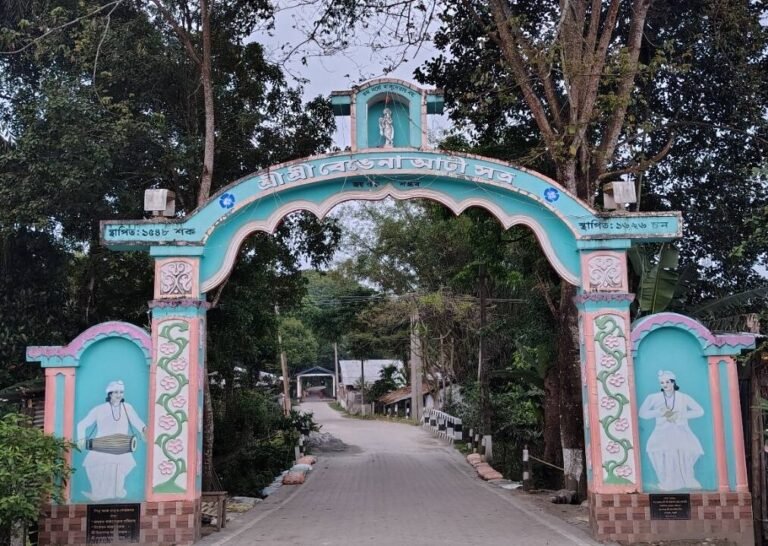
Among the historically significant institutions of Majuli is Bengenaati Satra, a prominent 17th-century Purusha Samhati Satra following the Grihastha (householder) tradition. Tracing its complex historical trajectory through five major migration phases across Assam. From Goreswar to its eventual permanent establishment in Majuli. Bengenaati Satra holds a remarkably rich repository of historical relics.
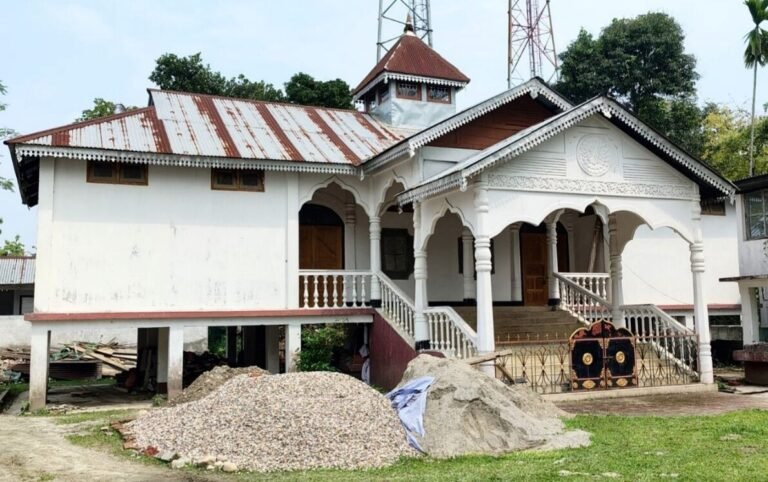
Due to its profound spiritual influence, the Satra enjoyed extensive patronage from Ahom royalty. Monarchs such as Swargadeo Gadadhar Singha and Swargadeo Lakshmi Singha bestowed rare gifts, royal decrees, epigraphic records, coins, and ceremonial objects upon the Satradhikars. The Satras Musuem as a developed building for display its some of its artifacts was formally established in 2013 to systematically organize and preserve its centuries-old heirlooms, the Bengenaati Satra Museum is a quintessential community-based custodial institution. Rather than operating purely as a display house, the museum serves as a bridge between active religious tradition and historical documentation.
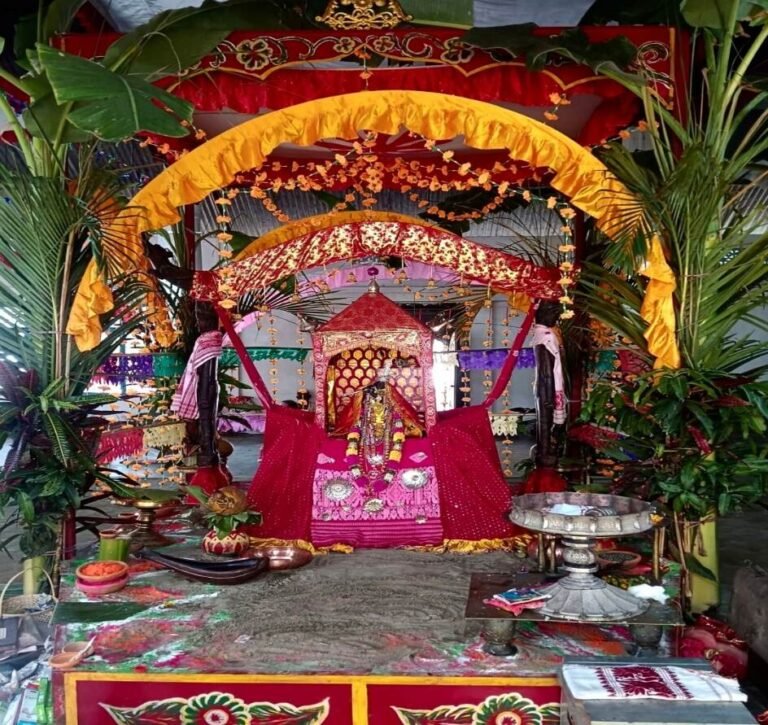
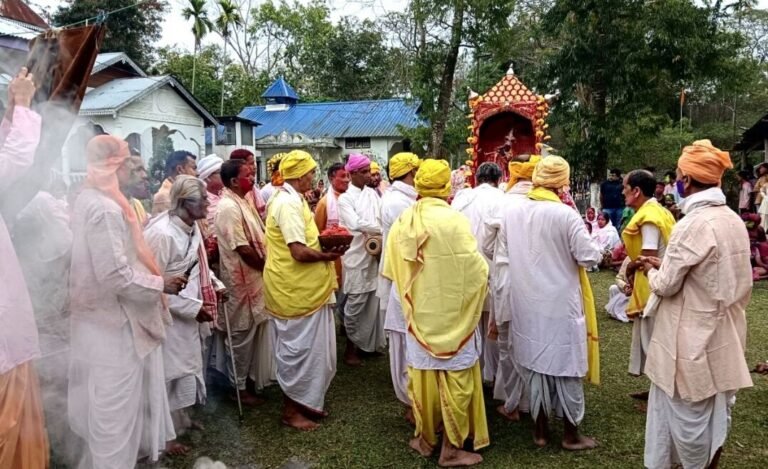
The Mahapuja of Sri Vasudev is the Satra’s very old ritual followed by the residences itself is a big celebration during the period and time of ‘Holi’, in the month of March. Here we can see the use and significance of the artifacts which were kept in the museum were respected and used. Acting as the living heritage of Assam itself. The sacred idols kept in the Satra also play a vital role during festivals like the “Falgutsav’. During this time, seven idols are worshipped inside a temporary ritual structure and later carried in a procession around the “Hatis” of the Satra during the ceremony known as “Phuroni of the Gosai” (The procession of the Deity).
The collection spans several distinct categories of material culture:
Royal Gifts and Courtly Paraphernalia: The centerpiece of the collection includes rare historical gifts bestowed directly by Ahom kings. Highlights include the famed Golden Umbrella (Swarna Chhatra) presented by Swargadeo Gadadhar Singha, intricate gold-embroidered royal garments (guna threadwork), royal shoes, and ceremonial accoutrements used during royal visits or monastic investitures.
Epigraphy and Sacred Manuscripts: The museumhouses rare bark-leaf manuscripts (Sanchi-pat) containing devotional texts, litanies, and scholarly works, as well as royal decrees and copper-plate grants (Tamra-patra) that record administrative land endowments and legal privileges granted by Ahom monarchs.
Ritual Metalware and Devotional Objects: Crafted from brass, bronze, and bell-metal (Kanh), these include ornate lamps (Gach-chaki), ceremonial trays (Xorai), water vessels, and carved altars. These objects remain central to monastic rituals, illustrating both advanced historical metallurgy and the concept of living heritage. Where historical relics are brought out of display for active use during major festivals like Rasa Leela and Bhaona performances.
Arms, Coins, and Utility Tools: Reflecting the Satra’s political connections and self-sustaining monastic economy, the museumpreserves medieval weaponry (including swords and daggers), historical coins minted under various Ahom reigns, and traditional artisan tools used for woodcraft and manuscript preparation.
Preserving this priceless repository in an island environment like Majuli presents unique museological challenges. High humidity, monsoonal flood risks, and microclimatic shifts demand a careful balance between traditional community stewardship and modern preventive conservation. Today, the Bengenaati Satra Museumremains an essential stop for scholars and heritage enthusiasts seeking an authentic look at Assam’s material and spiritual past.
Some of the documented pictures of these royal artifacts –
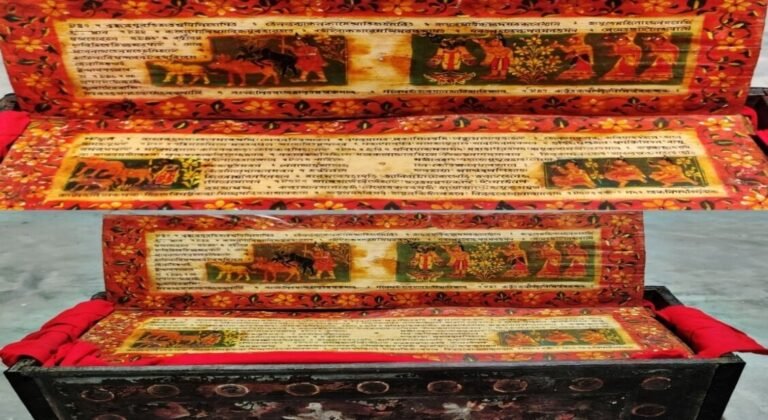
The Artifact is known as Chittrabhagavat, an illustrated painted assamese manuscript. Painted on traditional Sanchipat (agarwood bark) using vibrant natural dyes like Hengul (red) and Haital (yellow). This masterpiece seamlessly combines early Assamese script with striking pictorial panels, featuring distinct profile figures and dynamic compositions. The museum has more than 250 manuscripts preserved.
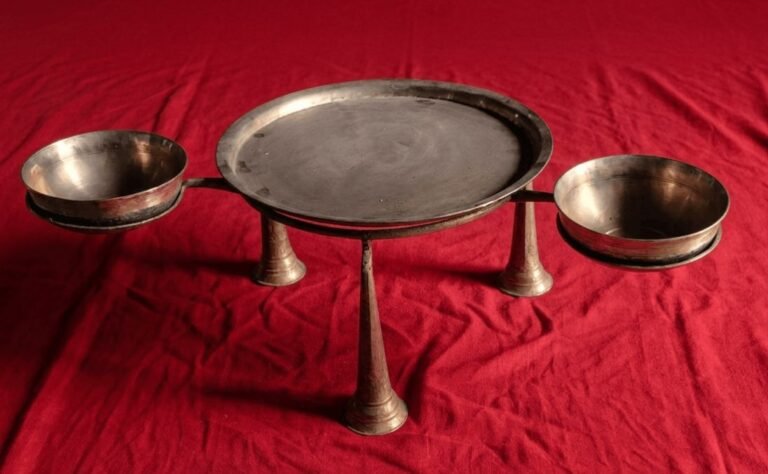
Locally known as ‘Bera Kahi’, its a traditional Assamese pedestal dish made from brass or bell metal, featuring a raised central serving plate held by trumpet-shaped legs. It is distinctly bordered by two smaller, connected side bowls on either side, showcasing the royal lineage and hospitality of Assam. This refined, hand-crafted piece is customarily employed to raise multi-course ceremonial feasts or ritual gifts off the ground.
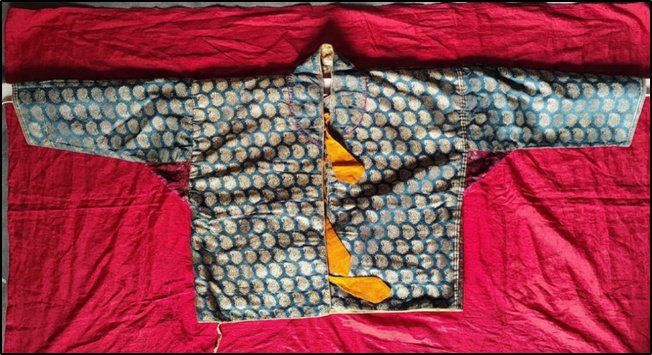
This item is a genuine, waist-length ceremonial jacket worn by Ahom royalty, known for its unique structured T-shape design and broad, rectangular-cut short sleeves. Crafted from luxurious, weighty Kingkhap silk, the piece showcases a rich indigo-blue foundation intricately hand-woven with a continuous buta (paisley) pattern in shimmering gold Guna (zari) threads. The jacket features an open, asymmetrical front bodice that closes securely with striking, contrasting mustard-yellow Muga silk ties.
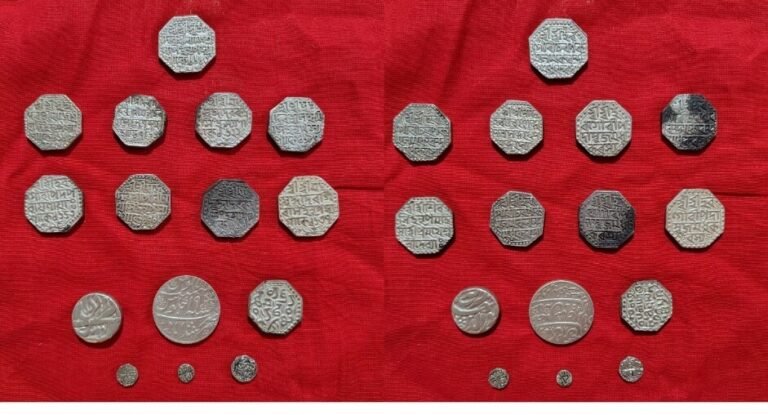
This numismatic collection showcases both the front and back sides of a fifteen-coin set from the Ahom Kingdom. The front sides feature clear, unframed edges surrounding three to four lines of horizontal metric inscriptions in the Eastern Nagari (Assamese-Sanskrit) script, containing pious invocations to Hindu gods like Shiva, Parvati, and Hari. In contrast, the corresponding reverse faces consistently document the current monarch’s official titles, personal regnal names, and accurate, sequential Sakaa dates (with Sakaa 1655 / 1733 CE for King Siva Singha and Sakaa 1693 / 1771 CE for King Lakshmi Singha distinctly visible). The lower register records the kingdom’s religious hierarchy and financial relations, showcasing a large, round trade rupee adorned with flowing Persian/Urdu calligraphy intended for inter-border Mughal trade, edge shearing on both sides together demonstrate a highly developed, multi-lingual state economy and accurate minting artistry.
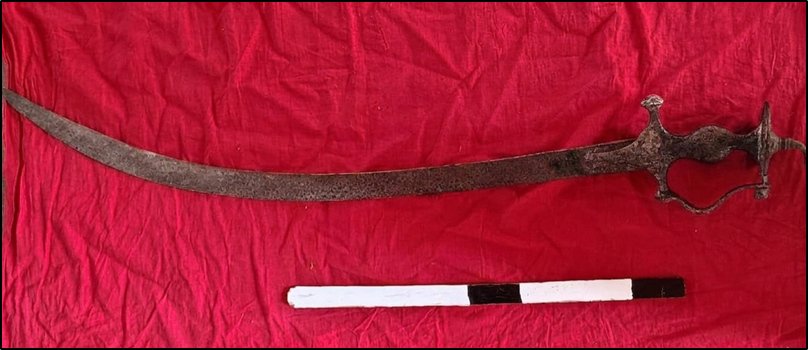
Made of Iron and from 18th century, This is called locally ‘Hengdang’ from the Ahom period is a single-edged sword made of forged iron. It features a lengthy, single-edged blade that arcs upward at the tip, with the metal displaying dark rust and small holes due to its age.
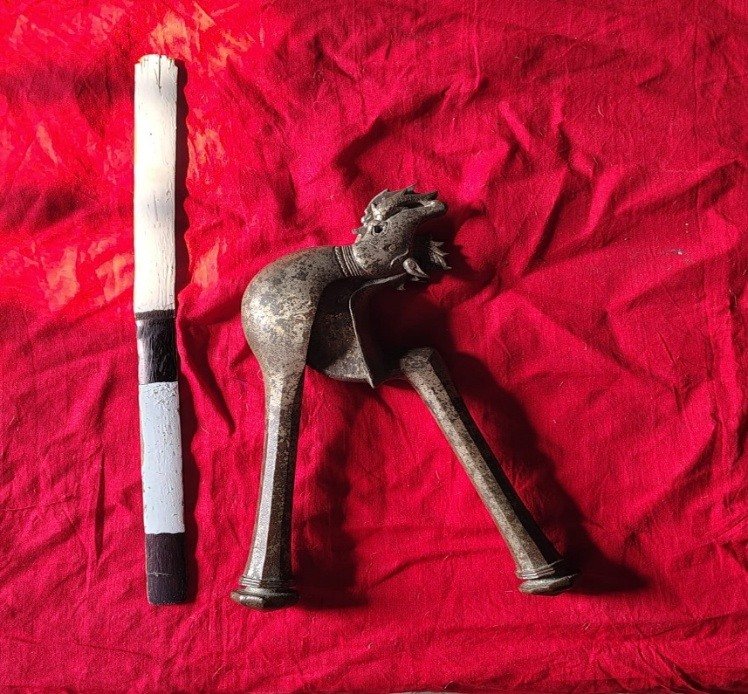
This remarkable Gota-Kutani, or mechanical betel nut cutter from the Ahom period, showcases the advanced craftsmanship involved in royal Tamul-Paan preparation rituals. Crafted from a sturdy, heavily tarnished metal composite intended to endure significant pressure, the tool features an operational hinged lever-action mechanism to break tough areca nuts. The upper pivot is expertly crafted into a zoomorphic finial representing a stylized mythical Ahom dragon, which elegantly narrows into a strong, dual-legged structural frame.
Conclusion: Preserving Sacred Memory Through Community Custodianship
The artifact collections across Majuli and specifically at Bengenaati Satra stand as a profound testament to the resilience of Assam’s living heritage. What makes this preservation model exceptional is that for centuries, the safeguarding of these rare historical records has depended not on state-directed museum frameworks or heavy government intervention, but on the unwavering devotion and self-sustained custodianship of the monastic community itself.
Operating largely in the absence of state indulgence or municipal museum funding, the Satradhikars, bhakats (monks), and local devotees have functioned as organic conservators. They have protected royal endowments, sacred manuscripts, and metallurgical masterworks across generations out of sacred duty (Seva).
As the world’s largest inhabited river island cradled by the Brahmaputra, Majuli serves as the spiritual heartland and cultural epicenter of Assam. Beyond its unique geographical identity, the island holds immense socio-religious significance as the birthplace of Srimanta Sankardeva’s 15th-century Neo-Vaishnavite movement. For over five centuries, Majuli has nurtured an unbroken tradition of egalitarian devotion, artistic excellence, and monastic living through its Satras, transforming the island into a vibrant sanctuary where indigenous tribal heritage, royal Ahom history, and living material culture seamlessly converge.
References
• Baruah, S. L. A Comprehensive History of Assam. New Delhi: Munshiram Manoharlal, 1985.
• Bhuyan, Suryakumar. Swargadeo Rajeswar. Guwahati: Department of Historical and Antiquarian Studies, Assam, 1960.
• Bharasa, P., and A. Gayen. “Safeguarding the Threatened Hydrogeo-Cultural Heritage of Majuli Island in Assam, India: A Case Study.” IOP Conference Series: Earth and Environmental Science 597 (2020).
• Barpujari, H.K., ed. The Comprehensive History of Assam, Volume II: Medieval Assam. Guwahati: Publication Board Assam, 1992.
• Barpujari, H.K., ed. The Comprehensive History of Assam, Volume III: The Ahom Period. Guwahati: Publication Board Assam, 1994.
• Dolores Root. “Review of Liberating Culture: Cross-Cultural Perspectives on Museums, Curation and Heritage Preservation, by Christina F. Kreps.” American Anthropologist 107, no. 2 (2005).
• Fahy, Anne, ed. Collections Management. London: Routledge, 1995.
• Gait, Sir Edward. A History of Assam. Calcutta: Thacker, Spink & Co., 1926.
• Galla, Amareswar. Culture and Heritage in Development: Ha Long Ecomuseum, A Case Study from Vietnam. Paris: UNESCO, 2001.
The documentation presented here is the result of independent field study conducted by Reetirisha Kashyap. All rights to this work remain with the author and are published on Trip and Tales under her authorization. Trip and Tales holds no ownership over this content.
Trip and Tales sincerely thanks Reetirisha Kashyap for permitting the publication of her work for the benefit of readers and heritage enthusiasts.